Ma Ying, Dias Maria Celeste, Freitas Helena
University of Coimbra, Centre for Functional Ecology, Department of Life Sciences, Coimbra, Portugal.
Front Plant Sci. 2020 Nov 13;11:591911. doi: 10.3389/fpls.2020.591911. eCollection 2020.
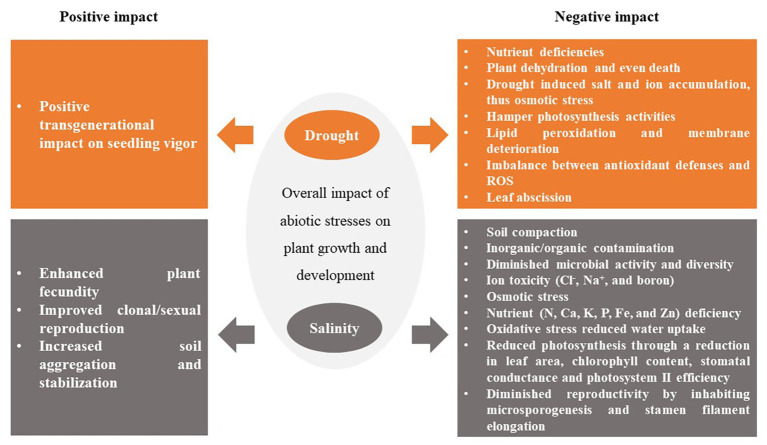
Drought and salinity are among the most important environmental factors that hampered agricultural productivity worldwide. Both stresses can induce several morphological, physiological, biochemical, and metabolic alterations through various mechanisms, eventually influencing plant growth, development, and productivity. The responses of plants to these stress conditions are highly complex and depend on other factors, such as the species and genotype, plant age and size, the rate of progression as well as the intensity and duration of the stresses. These factors have a strong effect on plant response and define whether mitigation processes related to acclimation will occur or not. In this review, we summarize how drought and salinity extensively affect plant growth in agriculture ecosystems. In particular, we focus on the morphological, physiological, biochemical, and metabolic responses of plants to these stresses. Moreover, we discuss mechanisms underlying plant-microbe interactions that confer abiotic stress tolerance.
干旱和盐碱化是阻碍全球农业生产力的最重要环境因素之一。这两种胁迫都可通过多种机制诱导多种形态、生理、生化和代谢变化,最终影响植物的生长、发育和生产力。植物对这些胁迫条件的反应非常复杂,并且取决于其他因素,例如物种和基因型、植物年龄和大小、胁迫的进展速度以及强度和持续时间。这些因素对植物反应有很大影响,并决定是否会发生与适应相关的缓解过程。在本综述中,我们总结了干旱和盐碱化如何广泛影响农业生态系统中的植物生长。特别是,我们关注植物对这些胁迫的形态、生理、生化和代谢反应。此外,我们还讨论了赋予非生物胁迫耐受性的植物-微生物相互作用的潜在机制。