Leibniz-Institut für Polymerforschung Dresden e.V., 01069, Dresden, Germany.
Technische Universität Dresden, 01069, Dresden, Germany.
Angew Chem Int Ed Engl. 2021 Mar 15;60(12):6724-6732. doi: 10.1002/anie.202015340. Epub 2021 Feb 12.
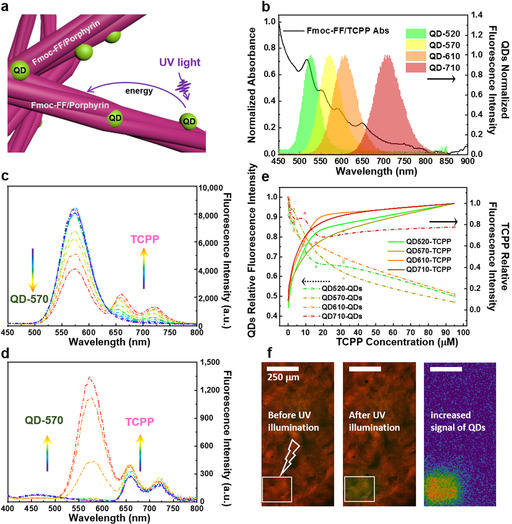
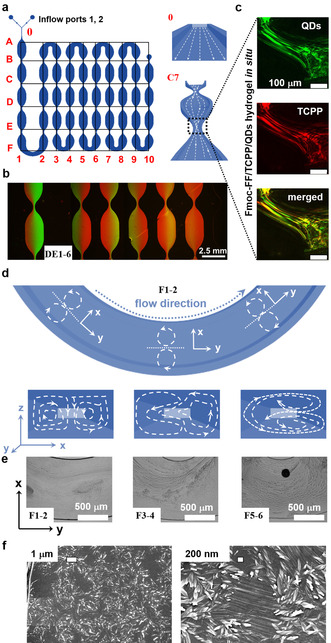
As low-molecular-weight hydrogelators, dipeptide hydrogel materials are suited for embedding multiple organic molecules and inorganic nanoparticles. Herein, a simple but precisely controllable method is presented that enables the fabrication of dipeptide-based hydrogels by supramolecular assembly inside microfluidic channels. Water-soluble quantum dots (QDs) as well as premixed porphyrins and a dipeptide in dimethyl sulfoxide (DMSO) were injected into a Y-shaped microfluidic junction. At the DMSO/water interface, the confined fabrication of a dipeptide-based hydrogel was initiated. Thereafter, the as-formed hydrogel flowed along a meandering microchannel in a continuous fashion, gradually completing gelation and QD entrapment. In contrast to hydrogelation in conventional test tubes, microfluidically controlled hydrogelation led to a tailored dipeptide hydrogel regarding material morphology and nanoparticle distribution.
作为低分子量水凝胶剂,二肽水凝胶材料适合嵌入多种有机分子和无机纳米粒子。本文提出了一种简单但可精确控制的方法,通过在微流道内的超分子组装来制备基于二肽的水凝胶。水溶性量子点(QD)以及预先混合的卟啉和二肽在二甲基亚砜(DMSO)中被注入 Y 型微流道的交汇点。在 DMSO/水界面处,受限的二肽基水凝胶的制备开始。此后,形成的水凝胶以连续的方式沿着蜿蜒的微通道流动,逐渐完成凝胶化和 QD 包埋。与传统试管中的凝胶化相比,微流控控制的凝胶化导致了针对材料形态和纳米颗粒分布的定制二肽水凝胶。