Khalid Rabiya, Javaid Nadeem, Al-Zahrani Fahad A, Aurangzeb Khursheed, Qazi Emad-Ul-Haq, Ashfaq Tehreem
Department of Computer Science, COMSATS University Islamabad, Islamabad 44000, Pakistan.
Computer Engineering Department, Umm AlQura University, Mecca 24381, Saudi Arabia.
Entropy (Basel). 2019 Dec 19;22(1):10. doi: 10.3390/e22010010.
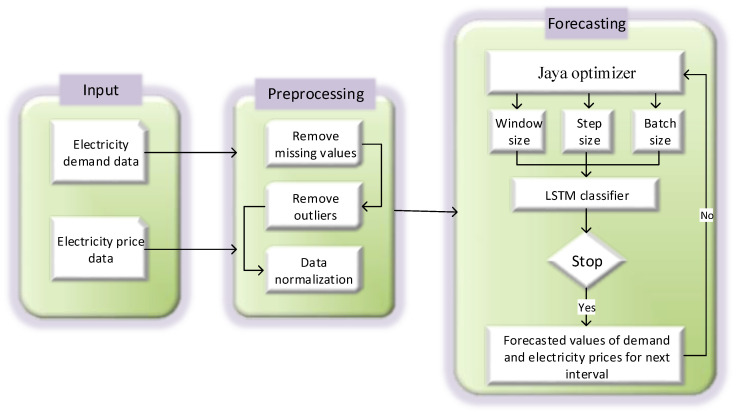
In the smart grid (SG) environment, consumers are enabled to alter electricity consumption patterns in response to electricity prices and incentives. This results in prices that may differ from the initial price pattern. Electricity price and demand forecasting play a vital role in the reliability and sustainability of SG. Forecasting using big data has become a new hot research topic as a massive amount of data is being generated and stored in the SG environment. Electricity users, having advanced knowledge of prices and demand of electricity, can manage their load efficiently. In this paper, a recurrent neural network (RNN), long short term memory (LSTM), is used for electricity price and demand forecasting using big data. Researchers are working actively to propose new models of forecasting. These models contain a single input variable as well as multiple variables. From the literature, we observed that the use of multiple variables enhances the forecasting accuracy. Hence, our proposed model uses multiple variables as input and forecasts the future values of electricity demand and price. The hyperparameters of this algorithm are tuned using the Jaya optimization algorithm to improve the forecasting ability and increase the training mechanism of the model. Parameter tuning is necessary because the performance of a forecasting model depends on the values of these parameters. Selection of inappropriate values can result in inaccurate forecasting. So, integration of an optimization method improves the forecasting accuracy with minimum user efforts. For efficient forecasting, data is preprocessed and cleaned from missing values and outliers, using the z-score method. Furthermore, data is normalized before forecasting. The forecasting accuracy of the proposed model is evaluated using the root mean square error (RMSE) and mean absolute error (MAE). For a fair comparison, the proposed forecasting model is compared with univariate LSTM and support vector machine (SVM). The values of the performance metrics depict that the proposed model has higher accuracy than SVM and univariate LSTM.
在智能电网(SG)环境中,消费者能够根据电价和激励措施改变用电模式。这导致电价可能与初始价格模式不同。电价和需求预测对智能电网的可靠性和可持续性起着至关重要的作用。随着大量数据在智能电网环境中生成和存储,利用大数据进行预测已成为一个新的热门研究课题。电力用户若能提前了解电价和电力需求,就能高效管理其负荷。在本文中,一种循环神经网络(RNN),即长短期记忆(LSTM),被用于利用大数据进行电价和需求预测。研究人员正在积极致力于提出新的预测模型。这些模型包含单个输入变量以及多个变量。从文献中我们观察到,使用多个变量可提高预测准确性。因此,我们提出的模型使用多个变量作为输入,并预测电力需求和价格的未来值。该算法的超参数使用Jaya优化算法进行调整,以提高预测能力并增强模型的训练机制。参数调整是必要的,因为预测模型的性能取决于这些参数的值。选择不合适的值可能导致预测不准确。所以,集成一种优化方法能以最小的用户工作量提高预测准确性。为了进行高效预测,使用z分数法对数据进行预处理,清理缺失值和异常值。此外,在预测前对数据进行归一化处理。使用均方根误差(RMSE)和平均绝对误差(MAE)评估所提模型的预测准确性。为了进行公平比较,将所提预测模型与单变量LSTM和支持向量机(SVM)进行比较。性能指标的值表明,所提模型比SVM和单变量LSTM具有更高的准确性。