Assistance Publique - Hôpitaux de Paris, Hôpitaux Universitaires Henri Mondor, Service de Médecine Intensive Réanimation, 51, Avenue du Maréchal de Lattre de Tassigny, 94010, Créteil Cedex, France.
Université Paris Est-Créteil, Faculté de Santé, Groupe de Recherche Clinique CARMAS, 94010, Créteil, France.
Crit Care. 2020 Dec 7;24(1):678. doi: 10.1186/s13054-020-03414-3.
Patients with coronavirus disease-19-related acute respiratory distress syndrome (C-ARDS) could have a specific physiological phenotype as compared with those affected by ARDS from other causes (NC-ARDS).
To describe the effect of positive end-expiratory pressure (PEEP) on respiratory mechanics in C-ARDS patients in supine and prone position, and as compared to NC-ARDS. The primary endpoint was the best PEEP defined as the smallest sum of hyperdistension and collapse.
Seventeen patients with moderate-to-severe C-ARDS were monitored by electrical impedance tomography (EIT) and evaluated during PEEP titration in supine (n = 17) and prone (n = 14) position and compared with 13 NC-ARDS patients investigated by EIT in our department before the COVID-19 pandemic.
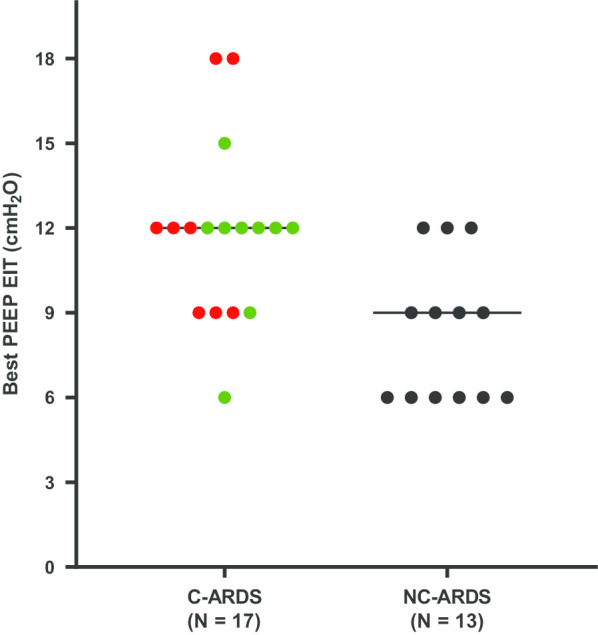
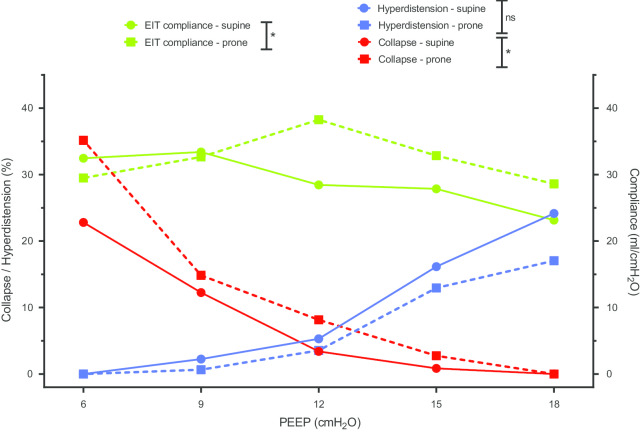
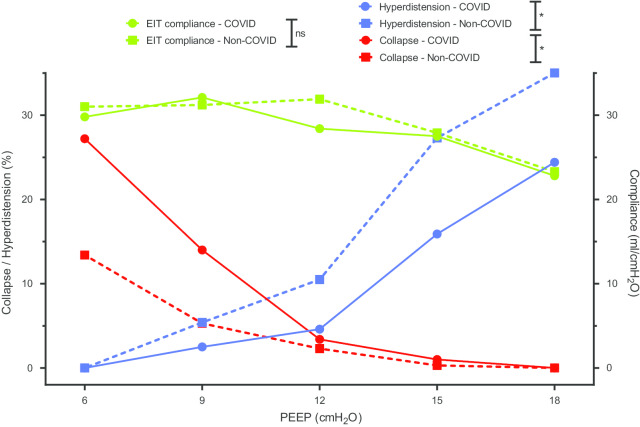
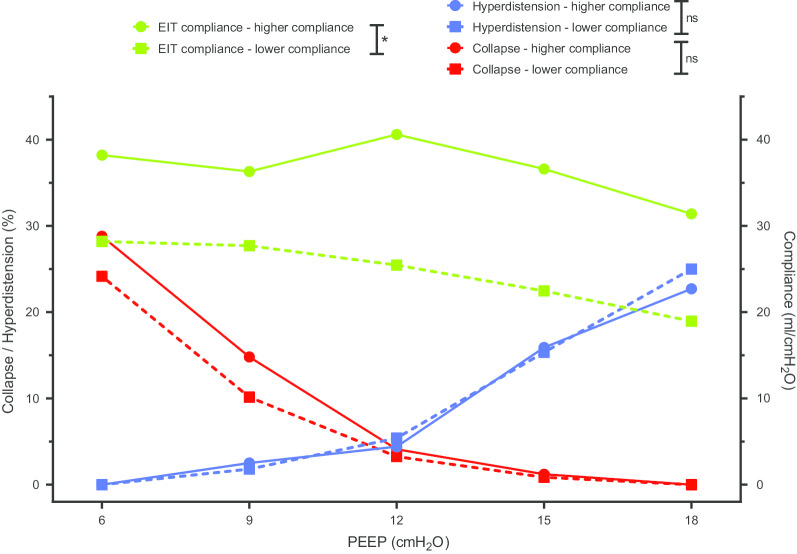
As compared with NC-ARDS, C-ARDS exhibited a higher median best PEEP (defined using EIT as the smallest sum of hyperdistension and collapse, 12 [9, 12] vs. 9 [6, 9] cmHO, p < 0.01), more collapse at low PEEP, and less hyperdistension at high PEEP. The median value of the best PEEP was similar in C-ARDS in supine and prone position: 12 [9, 12] vs. 12 [10, 15] cmHO, p = 0.59. The response to PEEP was also similar in C-ARDS patients with higher vs. lower respiratory system compliance.
An intermediate PEEP level seems appropriate in half of our C-ARDS patients. There is no solid evidence that compliance at low PEEP could predict the response to PEEP.
与其他原因导致的急性呼吸窘迫综合征(ARDS)患者相比,新型冠状病毒肺炎(COVID-19)相关急性呼吸窘迫综合征(C-ARDS)患者可能具有特定的生理学表型。
描述在仰卧位和俯卧位时,C-ARDS 患者的呼气末正压(PEEP)对呼吸力学的影响,并与非 COVID-19 相关 ARDS(NC-ARDS)进行比较。主要终点为定义为过度膨胀和塌陷之和最小的最佳 PEEP。
17 例中重度 C-ARDS 患者接受了电阻抗断层成像(EIT)监测,并在仰卧位(n = 17)和俯卧位(n = 14)进行 PEEP 滴定过程中进行了评估,并与 COVID-19 大流行前在我科接受 EIT 检查的 13 例 NC-ARDS 患者进行了比较。
与 NC-ARDS 相比,C-ARDS 的最佳 PEEP 中位数更高(使用 EIT 定义为过度膨胀和塌陷之和最小的最佳 PEEP,分别为 12[9,12]和 9[6,9]cmH2O,p < 0.01),低 PEEP 时塌陷更多,高 PEEP 时过度膨胀更少。C-ARDS 患者在仰卧位和俯卧位时的最佳 PEEP 中位数相似:12[9,12]和 12[10,15]cmH2O,p = 0.59。呼吸系统顺应性较高与较低的 C-ARDS 患者对 PEEP 的反应也相似。
在我们的一半 C-ARDS 患者中,中等 PEEP 水平似乎是合适的。没有确凿的证据表明低 PEEP 时的顺应性可以预测对 PEEP 的反应。