Keum Changmin, Murawski Caroline, Archer Emily, Kwon Seonil, Mischok Andreas, Gather Malte C
Organic Semiconductor Centre, SUPA, School of Physics and Astronomy, University of St Andrews, St Andrews, UK.
Kurt-Schwabe-Institut für Mess- und Sensortechnik Meinsberg e.V., Waldheim, Germany.
Nat Commun. 2020 Dec 7;11(1):6250. doi: 10.1038/s41467-020-20016-3.
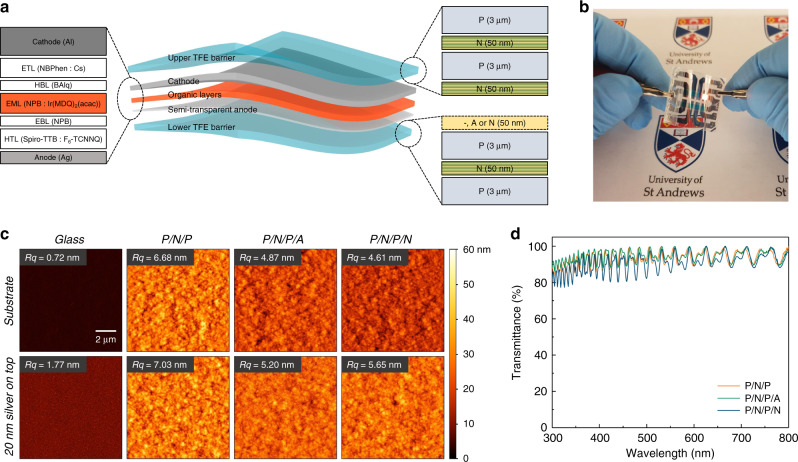
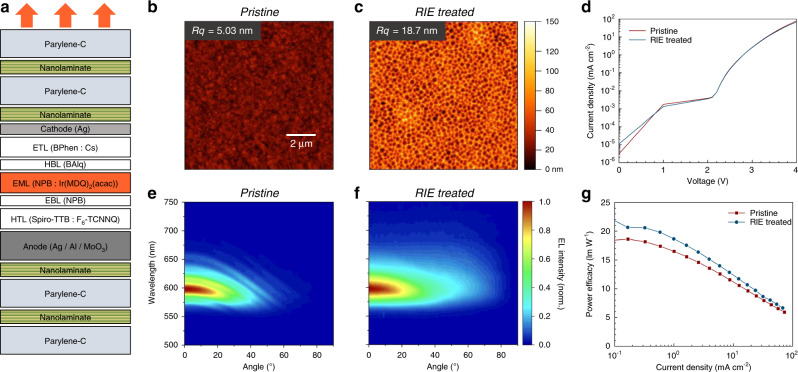
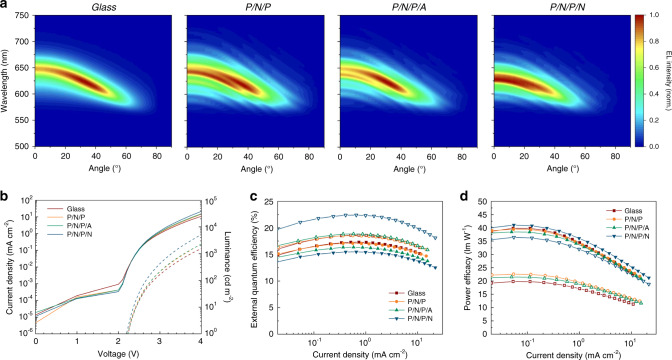
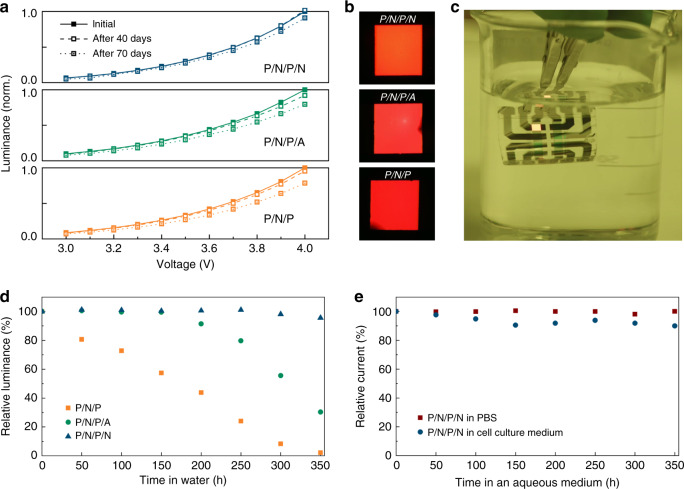
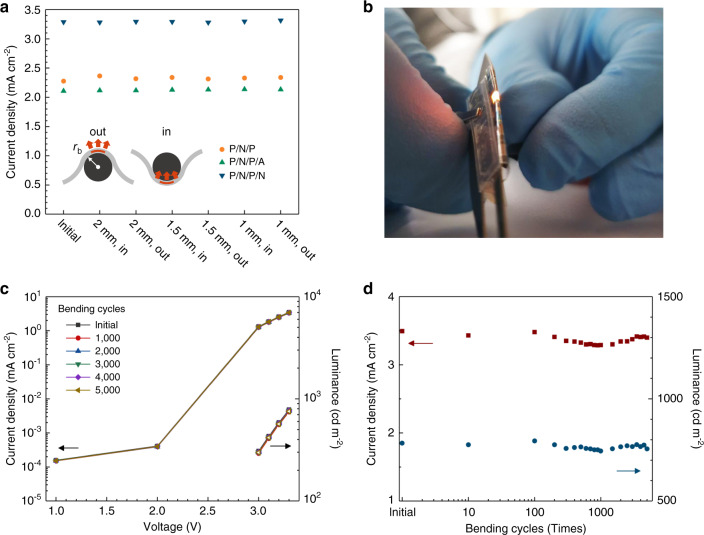
Despite widespread interest, ultrathin and highly flexible light-emitting devices that can be seamlessly integrated and used for flexible displays, wearables, and as bioimplants remain elusive. Organic light-emitting diodes (OLEDs) with µm-scale thickness and exceptional flexibility have been demonstrated but show insufficient stability in air and moist environments due to a lack of suitable encapsulation barriers. Here, we demonstrate an efficient and stable OLED with a total thickness of ≈ 12 µm that can be fully immersed in water or cell nutrient media for weeks without suffering substantial degradation. The active layers of the device are embedded between conformal barriers formed by alternating layers of parylene-C and metal oxides that are deposited through a low temperature chemical vapour process. These barriers also confer stability of the OLED to repeated bending and to extensive postprocessing, e.g. via reactive gas plasmas, organic solvents, and photolithography. This unprecedented robustness opens up a wide range of novel possibilities for ultrathin OLEDs.
尽管受到广泛关注,但能够无缝集成并用于柔性显示器、可穿戴设备以及生物植入物的超薄且高度柔性的发光器件仍然难以实现。已证明具有微米级厚度和出色柔韧性的有机发光二极管(OLED),但由于缺乏合适的封装阻挡层,在空气和潮湿环境中稳定性不足。在此,我们展示了一种总厚度约为12微米的高效且稳定的OLED,它可以完全浸入水中或细胞营养培养基中数周而不会遭受实质性降解。该器件的有源层嵌入由聚对二甲苯-C和金属氧化物交替层形成的保形阻挡层之间,这些阻挡层通过低温化学气相工艺沉积。这些阻挡层还使OLED对反复弯曲以及广泛的后处理(例如通过反应性气体等离子体、有机溶剂和光刻)具有稳定性。这种前所未有的坚固性为超薄OLED开辟了广泛的新可能性。