Department of Biological Sciences, University of South Carolina, Columbia, SC, USA.
Nat Rev Neurosci. 2021 Feb;22(2):77-91. doi: 10.1038/s41583-020-00407-7. Epub 2020 Dec 7.
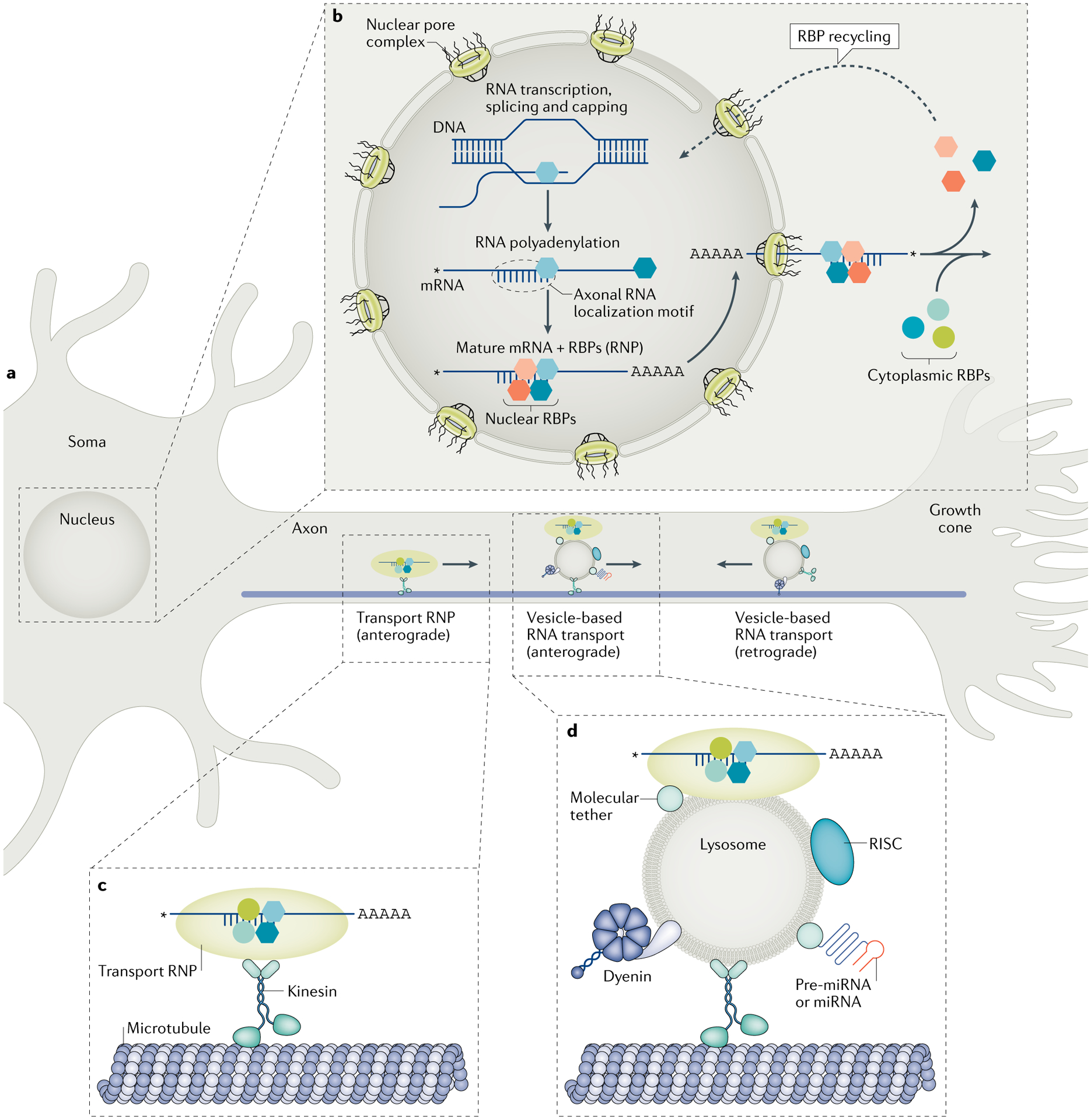
Axons extend for tremendously long distances from the neuronal soma and make use of localized mRNA translation to rapidly respond to different extracellular stimuli and physiological states. The locally synthesized proteins support many different functions in both developing and mature axons, raising questions about the mechanisms by which local translation is organized to ensure the appropriate responses to specific stimuli. Publications over the past few years have uncovered new mechanisms for regulating the axonal transport and localized translation of mRNAs, with several of these pathways converging on the regulation of cohorts of functionally related mRNAs - known as RNA regulons - that drive axon growth, axon guidance, injury responses, axon survival and even axonal mitochondrial function. Recent advances point to these different regulatory pathways as organizing platforms that allow the axon's proteome to be modulated to meet its physiological needs.
轴突从神经元体延伸出非常长的距离,并利用局部 mRNA 翻译来快速响应不同的细胞外刺激和生理状态。局部合成的蛋白质在发育和成熟的轴突中支持许多不同的功能,这引发了关于局部翻译如何组织以确保对特定刺激做出适当反应的机制的问题。过去几年的出版物揭示了调节 mRNA 的轴突运输和局部翻译的新机制,其中一些途径集中在调节功能相关 mRNA 的群体上——这些 mRNA 被称为 RNA 调控子——它们驱动轴突生长、轴突导向、损伤反应、轴突存活甚至轴突线粒体功能。最近的进展表明,这些不同的调节途径是组织平台,允许轴突的蛋白质组被调节以满足其生理需求。