Russo Danilo, Cistrone Luca, Budinski Ivana, Console Giulia, Della Corte Martina, Milighetti Claudia, Di Salvo Ivy, Nardone Valentina, Brigham R Mark, Ancillotto Leonardo
Wildlife Research Unit Dipartimento di Agraria Università degli Studi di Napoli Federico II Portici Italy.
School of Biological Sciences University of Bristol Bristol UK.
Ecol Evol. 2017 Jun 8;7(14):5310-5321. doi: 10.1002/ece3.3111. eCollection 2017 Jul.
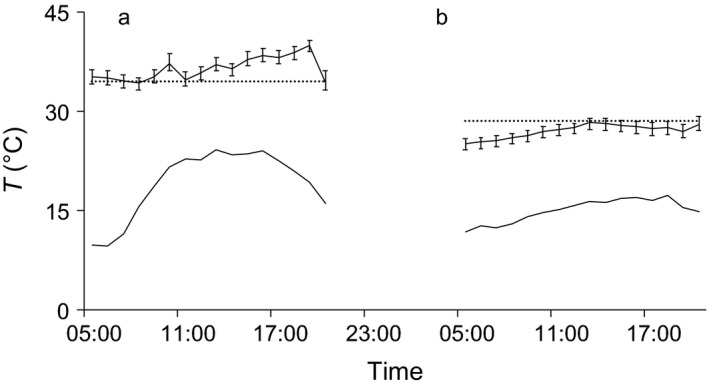
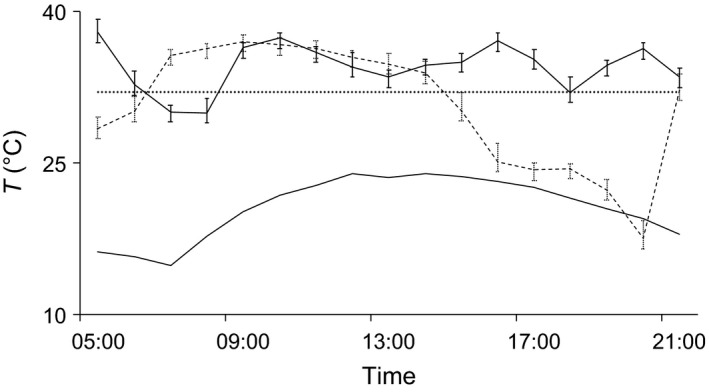
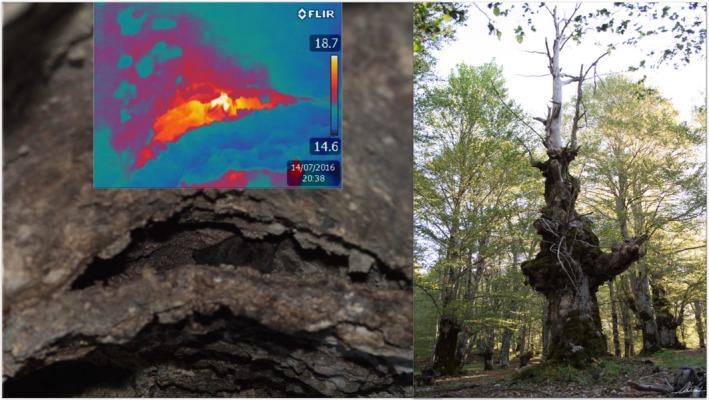
In summer, many temperate bat species use daytime torpor, but breeding females do so less to avoid interferences with reproduction. In forest-roosting bats, deep tree cavities buffer roost microclimate from abrupt temperature oscillations and facilitate thermoregulation. Forest bats also switch roosts frequently, so thermally suitable cavities may be limiting. We tested how barbastelle bats (), often roosting beneath flaking bark in snags, may thermoregulate successfully despite the unstable microclimate of their preferred cavities. We assessed thermoregulation patterns of bats roosting in trees in a beech forest of central Italy. Although all bats used torpor, females were more often normothermic. Cavities were poorly insulated, but social thermoregulation probably overcomes this problem. A model incorporating the presence of roost mates and group size explained thermoregulation patterns better than others based, respectively, on the location and structural characteristics of tree roosts and cavities, weather, or sex, reproductive or body condition. Homeothermy was recorded for all subjects, including nonreproductive females: This probably ensures availability of a warm roosting environment for nonvolant juveniles. Homeothermy may also represent a lifesaver for bats roosting beneath loose bark, very exposed to predators, because homeothermic bats may react quickly in case of emergency. We also found that barbastelle bats maintain group cohesion when switching roosts: This may accelerate roost occupation at the end of a night, quickly securing a stable microclimate in the newly occupied cavity. Overall, both thermoregulation and roost-switching patterns were satisfactorily explained as adaptations to a structurally and thermally labile roosting environment.
在夏季,许多温带蝙蝠物种会进行日间蛰伏,但繁殖期的雌蝙蝠较少这样做,以避免干扰繁殖。对于在森林中栖息的蝙蝠来说,深深的树洞可缓冲栖息地的小气候,使其免受温度的突然波动影响,并便于进行体温调节。森林蝙蝠还会频繁更换栖息地,因此温度适宜的树洞可能很有限。我们研究了 Barbastelle 蝙蝠(),它们通常在残干上剥落的树皮下方栖息,尽管其偏好的栖息地小气候不稳定,但它们如何成功地进行体温调节。我们评估了意大利中部一片山毛榉林中在树上栖息的蝙蝠的体温调节模式。尽管所有蝙蝠都采用了蛰伏状态,但雌蝙蝠保持正常体温的情况更为常见。树洞的隔热效果很差,但群体体温调节可能克服了这个问题。一个纳入了栖息伙伴的存在和群体大小的模型,比分别基于树洞栖息地的位置和结构特征、天气或性别、繁殖或身体状况的其他模型,能更好地解释体温调节模式。记录到所有个体,包括非繁殖期雌蝙蝠,都有恒温现象:这可能确保为不会飞的幼崽提供温暖的栖息环境。恒温对于栖息在松散树皮下方、极易被捕食者发现的蝙蝠来说,也可能是一种救命机制,因为处于恒温状态的蝙蝠在遇到紧急情况时可能会迅速做出反应。我们还发现,Barbastelle 蝙蝠在更换栖息地时会保持群体凝聚力:这可能会在夜间结束时加快对新栖息地的占据,迅速在新占据的树洞中确保稳定的小气候。总体而言,体温调节和栖息地更换模式都能很好地解释为是对结构和热不稳定的栖息环境的适应。