Department of Preventive Medicine and Public Health, School of Medicine, Universidad Autónoma de Madrid-IdiPaz, Madrid, Spain.
CIBERESP (CIBER of Epidemiology and Public Health), Madrid, Spain.
PLoS Med. 2020 Dec 8;17(12):e1003453. doi: 10.1371/journal.pmed.1003453. eCollection 2020 Dec.
Consumption of sugar-sweetened beverages (SSBs) has been consistently associated with a higher risk of obesity, type 2 diabetes, cardiovascular disease, and premature mortality, whereas evidence for artificially sweetened beverages (ASBs) and fruit juices on health is less solid. The aim of this study was to evaluate the consumption of SSBs, ASBs, and fruit juices in association with frailty risk among older women.
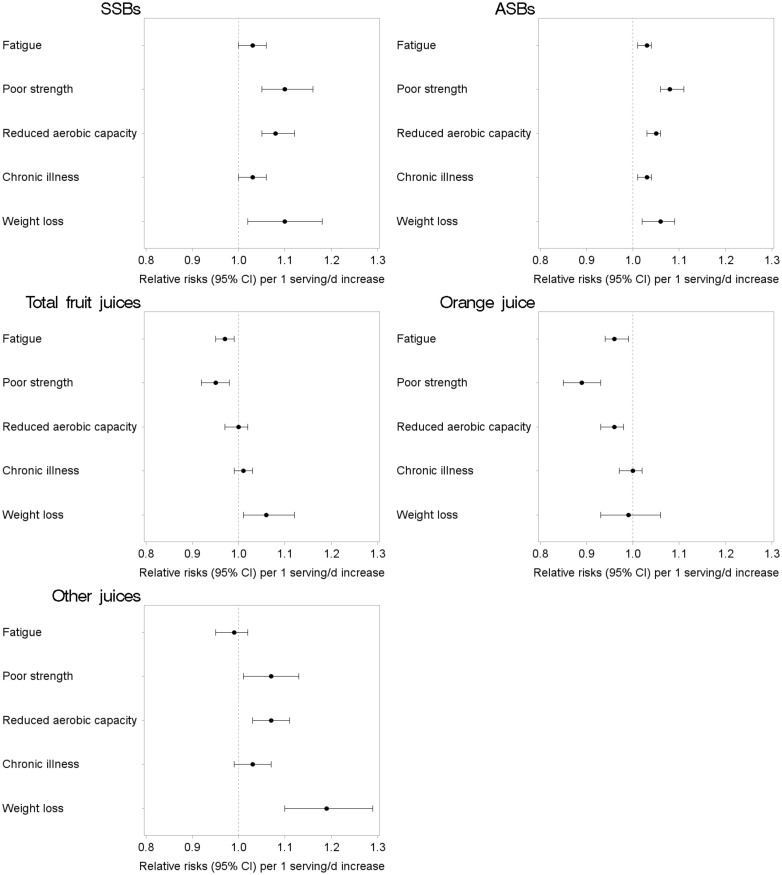
We analyzed data from 71,935 women aged ≥60 (average baseline age was 63) participating in the Nurses' Health Study (NHS), an ongoing cohort study initiated in 1976 among female registered nurses in the United States. Consumption of beverages was derived from 6 repeated food frequency questionnaires (FFQs) administered between 1990 and 2010. Frailty was defined as having at least 3 of the following 5 criteria from the FRAIL scale: fatigue, poor strength, reduced aerobic capacity, having ≥5 chronic illnesses, and weight loss ≥5%. The occurrence of frailty was assessed every 4 years from 1992 to 2014. During 22 years of follow-up, we identified 11,559 incident cases of frailty. Consumption of SSBs was associated with higher risk of frailty after adjustment for diet quality, body mass index (BMI), smoking status, and medication use, specifically, the relative risks (RRs) and 95% confidence interval (95% CI) for ≥2 serving/day versus no SSB consumption was 1.32 (1.10, 1.57); p-value <0.001. ASBs were also associated with frailty [RR ≥2 serving/day versus no consumption: 1.28 (1.17, 1.39); p-value <0.001]. Orange juice was associated with lower risk of frailty [RR ≥1 serving/day versus no consumption: 0.82 (0.76, 0.87); p-value <0.001], whereas other juices were associated with a slightly higher risk [RR ≥1 serving/day versus no consumption: 1.15 (1.03, 1.28); p-value <0.001]. A limitation of this study is that, due to self-reporting of diet and frailty, certain misclassification bias cannot be ruled out; also, some residual confounding may persist.
In this study, we observed that consumption of SSBs and ASBs was associated with a higher risk of frailty. However, orange juice intake showed an inverse association with frailty. These results need to be confirmed in further studies using other frailty definitions.
摄入含糖饮料(SSBs)与肥胖、2 型糖尿病、心血管疾病和早逝的风险增加一直相关,而人工甜味饮料(ASBs)和果汁对健康的证据则不那么确凿。本研究旨在评估 SSBs、ASBs 和果汁的摄入与老年女性虚弱风险之间的关系。
我们分析了 71935 名年龄≥60 岁(平均基线年龄为 63 岁)的女性的数据,这些女性参加了护士健康研究(NHS),这是一项始于 1976 年的美国注册护士的正在进行的队列研究。饮料的摄入量来自于 1990 年至 2010 年期间进行的 6 次重复的食物频率问卷(FFQ)。虚弱程度是根据 FRAIL 量表中的以下 5 个标准中的至少 3 个来定义的:疲劳、力量差、有氧能力降低、患有≥5 种慢性疾病和体重减轻≥5%。从 1992 年到 2014 年,每 4 年评估一次虚弱的发生情况。在 22 年的随访中,我们确定了 11559 例虚弱病例。调整饮食质量、体重指数(BMI)、吸烟状况和药物使用后,摄入 SSBs 与虚弱风险增加相关,具体而言,每天≥2 份与不摄入 SSB 相比的相对风险(RR)和 95%置信区间(95%CI)为 1.32(1.10,1.57);p 值<0.001。ASBs 也与虚弱有关[RR 每天≥2 份与不摄入相比:1.28(1.17,1.39);p 值<0.001]。橙汁与虚弱风险降低相关[RR 每天≥1 份与不摄入相比:0.82(0.76,0.87);p 值<0.001],而其他果汁则与稍高的风险相关[RR 每天≥1 份与不摄入相比:1.15(1.03,1.28);p 值<0.001]。本研究的一个局限性是,由于饮食和虚弱的自我报告,某些分类错误的偏见无法排除;此外,可能仍然存在一些残余混杂。
在这项研究中,我们观察到摄入 SSBs 和 ASBs 与虚弱风险增加相关。然而,橙汁摄入与虚弱呈负相关。这些结果需要使用其他虚弱定义在进一步的研究中得到证实。