Laboratory of Photobiology, Keio University School of Medicine, 35 Shinanomachi, Shinjuku-ku, Tokyo 160-8582, Japan.
Department of Ophthalmology, Keio University School of Medicine, 35 Shinanomachi, Shinjuku-ku, Tokyo 160-8582, Japan.
Nutrients. 2020 Dec 5;12(12):3744. doi: 10.3390/nu12123744.
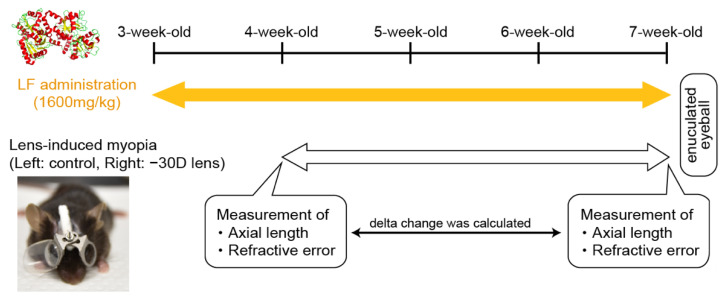
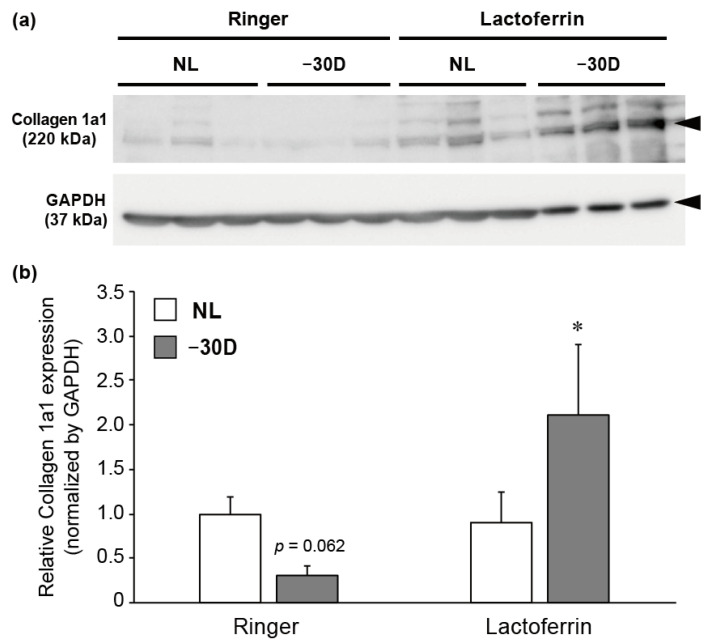
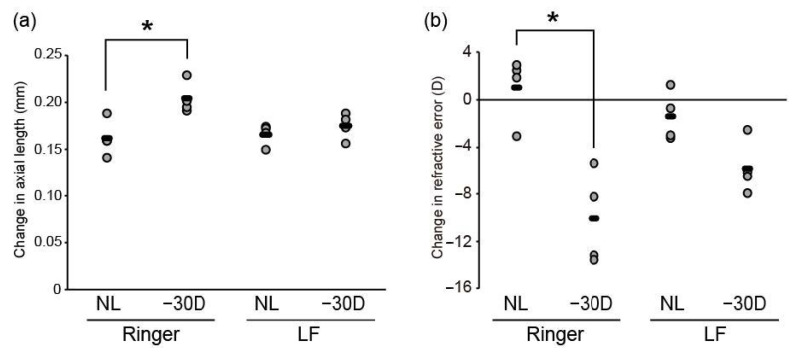
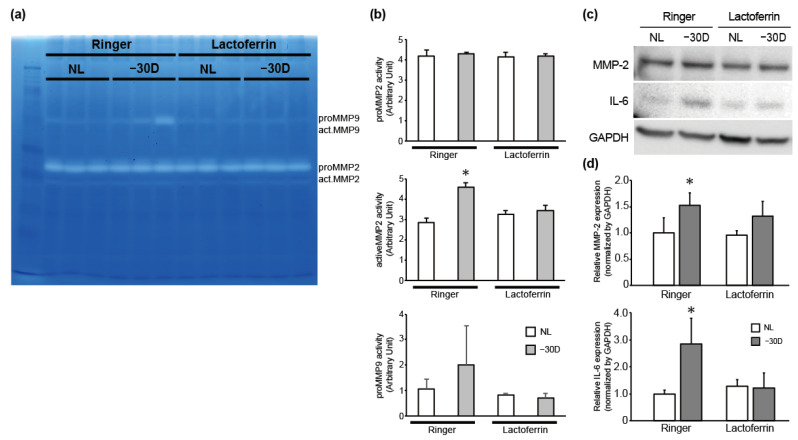
Recent studies have reported an association between myopia development and local ocular inflammation. Lactoferrin (LF) is an iron-binding protein present in saliva, tears, and mother's milk. Furthermore, sequestering iron by LF can cause its antibacterial property. Moreover, LF has an anti-inflammatory effect. We aimed to determine the suppressive effect of LF against the development and progress of myopia using a murine lens-induced myopia (LIM) model. We divided male C57BL/6J mice (3 weeks old) into two groups. While the experimental group was orally administered LF (1600 mg/kg/day, from 3-weeks-old to 7-weeks-old), a similar volume of Ringer's solution was administered to the control group. We subjected the 4-week-old mice to -30 diopter lenses and no lenses on the right and left eyes, respectively. We measured the refraction and the axial length at baseline and 3 weeks after using a refractometer and a spectral domain optical coherence tomography (SD-OCT) system in both eyes. Furthermore, we determined the matrix metalloproteinase-2 (MMP-2) activity, and the amount of interleukin-6 (IL-6), MMP-2, and collagen 1A1 in the choroid or sclera. The eyes with a minus lens showed a refractive error shift and an axial length elongation in the control group, thus indicating the successful induction of myopia. However, there were no significant differences in the aforementioned parameters in the LF group. While LIM increased IL-6 expression and MMP-2 activity, it decreased collagen 1A1 content. However, orally administered LF reversed these effects. Thus, oral administration of LF suppressed lens-induced myopia development by modifying the extracellular matrix remodeling through the IL-6-MMP-2 axis in mice.
最近的研究报告指出,近视的发展与局部眼部炎症有关。乳铁蛋白(LF)是一种存在于唾液、眼泪和母乳中的铁结合蛋白。此外,LF 螯合铁可以使其具有抗菌特性。此外,LF 具有抗炎作用。我们旨在使用鼠晶状体诱导性近视(LIM)模型来确定 LF 对近视发展和进展的抑制作用。我们将雄性 C57BL/6J 小鼠(3 周龄)分为两组。实验组经口给予 LF(1600mg/kg/天,从 3 周龄到 7 周龄),对照组给予等体积的林格氏液。我们对 4 周龄的小鼠右眼和左眼分别施加-30 屈光度的透镜和无透镜。我们使用折射仪和光谱域光相干断层扫描(SD-OCT)系统在双眼测量屈光度和眼轴长度,分别在基线和 3 周后。此外,我们还测定脉络膜或巩膜中的基质金属蛋白酶-2(MMP-2)活性以及白细胞介素-6(IL-6)、MMP-2 和胶原 1A1 的量。在对照组中,带有负透镜的眼睛表现出屈光不正的转变和眼轴的延长,这表明近视的成功诱导。然而,LF 组的上述参数没有明显差异。虽然 LIM 增加了 IL-6 的表达和 MMP-2 的活性,但降低了胶原 1A1 的含量。然而,经口给予 LF 逆转了这些效应。因此,LF 的口服给药通过改变细胞外基质重塑来抑制 LIM 诱导的近视发展,通过 IL-6-MMP-2 轴在小鼠中。