Walshe Nicola, Mulcahy Grace, Hodgkinson Jane, Peachey Laura
School of Veterinary Medicine, University College Dublin, 4 Dublin, Ireland.
Institute of Infection and Global Health, University of Liverpool, Liverpool L69 7ZJ, UK.
Animals (Basel). 2020 Dec 5;10(12):2309. doi: 10.3390/ani10122309.
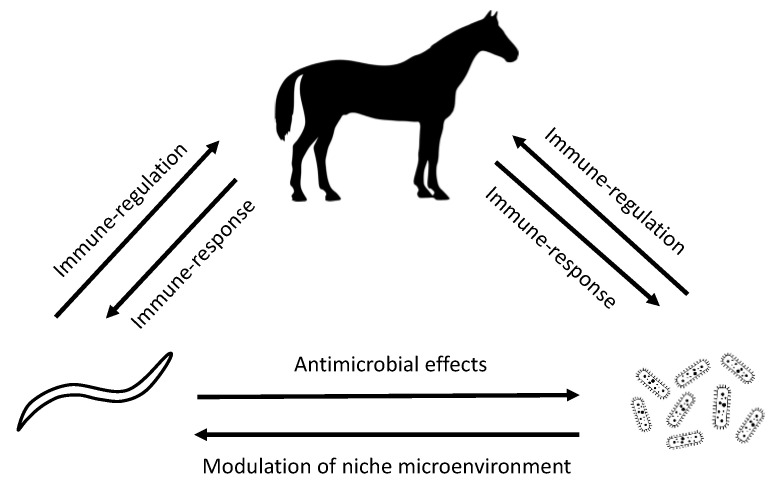
The importance of the gut microbiome for host health has been the subject of intense research over the last decade. In particular, there is overwhelming evidence for the influence of resident microbiota on gut mucosal and systemic immunity; with significant implications for the outcome of gastrointestinal (GI) infections, such as parasitic helminths. The horse is a species that relies heavily on its gut microbiota for GI and overall health, and disturbances in this complex ecosystem are often associated with life-threatening disease. In turn, nearly all horses harbour parasitic helminths from a young age, the most prevalent of which are the small strongyles, or cyathostomins. Research describing the relationship between gut microbiota and cyathostomin infection is in its infancy, however, to date there is evidence of meaningful interactions between these two groups of organisms which not only influence the outcome of cyathostomin infection but have long term consequences for equine host health. Here, we describe these interactions alongside supportive evidence from other species and suggest novel theories and avenues for research which have the potential to revolutionize our approach to cyathostomin prevention and control in the future.
在过去十年中,肠道微生物群对宿主健康的重要性一直是深入研究的主题。特别是,有压倒性的证据表明常驻微生物群对肠道黏膜和全身免疫有影响;这对胃肠道(GI)感染的结果具有重要意义,例如寄生虫感染。马是一种严重依赖其肠道微生物群来维持胃肠道和整体健康的物种,这个复杂生态系统的紊乱通常与危及生命的疾病有关。反过来,几乎所有的马从幼年起就携带寄生虫,其中最常见的是小型圆线虫,即杯状线虫。然而,描述肠道微生物群与杯状线虫感染之间关系的研究尚处于起步阶段,迄今为止,有证据表明这两组生物体之间存在有意义的相互作用,这不仅会影响杯状线虫感染的结果,还会对马宿主的健康产生长期影响。在这里,我们描述了这些相互作用以及来自其他物种的支持性证据,并提出了新的理论和研究途径,这些理论和途径有可能在未来彻底改变我们预防和控制杯状线虫的方法。