Zhang Qing, Wu Lian, Liu Shaozheng, Chen Qingjie, Zeng Lingpeng, Chen Xuezhong, Zhang Qing
Department of Nuclear Medicine, The First Affiliated Hospital of Nanchang University, No. 17, Yongwai Zheng Street, Donghu District, Nanchang, 330006, People's Republic of China.
Department of Nephrology, The First Affiliated Hospital of Nanchang University, Nanchang, 330006, People's Republic of China.
Cancer Cell Int. 2020 Nov 27;20(1):570. doi: 10.1186/s12935-020-01613-0.
To investigate the efficacy of a PLGA-based nanobody complex in photodynamic therapy (PDT) and NIR-II imaging in A549 tumor hypoxic model.
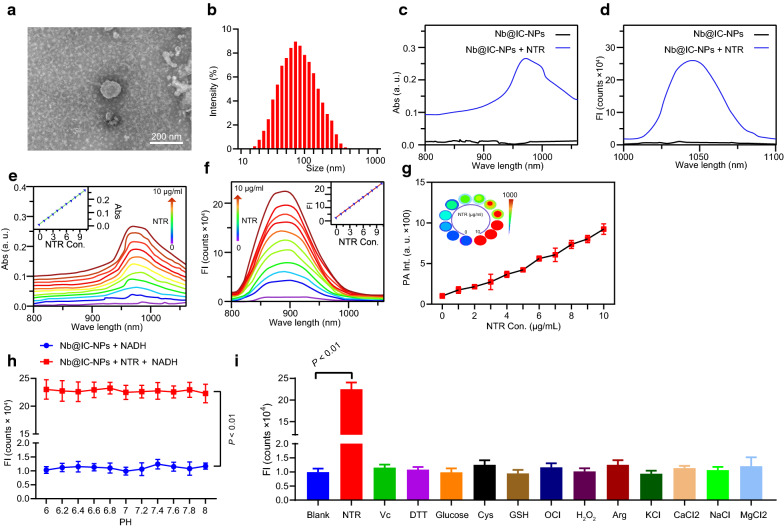
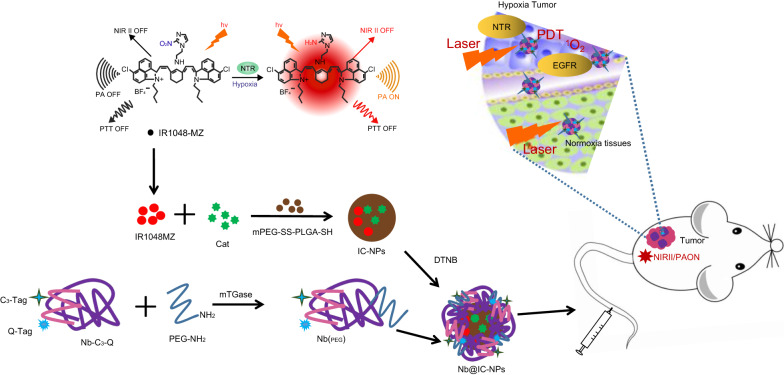
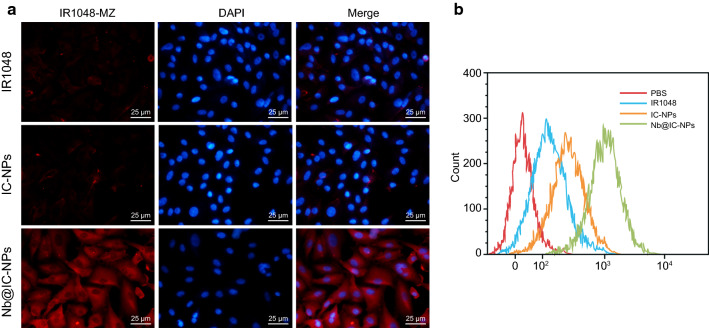
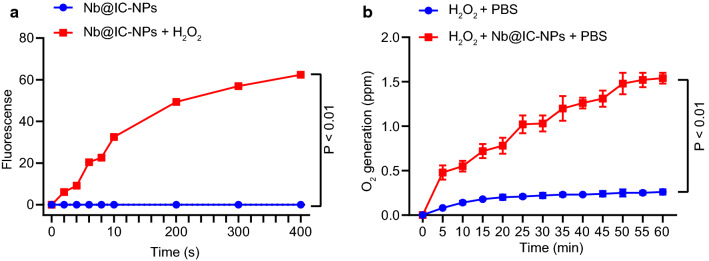
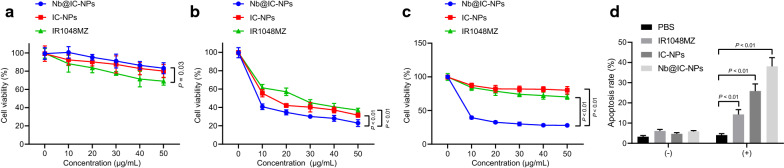
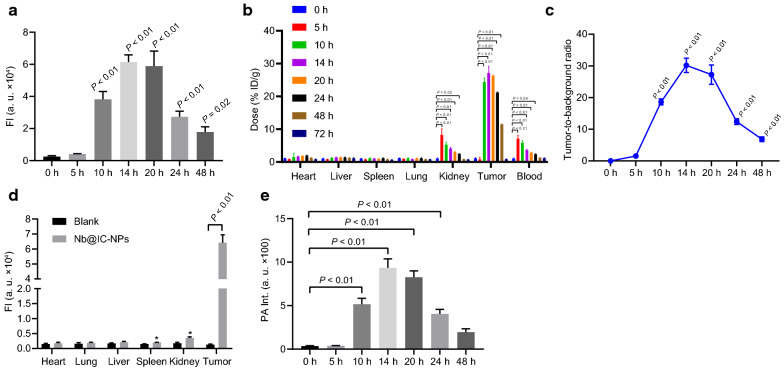
IR1048-MZ was firstly synthesized by conjugating a nitro imidazole group to IR1048. IR1048-MZ and Cat were then encapsulated in PLGA-SH solution. Anti-EGFR-Nanobody was also expressed and purified, and finally Anti-EGFR-Nanobody@PLGA-IR1048MZ-Cat (Nb@IC-NPs) nanobody complex was obtained based on the formation of desulfide bond between PLGA-SH and Anti-EGFR-Nanobody. Size distribution and morphology were characterized by TEM and DLS. Spectrum of Nb@IC-NPs towards NTR was measured by UV and fluorescence, while the particle's selective response was studied using fluorescence. The uptake of Nb@IC-NPs in A549 cells was observed by flow cytometry and CLSM. In the meantime, its' catalytic ability that decomposes HO both extra-and intra-cellular was observed by fluorescence and CLSM. In vitro photodynamic toxicity of Nb@IC-NPs was examined by MTT, Live/Dead Cell Staining, Flow Cytometry and Apoptosis Assay. Tumor-bearing model was constructed to observe a semi-quantitative fluorescent distribution and the possibility of NIR-II fluorescence/photoacoustic (PA) imaging. Effect of Nb@IC-NPs on enhancing A549 tumor hypoxia and expression profile of HIF-1α was investigated in the presence of NIR. An A549 tumor metastasis model was also constructed to confirm the complex' potential to destroy primary tumor, inhibit lung metastasis, and prolong mice' survival. Lastly, impact of Nb@IC-NPs on mice' main organs and blood indices was observed.
Nb@IC-NPs was successfully fabricated with good homogeneity. The fluorescent absorbance of Nb@IC-NPs showed a linear relationship with the concentration of NTR, and a higher concentration of NTR corresponded to a stronger photoacoustic signal. In addition, Nb@IC-NPs showed a stable selectivity toward NTR. Our results also suggested a high efficient uptake of Nb@IC-NPs in A549 cells, which was more efficient than IC-NPs and IR1048-MZ alone. In vitro assays confirmed the effects of Nb@IC-NPs on catalytic O generation even in hypoxic cells. The cell viability was upregulated with the nanocomplex at the absence of the laser, whereas it was dramatically declined with laser treatment that excited at 980 nm. Nb@IC-NPs achieved tumor hypoxia NIR-II/PA imaging through assisting A549 gathering. When NIR was applied, Nb@IC-NPs can significantly relieve A549 cellular/tumor hypoxia by generating more reactive oxygen species (ROS), which in turn helps lower the expression level of HIF-1α. In summary, Nb@IC-NPs based PDT can efficiently decimate A549 primary tumor, inhibit metastatic lung cancer, and prolong the lifespan of the mice under tolerable dosage. At last, in vivo toxicity tests of the nanocomplex showed its biosafety to the main organs and normal blood indices values.
Nb@IC-NPs improves tumor hypoxia through catalytic reaction and lowers the expression level of HIF-1α. It achieves tumor PA imaging through intensified NIR-II fluorescence signal that caused by response of the complex to the lesion's nitroreductase (NTR). Nb@IC-NPs based PDT can efficiently kill A549 primary tumor, inhibit a lung metastasis, as well as prolong mice' survival cycle.
研究基于聚乳酸-羟基乙酸共聚物(PLGA)的纳米抗体复合物在A549肿瘤缺氧模型中的光动力疗法(PDT)及近红外二区(NIR-II)成像效果。
首先通过将硝基咪唑基团与IR1048偶联合成IR1048-MZ。然后将IR1048-MZ和Cat包裹于PLGA-SH溶液中。同时表达并纯化抗表皮生长因子受体(EGFR)纳米抗体,最终基于PLGA-SH与抗EGFR纳米抗体之间形成二硫键获得抗EGFR纳米抗体@PLGA-IR1048MZ-Cat(Nb@IC-NPs)纳米抗体复合物。通过透射电子显微镜(TEM)和动态光散射(DLS)对其尺寸分布和形态进行表征。利用紫外和荧光光谱测定Nb@IC-NPs对硝基还原酶(NTR)的光谱,同时采用荧光法研究颗粒的选择性响应。通过流式细胞术和共聚焦激光扫描显微镜(CLSM)观察Nb@IC-NPs在A549细胞中的摄取情况。与此同时通过荧光和CLSM观察其在细胞内外分解过氧化氢(HO)的催化能力。采用MTT法、活/死细胞染色、流式细胞术和凋亡检测法检测Nb@IC-NPs的体外光动力毒性。构建荷瘤模型以观察半定量荧光分布及NIR-II荧光/光声(PA)成像的可能性。研究在近红外光存在下Nb@IC-NPs对增强A549肿瘤缺氧及缺氧诱导因子-1α(HIF-1α)表达谱的影响。还构建了A549肿瘤转移模型以证实该复合物破坏原发肿瘤、抑制肺转移及延长小鼠生存期的潜力。最后,观察Nb@IC-NPs对小鼠主要器官和血液指标的影响。
成功制备了具有良好均匀性的Nb@IC-NPs。Nb@IC-NPs的荧光吸光度与NTR浓度呈线性关系,且NTR浓度越高,光声信号越强。此外,Nb@IC-NPs对NTR表现出稳定的选择性。我们的结果还表明Nb@IC-NPs在A549细胞中具有高效摄取能力,其摄取效率高于单独的IC-NPs和IR1048-MZ。体外实验证实了Nb@IC-NPs即使在缺氧细胞中对催化产生氧(O)的作用。在无激光照射时,纳米复合物上调细胞活力,而在980nm激光照射下细胞活力显著下降。Nb@IC-NPs通过协助A549聚集实现肿瘤缺氧NIR-II/PA成像。当施加近红外光时,Nb@IC-NPs可通过产生更多活性氧(ROS)显著缓解A549细胞/肿瘤缺氧,进而有助于降低HIF-1α的表达水平。总之,基于Nb@IC-NPs的PDT在可耐受剂量下可有效消除A549原发肿瘤、抑制转移性肺癌并延长小鼠寿命。最后,该纳米复合物的体内毒性试验表明其对主要器官和正常血液指标值具有生物安全性。
Nb@IC-NPs通过催化反应改善肿瘤缺氧并降低HIF-1α的表达水平。它通过复合物对病变部位硝基还原酶(NTR)的响应所引起的增强近红外二区荧光信号实现肿瘤PA成像。基于Nb@IC-NPs的PDT可有效杀死A549原发肿瘤、抑制肺转移并延长小鼠生存周期。