Gunaydin Gurcan, Gedik M Emre, Ayan Seylan
Department of Basic Oncology, Hacettepe University Cancer Institute, Ankara, Turkey.
Department of Chemistry, Bilkent University, Ankara, Turkey.
Front Chem. 2021 Aug 2;9:686303. doi: 10.3389/fchem.2021.686303. eCollection 2021.
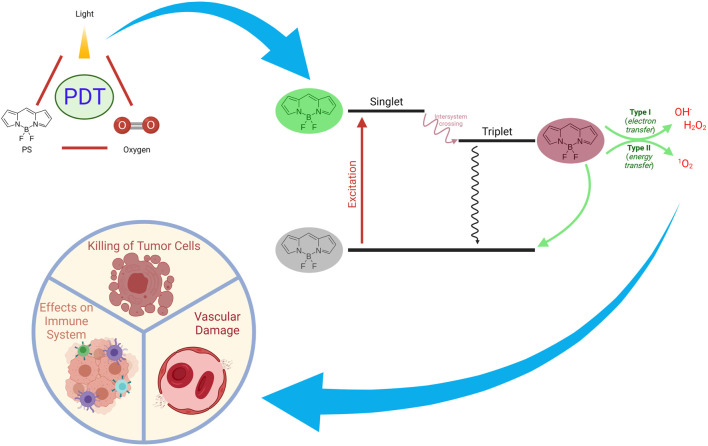
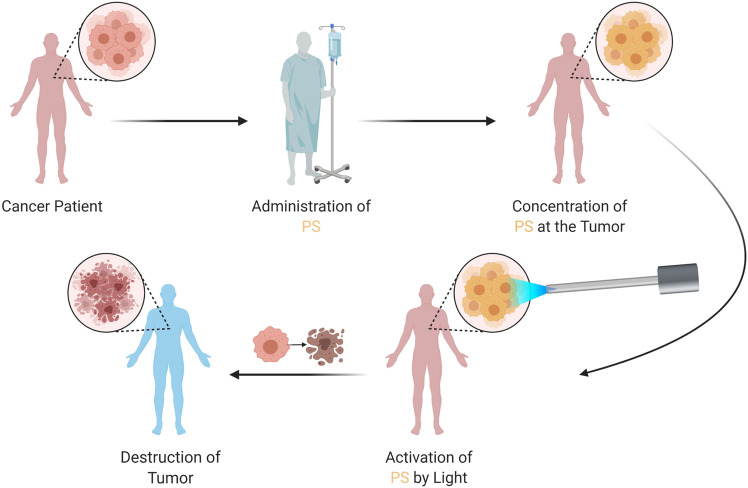
Photodynamic therapy (PDT) has been used as an anti-tumor treatment method for a long time and photosensitizers (PS) can be used in various types of tumors. Originally, light is an effective tool that has been used in the treatment of diseases for ages. The effects of combination of specific dyes with light illumination was demonstrated at the beginning of 20th century and novel PDT approaches have been developed ever since. Main strategies of current studies are to reduce off-target effects and improve pharmacokinetic properties. Given the high interest and vast literature about the topic, approval of PDT as the first drug/device combination by the FDA should come as no surprise. PDT consists of two stages of treatment, combining light energy with a PS in order to destruct tumor cells after activation by light. In general, PDT has fewer side effects and toxicity than chemotherapy and/or radiotherapy. In addition to the purpose of treatment, several types of PSs can be used for diagnostic purposes for tumors. Such approaches are called photodynamic diagnosis (PDD). In this Review, we provide a general overview of the clinical applications of PDT in cancer, including the diagnostic and therapeutic approaches. Assessment of PDT therapeutic efficacy in the clinic will be discussed, since identifying predictors to determine the response to treatment is crucial. In addition, examples of PDT in various types of tumors will be discussed. Furthermore, combination of PDT with other therapy modalities such as chemotherapy, radiotherapy, surgery and immunotherapy will be emphasized, since such approaches seem to be promising in terms of enhancing effectiveness against tumor. The combination of PDT with other treatments may yield better results than by single treatments. Moreover, the utilization of lower doses in a combination therapy setting may cause less side effects and better results than single therapy. A better understanding of the effectiveness of PDT in a combination setting in the clinic as well as the optimization of such complex multimodal treatments may expand the clinical applications of PDT.
光动力疗法(PDT)长期以来一直被用作一种抗肿瘤治疗方法,光敏剂(PS)可用于各类肿瘤。最初,光作为一种有效的工具,已被用于疾病治疗达数百年之久。20世纪初就已证实特定染料与光照相结合的效果,此后便不断开发新的光动力疗法。当前研究的主要策略是减少脱靶效应并改善药代动力学特性。鉴于对该主题的高度关注和大量文献,光动力疗法作为首个药物/器械组合获得美国食品药品监督管理局(FDA)的批准也就不足为奇了。光动力疗法包括两个治疗阶段,即光能与光敏剂相结合,以便在光照激活后破坏肿瘤细胞。一般来说,与化疗和/或放疗相比,光动力疗法的副作用和毒性更少。除了治疗目的外,几种类型的光敏剂还可用于肿瘤的诊断目的。此类方法称为光动力诊断(PDD)。在本综述中,我们对光动力疗法在癌症中的临床应用进行了总体概述,包括诊断和治疗方法。将讨论光动力疗法临床治疗效果的评估,因为确定预测指标以判断治疗反应至关重要。此外,还将讨论光动力疗法在各类肿瘤中的应用实例。此外,将重点强调光动力疗法与化疗、放疗、手术和免疫疗法等其他治疗方式的联合应用,因为此类方法在增强抗肿瘤效果方面似乎很有前景。光动力疗法与其他治疗方法联合使用可能比单一治疗产生更好的效果。此外,在联合治疗中使用较低剂量可能比单一治疗产生更少的副作用和更好的效果。更好地了解光动力疗法在临床联合治疗中的有效性以及优化此类复杂的多模式治疗可能会扩大光动力疗法的临床应用。