Institute for General Practice, Hannover Medical School, Carl-Neuberg-Straße 1, 30625, Hannover, Germany.
AOK Lower Saxony, Department for Health Services Research, Hildesheimer Str. 273, 30519, Hannover, Germany.
BMC Palliat Care. 2020 Dec 8;19(1):187. doi: 10.1186/s12904-020-00679-x.
The provision and quality of end-of-life care (EoLC) in Germany is inconsistent. Therefore, an evaluation of current EoLC based on quality indicators is needed. This study aims to evaluate EoLC in Germany on the basis of quality indicators pertaining to curative overtreatment, palliative undertreatment and delayed palliative care (PC). Results were compared with previous findings.
Data from a statutory health insurance provider (AOK Lower Saxony) pertaining to deceased members in the years 2016 and 2017 were used to evaluate EoLC. The main indicators were: chemotherapy for cancer patients in the last month of life, first-time percutaneous endoscopic gastrostomy (PEG) for patients with dementia in the last 3 months of life, number of hospitalisations and days spent in inpatient treatment in the last 6 months of life, and provision of generalist and specialist outpatient PC in the last year of life. Data were analysed descriptively.
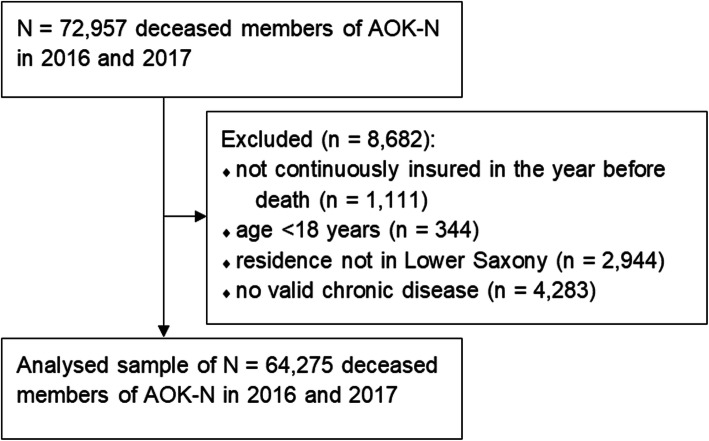
Data for 64,275 deceased members (54.3% female; 35.1% cancer patients) were analysed. With respect to curative overtreatment, 10.4% of the deceased with cancer underwent chemotherapy in the last month and 0.9% with dementia had a new PEG insertion in the last 3 months of life. The mean number of hospitalisations and inpatient treatment days per deceased member was 1.6 and 16.5, respectively, in the last 6 months of life. Concerning palliative undertreatment, generalist outpatient PC was provided for 28.0% and specialist outpatient PC was provided for 9.0% of the deceased. Regarding indicators for delayed PC, the median onset of generalist and specialist outpatient PC was 47.0 and 24.0 days before death, respectively.
Compared to data from 2010 to 2014, the data analysed in the present study suggest an ongoing curative overtreatment in terms of chemotherapy and hospitalisation, a reduction in new PEG insertions and an increase in specialist PC. The number of patients receiving generalist PC remained low, with delayed onset. Greater awareness of generalist PC and the early integration of PC are recommended.
The study was registered in the German Clinical Trials Register ( DRKS00015108 ; 22 January 2019).
德国的临终关怀(EoLC)的提供和质量参差不齐。因此,需要基于质量指标对当前的 EoLC 进行评估。本研究旨在基于与过度治疗、不足治疗和延迟姑息治疗(PC)相关的质量指标,评估德国的 EoLC。结果与之前的研究结果进行了比较。
使用法定健康保险公司(AOK 下萨克森州)2016 年和 2017 年去世的成员的数据,评估 EoLC。主要指标为:生命最后一个月癌症患者的化疗、生命最后 3 个月痴呆患者首次经皮内镜胃造口术(PEG)、生命最后 6 个月的住院次数和住院天数,以及生命最后一年提供的普通科和专科门诊 PC。数据进行描述性分析。
分析了 64275 名去世成员的数据(女性占 54.3%;35.1%为癌症患者)。在过度治疗方面,10.4%的癌症去世患者在生命最后一个月接受了化疗,0.9%的痴呆去世患者在生命最后 3 个月进行了新的 PEG 插入。生命最后 6 个月,每位去世成员的平均住院次数和住院天数分别为 1.6 次和 16.5 天。在不足治疗方面,为 28.0%的去世患者提供了普通科门诊 PC,为 9.0%的去世患者提供了专科门诊 PC。关于延迟 PC 的指标,普通科和专科门诊 PC 的中位起始时间分别为死亡前 47.0 天和 24.0 天。
与 2010 年至 2014 年的数据相比,本研究分析的数据表明,在化疗和住院方面仍存在过度治疗,新的 PEG 插入减少,专科 PC 增加。接受普通科 PC 的患者人数仍然较少,且开始时间较晚。建议提高对普通科 PC 的认识,并尽早纳入 PC。
该研究在德国临床试验注册处(DRKS00015108;2019 年 1 月 22 日)注册。