Kononowech Jennifer, Landis-Lewis Zach, Carpenter Joan, Ersek Mary, Hogikyan Robert, Levy Cari, Phibbs Ciaran, Scott Winifred, Sales Anne E
Center for Clinical Management Research, VA Ann Arbor Healthcare System, 2800 Plymouth Rd, Ann Arbor, MI, 48109, USA.
University of Michigan Medical School, 300 N. Ingalls Street, Ann Arbor, MI, 48109, USA.
Implement Sci Commun. 2020 Nov 25;1(1):105. doi: 10.1186/s43058-020-00094-6.
Process mapping is often used in quality improvement work to examine current processes and workflow and to identify areas to intervene to improve quality. Our objective in this paper is to describe process maps as a visual means of understanding modifiable behaviors and activities, in this case example to ensure that goals of care conversations are part of admitting a veteran in long-term care settings.
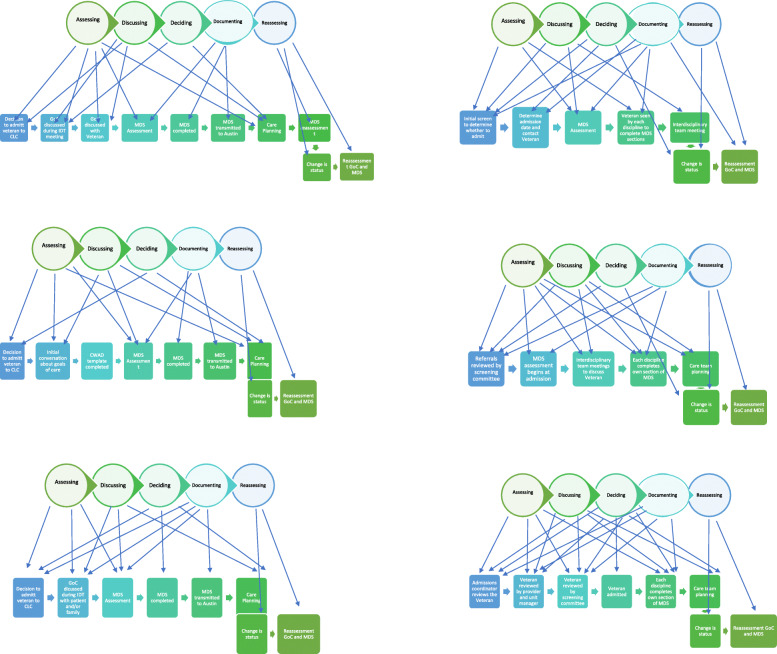
We completed site visits to 6 VA nursing homes and reviewed their current admission processes. We conducted interviews to document behaviors and activities that occur when a veteran is referred to a long-term care setting, during admission, and during mandatory VA reassessments. We created visualizations of the data using process mapping approaches. Process maps for each site were created to document the admission activities for each VA nursing home and were reviewed by the research team to identify consistencies across sites and to identify potential opportunities for implementing goals of care conversations.
We identified five consistent behaviors that take place when a veteran is referred and admitted in long-term care. These behaviors are assessing, discussing, decision-making, documenting, and re-assessing.
Based on the process maps, it seems feasible that the LST note and order template could be completed along with other routine assessment processes. However, this will require more robust multi-disciplinary collaboration among both prescribing and non-prescribing health care providers. Completing the LST template during the current admission process would increase the likelihood that the template is completed in a timely manner, potentially alleviate the perceived time burden, and help with the provision of veteran-centered care.
流程映射常用于质量改进工作,以检查当前流程和工作流程,并确定需要干预以提高质量的领域。本文的目的是将流程映射描述为一种理解可改变行为和活动的可视化手段,在此案例中,以确保护理谈话的目标成为长期护理机构中接纳退伍军人流程的一部分。
我们对6家退伍军人事务部(VA)疗养院进行了实地考察,并审查了它们当前的入院流程。我们进行了访谈,记录退伍军人被转介到长期护理机构时、入院期间以及退伍军人事务部强制重新评估期间发生的行为和活动。我们使用流程映射方法对数据进行了可视化处理。为每个地点创建了流程地图,以记录每家退伍军人事务部疗养院的入院活动,并由研究团队进行审查,以确定各地点之间的一致性,并确定实施护理谈话目标的潜在机会。
我们确定了退伍军人在被转介并入住长期护理机构时发生的五种一致行为。这些行为是评估、讨论、决策、记录和重新评估。
基于流程地图,在进行其他常规评估流程的同时完成LST记录和医嘱模板似乎是可行的。然而,这将需要开处方和不开处方的医疗保健提供者之间进行更强大的多学科协作。在当前入院流程中完成LST模板将增加模板及时完成的可能性,潜在地减轻感知到的时间负担,并有助于提供以退伍军人为中心 的护理。