Villalobos Aubrey, Blachman-Demner Dara, Percy-Laurry Antoinette, Belis Deshiree, Bhattacharya Manami
Division of Cancer Control and Population Sciences, National Cancer Institute, 9609 Medical Center Dr, Bethesda, MD, 20892, USA.
Office of Behavioral and Social Sciences Research, Office of the Director, National Institutes of Health, 31 Center Dr, Bethesda, MD, 20892, USA.
Implement Sci Commun. 2023 Jul 12;4(1):77. doi: 10.1186/s43058-023-00462-y.
As the focus has grown in recent years on both engaged research and dissemination and implementation (D&I) research, so too has federal funding to support these areas. The purpose of this analysis is to provide an overall perspective about the range of practices and approaches being used to engage partners in D&I research, with special attention to disparities-relevant research, and to identify gaps and opportunities in research funded by the US National Institutes of Health (NIH) in this space.
This analysis examined a portfolio of active D&I research grants funded in fiscal years 2020 and 2021 across the NIH. Grant applications were deductively coded and summary statistics were calculated. Cross-tabulations were used to identify trends by engagement and disparities foci.
There were 103 grants included in the portfolio, of which 87% contained some form of community or partner engagement, and 50% of engaged grants were relevant to health disparities. Engagement was planned across the research continuum with each study engaging on average 2.5 different partner types. Consultation was the most common level of engagement (56%) while partnership was the least common (3%). On average, each study used 2.2 engagement strategies. Only 16% of grants indicated formally measuring engagement. Compared to non-disparities studies, disparities-relevant studies were about twice as likely to engage partners at the higher levels of partnership or collaboration (19% vs. 11%) and were also more likely to be conducted in community settings (26% vs. 5%).
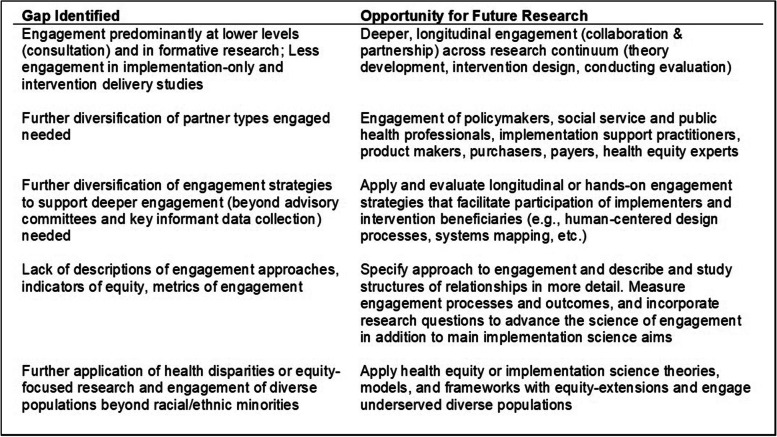
Based on this portfolio analysis, D&I research appears to regularly integrate engagement approaches and strategies, though opportunities to deepen engagement and diversify who is engaged remain. This manuscript outlines several gaps in the portfolio and describes opportunities for increasing engagement to improve the quality of D&I research and application to advancing health equity. In addition, opportunities for leveraging the consistent and systematic application of engagement approaches and strategies to advance the science of engagement are discussed.
近年来,随着对参与性研究以及传播与实施(D&I)研究的关注不断增加,联邦政府用于支持这些领域的资金也在增加。本分析的目的是全面了解在D&I研究中用于吸引合作伙伴的一系列实践和方法,特别关注与差异相关的研究,并确定美国国立卫生研究院(NIH)在这一领域资助的研究中的差距和机会。
本分析审查了NIH在2020财年和2021财年资助的一系列活跃的D&I研究拨款。对拨款申请进行演绎编码并计算汇总统计数据。使用交叉列表来确定参与情况和差异重点方面的趋势。
该系列中有103项拨款,其中87%包含某种形式的社区或合作伙伴参与,50%的参与性拨款与健康差异相关。参与计划贯穿研究的整个过程,每项研究平均涉及2.5种不同类型的合作伙伴。咨询是最常见的参与级别(56%),而伙伴关系是最不常见的(3%)。平均而言,每项研究使用2.2种参与策略。只有16%的拨款表示正式衡量参与情况。与非差异研究相比,与差异相关的研究在更高层次的伙伴关系或合作中吸引合作伙伴的可能性约为两倍(19%对11%),并且也更有可能在社区环境中进行(26%对5%)。
基于此系列分析,D&I研究似乎经常整合参与方法和策略,尽管仍有机会加深参与并使参与对象多样化。本手稿概述了该系列中的几个差距,并描述了增加参与以提高D&I研究质量以及应用于促进健康公平的机会。此外,还讨论了利用参与方法和策略的一致和系统应用来推进参与科学的机会。