Department of Microbiology, Molecular Genetics and Immunology, University of Kansas Medical Center, Kansas City, Kansas, USA.
Department of Microbiology, Molecular Genetics and Immunology, University of Kansas Medical Center, Kansas City, Kansas, USA
mBio. 2020 Dec 8;11(6):e03012-20. doi: 10.1128/mBio.03012-20.
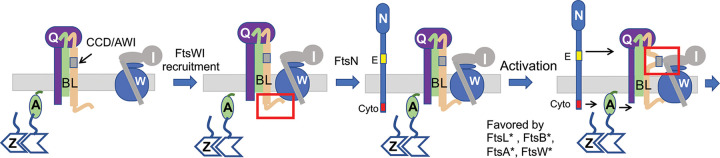
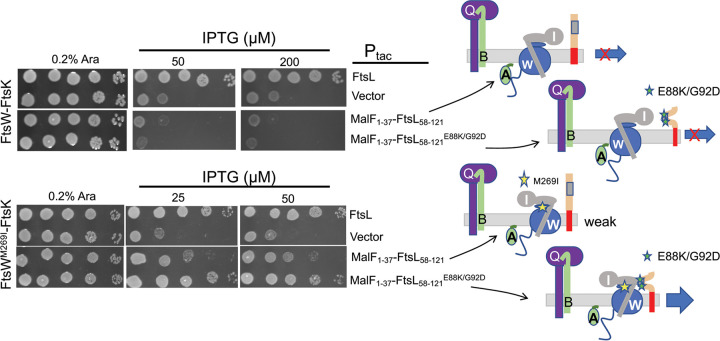
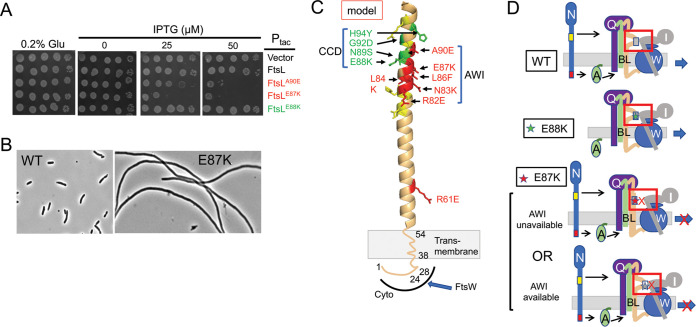
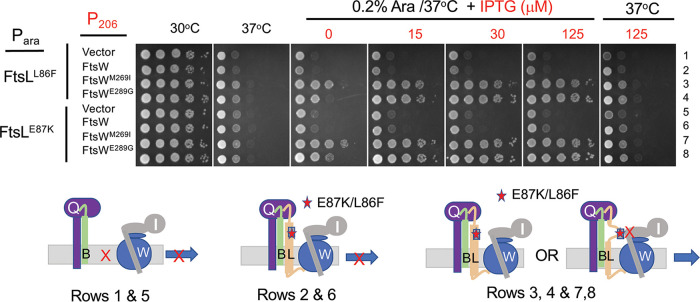
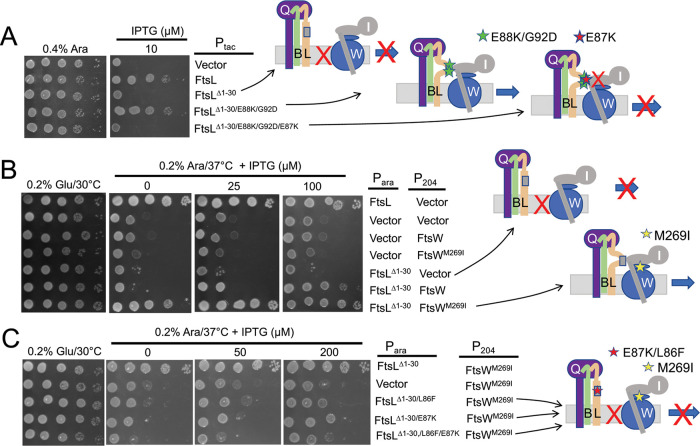
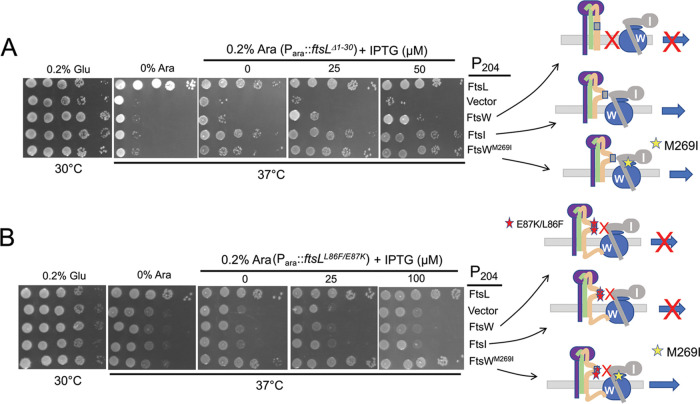
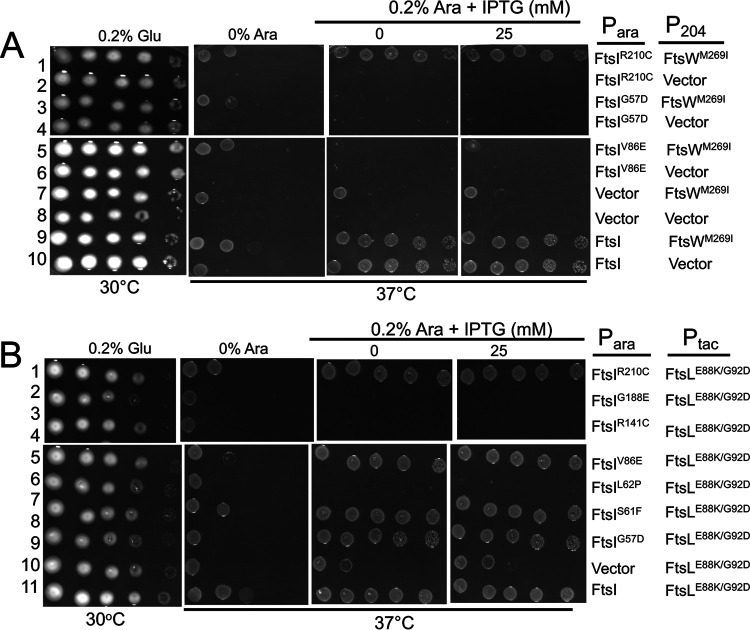
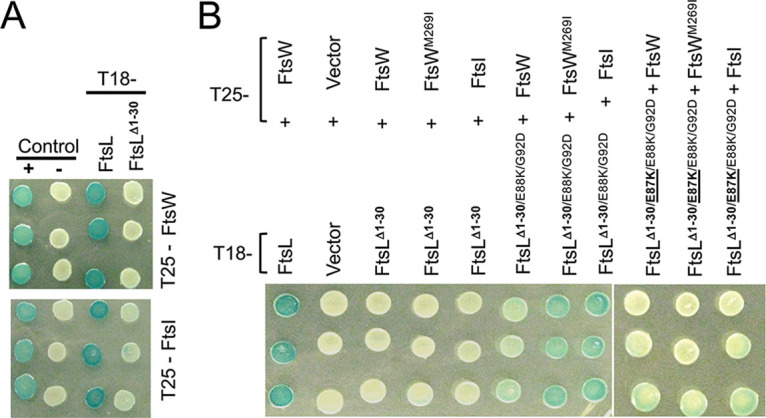
Spatiotemporal regulation of septal peptidoglycan (PG) synthesis is achieved by coupling assembly and activation of the synthetic enzymes (FtsWI) to the Z ring, a cytoskeletal element that is required for division in most bacteria. In , the recruitment of the FtsWI complex is dependent upon the cytoplasmic domain of FtsL, a component of the conserved FtsQLB complex. Once assembled, FtsWI is activated by the arrival of FtsN, which acts through FtsQLB and FtsA, which are also essential for their recruitment. However, the mechanism of activation of FtsWI by FtsN is not clear. Here, we identify a region of FtsL that plays a key role in the activation of FtsWI which we designate AWI (ctivation of Fts) and present evidence that FtsL acts through FtsI. Our results suggest that FtsN switches FtsQLB from a recruitment complex to an activator with FtsL interacting with FtsI to activate FtsW. Since FtsQLB and FtsWI are widely conserved in bacteria, this mechanism is likely to be also widely conserved. A critical step in bacterial cytokinesis is the activation of septal peptidoglycan synthesis at the Z ring. Although FtsN is the trigger and acts through FtsQLB and FtsA to activate FtsWI the mechanism is unclear. Here, we find an essential role for FtsL in activating septal peptidoglycan (PG) synthesis and find that it acts on FtsI. Our results suggest a model where FtsWI is recruited in an inactive form by FtsQLB, and upon the arrival of FtsN, FtsQLB undergoes a conformational change so that a region of FtsL, which we designate the AWI domain, becomes available to interact with FtsI and activate the FtsWI complex. This mechanism for activation of the divisome has similarities to the activation of the elongasome and is likely to be widely conserved in bacteria.
隔室肽聚糖(PG)合成的时空调节是通过将合成酶(FtsWI)与 Z 环组装和激活偶联来实现的,Z 环是大多数细菌分裂所必需的细胞骨架元件。在这项研究中,FtsWI 复合物的招募依赖于 FtsL 的细胞质结构域,FtsL 是保守的 FtsQLB 复合物的一个组成部分。一旦组装完成,FtsN 的到达就会激活 FtsWI,FtsN 通过 FtsQLB 和 FtsA 发挥作用,这两者对于它们的招募也是必不可少的。然而,FtsN 激活 FtsWI 的机制尚不清楚。在这里,我们确定了 FtsL 的一个区域在 FtsWI 的激活中起着关键作用,我们将其命名为 AWI(Fts 的激活),并提供了证据表明 FtsL 通过 FtsI 发挥作用。我们的结果表明,FtsN 将 FtsQLB 从招募复合物转换为激活剂,FtsL 与 FtsI 相互作用激活 FtsW。由于 FtsQLB 和 FtsWI 在细菌中广泛保守,这种机制也可能广泛保守。细菌胞质分裂的一个关键步骤是在 Z 环处激活隔室肽聚糖(PG)合成。尽管 FtsN 是触发因子,通过 FtsQLB 和 FtsA 作用于 FtsWI,但机制尚不清楚。在这里,我们发现 FtsL 在激活隔室 PG 合成中起着至关重要的作用,并发现它作用于 FtsI。我们的结果表明,FtsWI 以无活性形式被 FtsQLB 招募,并且在 FtsN 到达后,FtsQLB 发生构象变化,使得我们命名为 AWI 结构域的 FtsL 区域能够与 FtsI 相互作用并激活 FtsWI 复合物。这种分裂体的激活机制与伸长体的激活机制相似,并且很可能在细菌中广泛保守。