Department of Physics and Astronomy, University of Tennessee, Knoxville, Tennessee, USA.
Department of Microbiology, Molecular Genetics, and Immunology, University of Kansas Medical Centergrid.412016.0, Kansas City, Kansas, USA.
mBio. 2022 Aug 30;13(4):e0201722. doi: 10.1128/mbio.02017-22. Epub 2022 Aug 15.
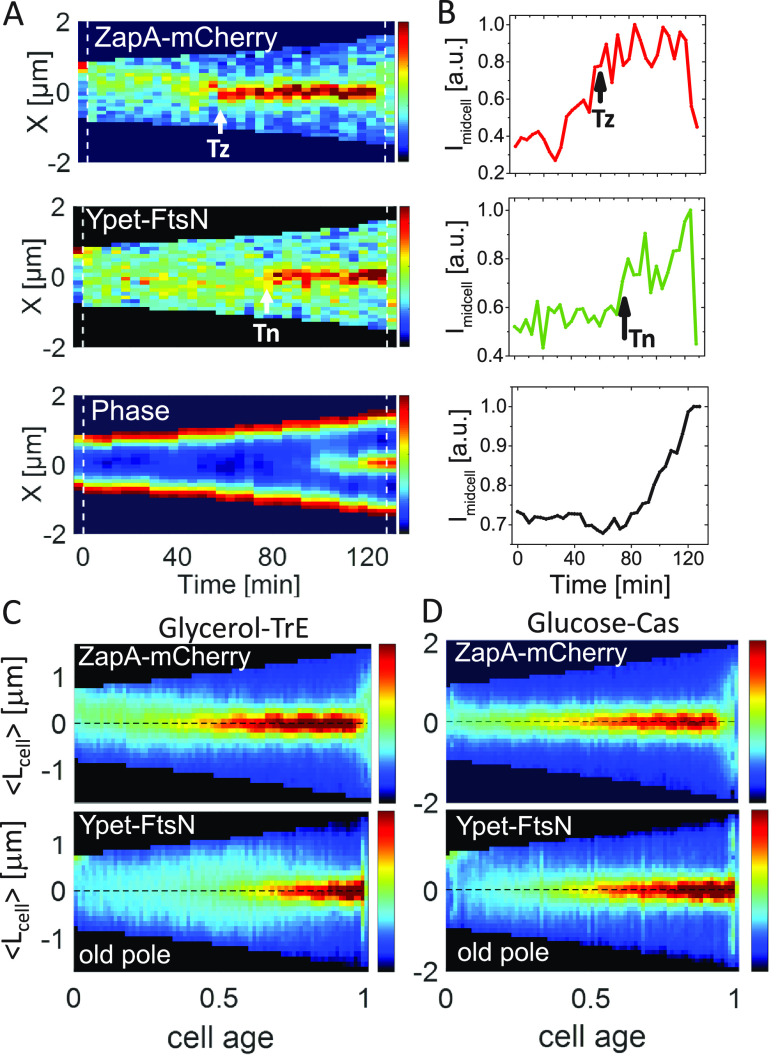
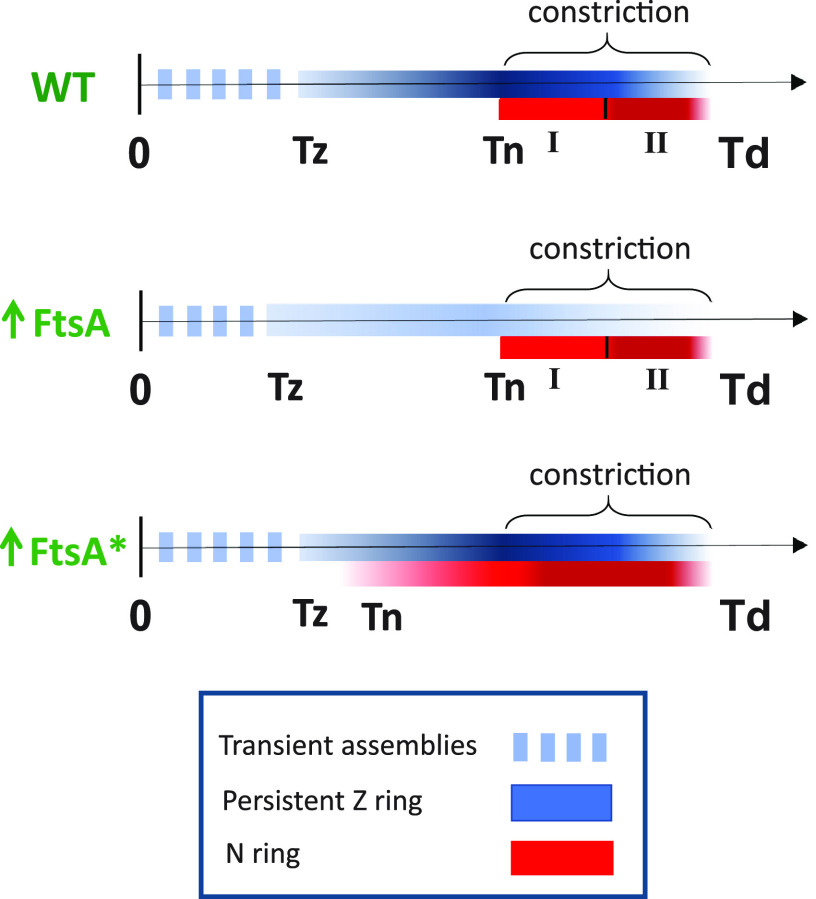
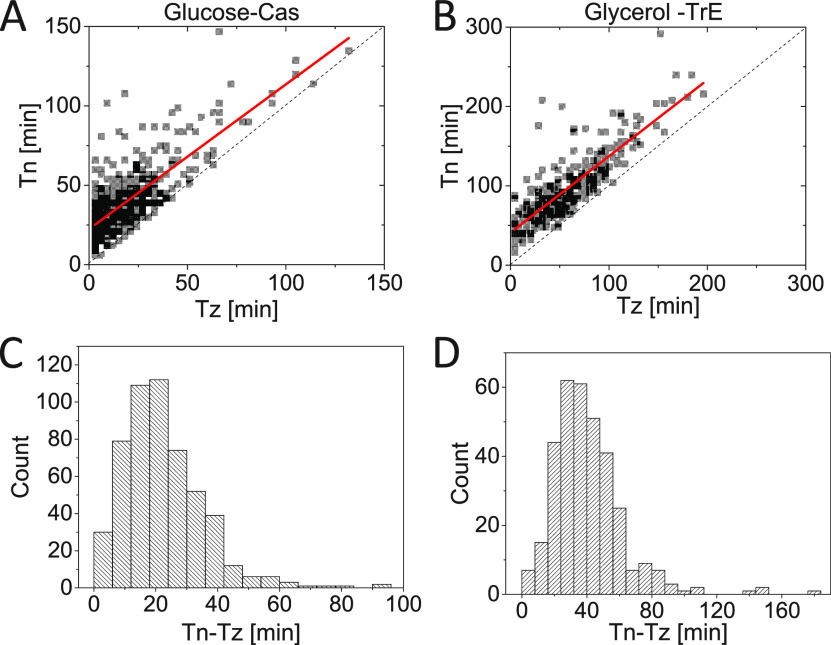
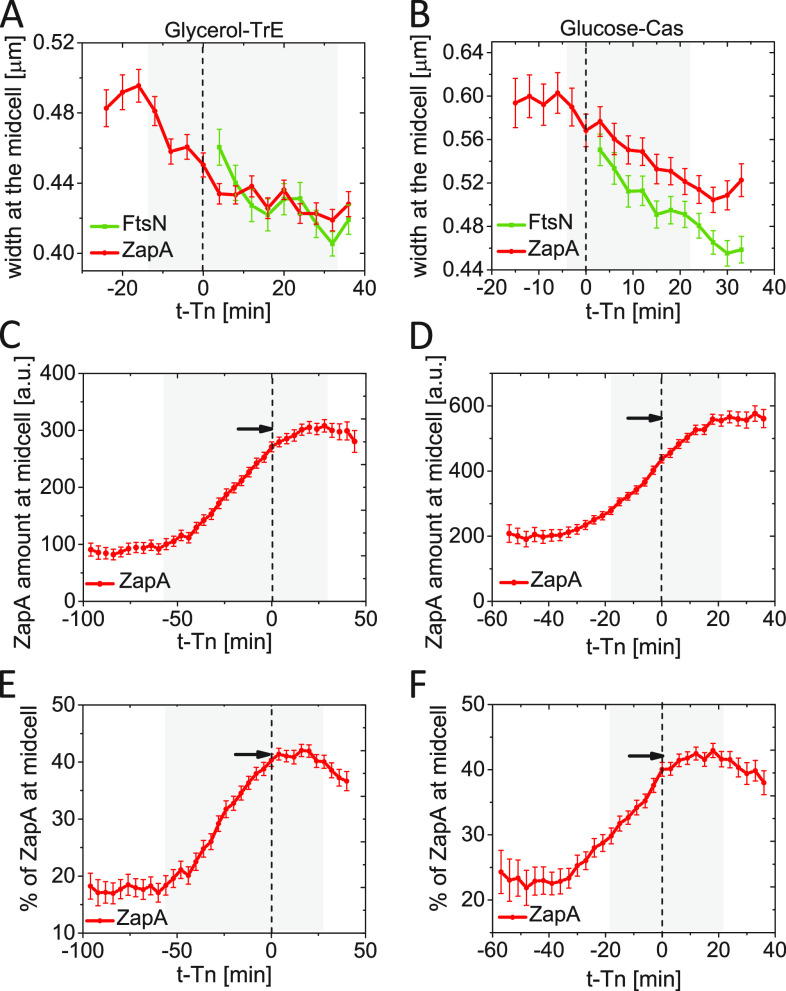
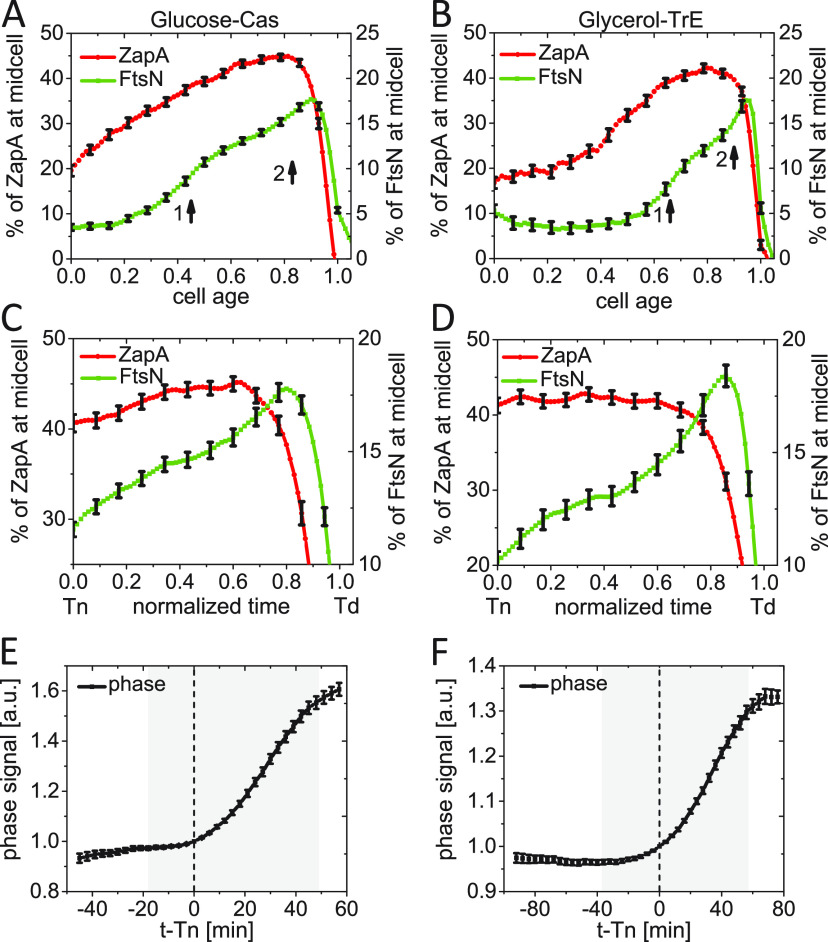
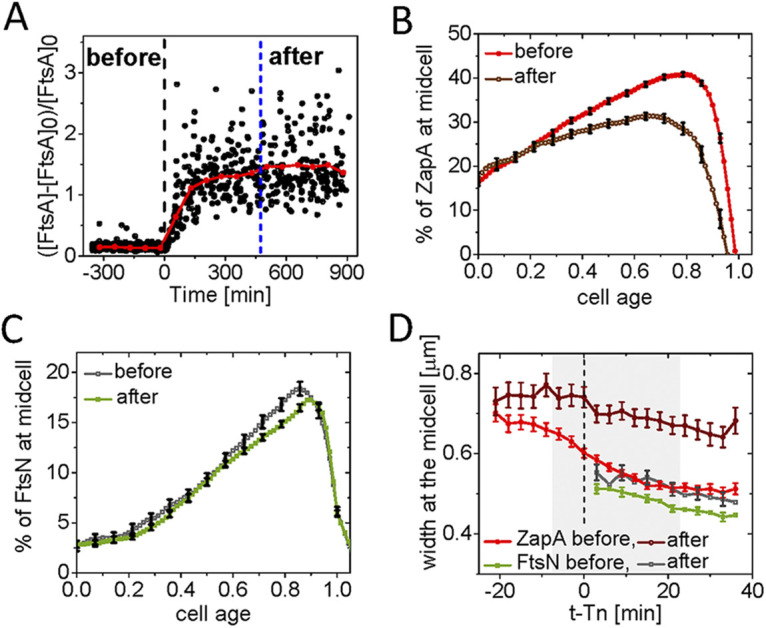
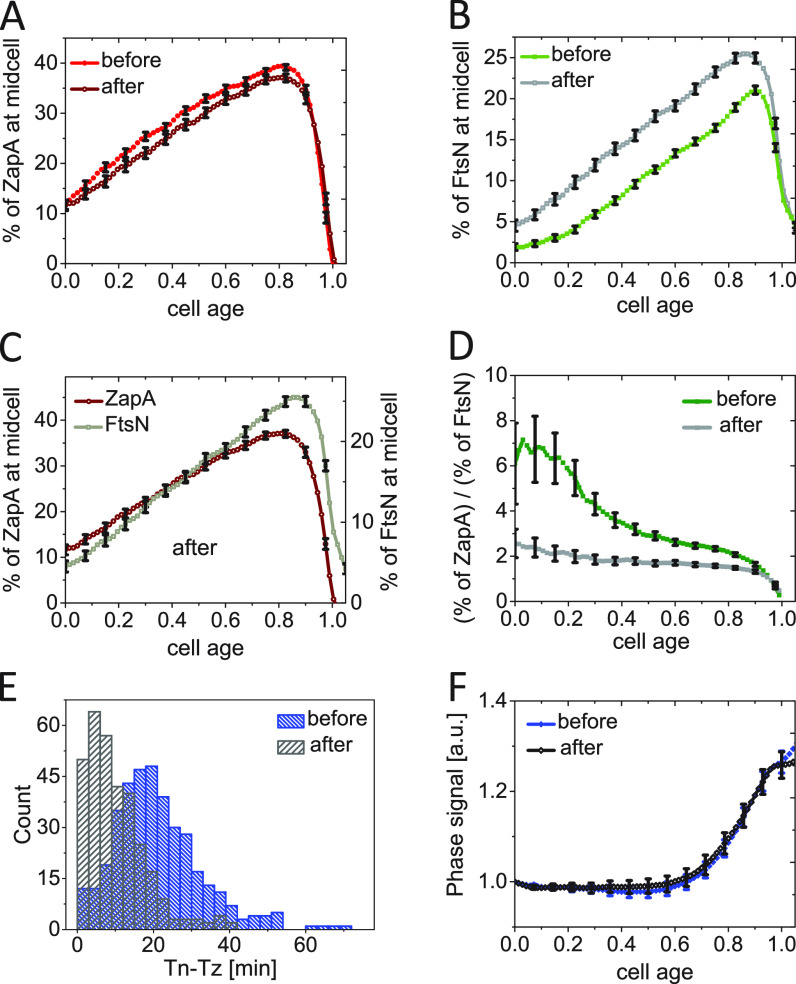
Cell division in Escherichia coli starts with the formation of an FtsZ protofilament network at midcell, the Z ring. However, only after a considerable lag period does the cell start to form a midcell constriction. The onset of constriction depends upon the arrival of so-called late divisome proteins, among which, FtsN is the last essential one. The timing and dependency of FtsN arrival to the divisome, along with genetic evidence, suggests it triggers cell division. In this study, we used high-throughput fluorescence microscopy to determine the arrival of FtsN and the early divisome protein ZapA to midcell at a single-cell level during the cell cycle. Our data show while the recruitment of ZapA/FtsZ is gradual in the cell cycle, recruitment of FtsN is rapid and begins at about the onset of constriction. At this time, the fraction of ZapA/FtsZ in the Z ring approaches its peak value. We also find a second increase in FtsN recruitment to the divisome, which begins once the amount of ZapA/FtsZ at midcell starts decreasing. Increasing hypermorphic FtsA* (FtsA R286W), but not FtsA, accelerates FtsN recruitment but not constriction. This finding is consistent with FtsA* recruiting FtsN with some other divisome component being rate-limiting for constriction under these conditions. Finally, our data support the recently proposed idea that ZapA/FtsZ and FtsN are part of physically separate complexes in midcell throughout the whole septation process. Cell division in most bacteria starts with the formation of an FtsZ protofilament network at midcell, the Z ring. However, cells only start to constrict after a considerable lag. A factor thought to trigger the onset of constriction in Escherichia coli is FtsN, which is the last essential protein to be recruited to the Z ring. Using a high-throughput quantitative fluorescence microscopy, we determine the cell cycle-dependent recruitment of FtsN to the Z ring. Our data show rapid accumulation of FtsN to the Z ring about a quarter of the cell cycle after the formation of the Z ring. This initial wave is followed by another increase in FtsN recruitment once the FtsZ protofilament network starts to disassemble. The presence of FtsA* accelerates FtsN recruitment to the Z ring but does not lead to earlier constrictions. Our data furthermore suggest FtsZ and FtsN are part of physically separate complexes throughout the division process.
大肠杆菌的细胞分裂始于在细胞中部形成 FtsZ 原丝网络,即 Z 环。然而,细胞要经过相当长的滞后时间才开始在细胞中部形成收缩。收缩的开始取决于所谓的晚期分裂体蛋白的到达,其中 FtsN 是最后一个必需的蛋白。FtsN 到达分裂体的时间和依赖性以及遗传证据表明,它触发了细胞分裂。在这项研究中,我们使用高通量荧光显微镜在单细胞水平上确定了 FtsN 和早期分裂体蛋白 ZapA 在细胞周期中的到达细胞中部的时间。我们的数据表明,虽然 ZapA/FtsZ 的募集在细胞周期中是逐渐进行的,但 FtsN 的募集是快速的,并且在收缩开始时就开始了。此时,Z 环中 ZapA/FtsZ 的分数接近其峰值。我们还发现,当 ZapA/FtsZ 在细胞中部的量开始减少时,FtsN 向分裂体的募集会出现第二次增加。增加超突变的 FtsA*(FtsA R286W),而不是 FtsA,会加速 FtsN 的募集,但不会加速收缩。这一发现与 FtsA与其他一些分裂体成分一起招募 FtsN 的观点一致,在这些条件下,对于收缩来说,可能是某种其他分裂体成分的募集是限速的。最后,我们的数据支持了最近提出的观点,即 ZapA/FtsZ 和 FtsN 在整个分隔过程中都是在细胞中部物理上分离的复合物的一部分。大多数细菌的细胞分裂始于在细胞中部形成 FtsZ 原丝网络,即 Z 环。然而,细胞只有在经过相当长的滞后时间后才开始收缩。在大肠杆菌中,一种被认为能触发收缩开始的因子是 FtsN,它是最后一个被招募到 Z 环的必需蛋白。我们使用高通量定量荧光显微镜,确定了 FtsN 在细胞周期中向 Z 环的募集情况。我们的数据表明,在 Z 环形成后大约四分之一的细胞周期内,FtsN 迅速积累到 Z 环上。这一初始波之后,一旦 FtsZ 原丝网络开始解体,FtsN 的募集就会再次增加。FtsA的存在加速了 FtsN 向 Z 环的募集,但并没有导致更早的收缩。我们的数据进一步表明,FtsZ 和 FtsN 在整个分裂过程中是物理上分离的复合物的一部分。