Ma Zhong-Hua, Shuai You, Gao Xiang-Yu, Yan Yan, Wang Ke-Ming, Wen Xian-Zi, Ji Jia-Fu
Key Laboratory of Carcinogenesis and Translational Research (Ministry of Education), Division of Gastrointestinal Cancer Translational Research Laboratory, Peking University Cancer Hospital and Institute, Beijing, China.
Department of Medical Oncology, Jiangsu Cancer Hospital, Jiangsu Institute of Cancer Research, The Affiliated Cancer Hospital of Nanjing Medical University, Nanjing, Jiangsu, China.
Mol Ther Nucleic Acids. 2020 Oct 22;22:1129-1141. doi: 10.1016/j.omtn.2020.10.022. eCollection 2020 Dec 4.
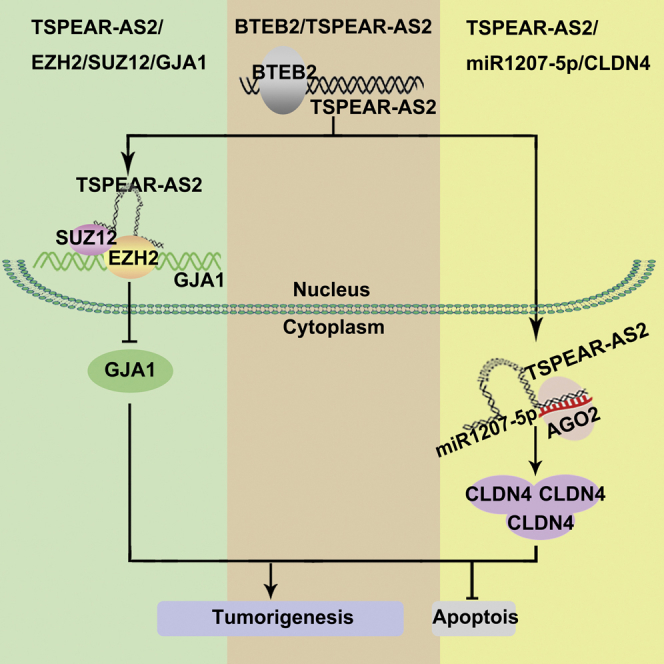
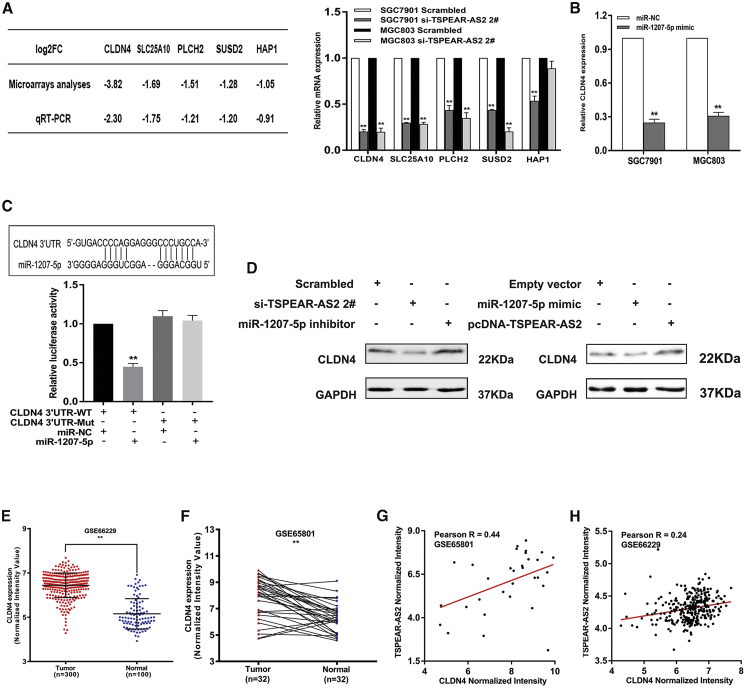
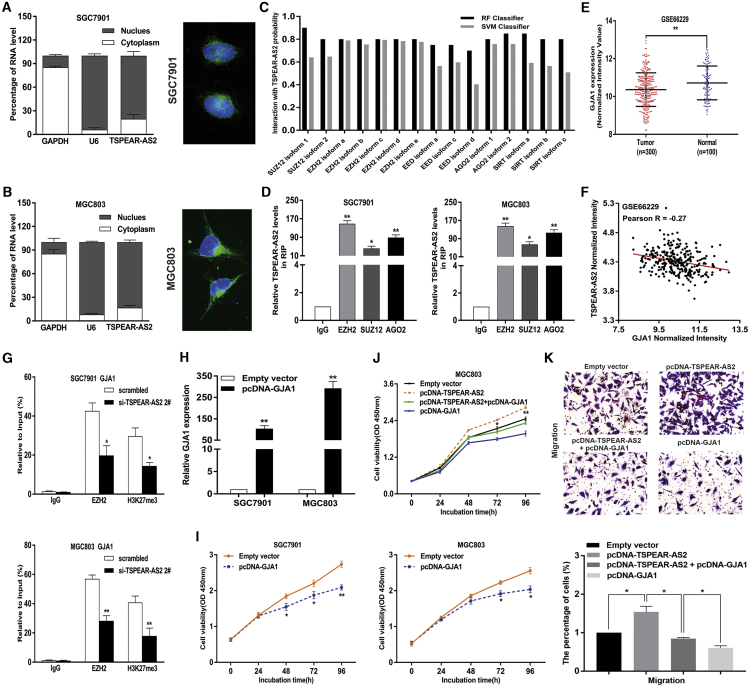
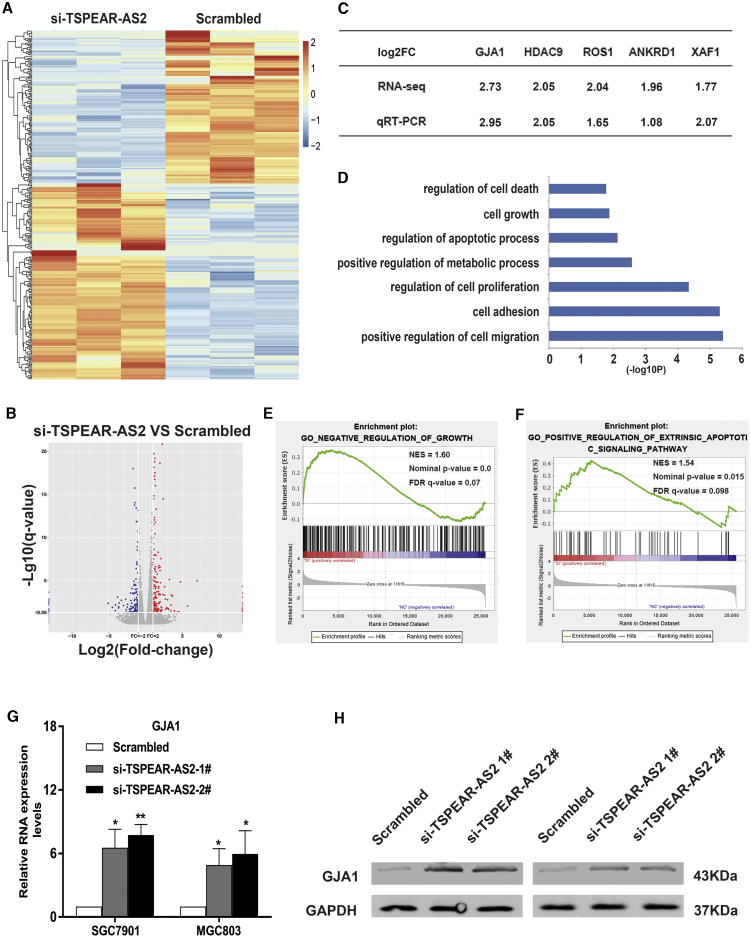
Long non-coding RNAs (lncRNAs) are characterized as key layers of the genome in various cancers. TSPEAR-AS2 was highlighted to be a candidate lncRNA potentially involved in gastric cancer (GC) progression. However, the clinical significance and mechanism of TSPEAR-AS2 in GC required clarification. The clinical significance of TSPEAR-AS2 was elucidated through Kaplan-Meier Plotter. The mechanism of TSPEAR-AS2 in GC was clarified and using luciferase reporter, chromatin immunoprecipitation, RNA immunoprecipitation assays, and animal models. TSPEAR-AS2 elevation was closely correlated with overall survival of GC patients. A basic transcription element-binding protein 2 (BTEB2)-activated TSPEAR-AS2 model was first explored in this study. TSPEAR-AS2 silencing substantially reduced tumorigenic capacities of GC cells, while TSPEAR-AS2 elevation had the opposite effect. Mechanistically, TSPEAR-AS2 bound with both polycomb repressive complex 2 (PRC2) and argonaute 2 (Ago2). TSPEAR-AS2 knockdown significantly decreased H3K27me3 levels at promoter regions of gap junction protein alpha 1 (GJA1). Ago2 was recruited by TSPEAR-AS2, which was defined to sponge miR-1207-5p, contributing to the repression of claudin 4 (CLDN4) translation. The axis of EZH2/GJA1 and miR-1207-5p/CLDN4 mediated by BTEB2-activated-TSPEAR-AS2 plays an important role in GC progression, suggesting a new therapeutic direction in GC treatment.
长链非编码RNA(lncRNAs)被认为是多种癌症基因组的关键组成部分。TSPEAR-AS2被认为是一种潜在参与胃癌(GC)进展的候选lncRNA。然而,TSPEAR-AS2在GC中的临床意义和机制尚需阐明。通过Kaplan-Meier Plotter分析阐明了TSPEAR-AS2的临床意义。利用荧光素酶报告基因、染色质免疫沉淀、RNA免疫沉淀实验和动物模型阐明了TSPEAR-AS2在GC中的作用机制。TSPEAR-AS2水平升高与GC患者的总生存期密切相关。本研究首次探索了一种由碱性转录元件结合蛋白2(BTEB2)激活的TSPEAR-AS2模型。TSPEAR-AS2沉默显著降低了GC细胞的致瘤能力,而TSPEAR-AS2水平升高则产生相反的效果。机制上,TSPEAR-AS2与多梳抑制复合物2(PRC2)和AGO2蛋白均结合。TSPEAR-AS2敲低显著降低了缝隙连接蛋白α1(GJA1)启动子区域的H3K27me3水平。TSPEAR-AS2招募AGO2,后者被定义为miR-1207-5p的海绵,从而抑制紧密连接蛋白4(CLDN4)的翻译。由BTEB2激活的TSPEAR-AS2介导的EZH2/GJA1和miR-1207-5p/CLDN4轴在GC进展中起重要作用,为GC治疗提供了新的治疗方向。