Bohns Fábio Rocha, Leitune Vicente Castelo Branco, Garcia Isadora Martini, Genari Bruna, Dornelles Nélio Bairros, Guterres Silvia Stanisçuaski, Ogliari Fabrício Aulo, de Melo Mary Anne Sampaio, Collares Fabrício Mezzomo
Department of Dental Materials, School of Dentistry, Federal University of Rio Grande do Sul, Porto Alegre, RS, Brazil.
Department of Orthodontics and Biomaterials, Centro Universitário UDF, Brasília, DF, Brazil.
Restor Dent Endod. 2020 Oct 7;45(4):e50. doi: 10.5395/rde.2020.45.e50. eCollection 2020 Nov.
In this study, we investigated the potential of amoxicillin-loaded polymeric microspheres to be delivered to tooth root infection sites via a bioactive reparative cement.
Amoxicillin-loaded microspheres were synthesized by a spray-dray method and incorporated at 2.5% and 5% into a mineral trioxide aggregate cement clinically used to induce a mineralized barrier at the root tip of young permanent teeth with incomplete root development and necrotic pulp. The formulations were modified in liquid:powder ratios and in composition by the microspheres. The optimized formulations were evaluated for physical and mechanical eligibility. The morphology of microspheres was observed under scanning electron microscopy.
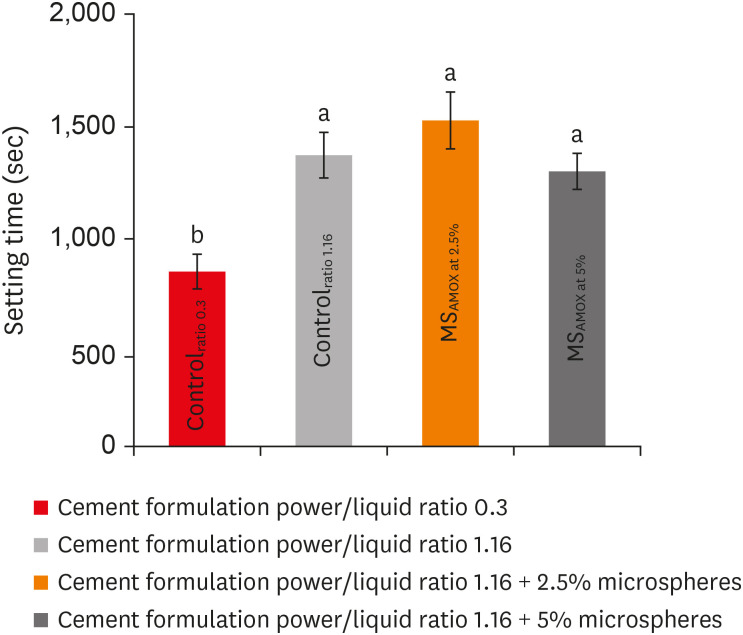
The optimized cement formulation containing microspheres at 5% exhibited a delayed-release response and maintained its fundamental functional properties. When mixed with amoxicillin-loaded microspheres, the setting times of both test materials significantly increased. The diametral tensile strength of cement containing microspheres at 5% was similar to control. However, phytic acid had no effect on this outcome ( > 0.05). When mixed with modified liquid:powder ratio, the setting time was significantly longer than that original liquid:powder ratio ( < 0.05).
Lack of optimal concentrations of antibiotics at anatomical sites of the dental tissues is a hallmark of recurrent endodontic infections. Therefore, targeting the controlled release of broad-spectrum antibiotics may improve the therapeutic outcomes of current treatments. Overall, these results indicate that the carry of amoxicillin by microspheres could provide an alternative strategy for the local delivery of antibiotics for the management of tooth infections.
在本研究中,我们调查了载有阿莫西林的聚合物微球通过生物活性修复性粘固剂递送至牙根感染部位的潜力。
通过喷雾干燥法合成载有阿莫西林的微球,并以2.5%和5%的比例掺入一种临床上用于在牙根发育不全和牙髓坏死的年轻恒牙根尖诱导矿化屏障的三氧化矿物凝聚体粘固剂中。通过改变液粉比和微球组成对配方进行了改良。对优化后的配方进行了物理和机械性能评估。在扫描电子显微镜下观察微球的形态。
含5%微球的优化粘固剂配方表现出缓释反应并保持其基本功能特性。当与载有阿莫西林的微球混合时,两种测试材料的凝固时间均显著延长。含5%微球的粘固剂的径向拉伸强度与对照组相似。然而,植酸对此结果无影响(P>0.05)。当与改良的液粉比混合时,凝固时间显著长于原始液粉比(P<0.05)。
在牙齿组织的解剖部位缺乏最佳浓度的抗生素是复发性牙髓感染的一个标志。因此,靶向控制释放广谱抗生素可能会改善当前治疗的疗效。总体而言,这些结果表明微球携带阿莫西林可为局部递送抗生素治疗牙齿感染提供一种替代策略。