Bracis Chloe, Burns Eileen, Moore Mia, Swan David, Reeves Daniel B, Schiffer Joshua T, Dimitrov Dobromir
Université Grenoble Alpes, TIMC-IMAG/BCM, 38000, Grenoble, France.
Independent Researcher, Seattle, WA, USA.
Infect Dis Model. 2020 Nov 13;6:24-35. doi: 10.1016/j.idm.2020.11.003. eCollection 2021.
In late March 2020, a "Stay Home, Stay Healthy" order was issued in Washington State in response to the COVID-19 pandemic. On May 1, a 4-phase reopening plan began. We investigated whether adjunctive prevention strategies would allow less restrictive physical distancing to avoid second epidemic waves and secure safe school reopening.
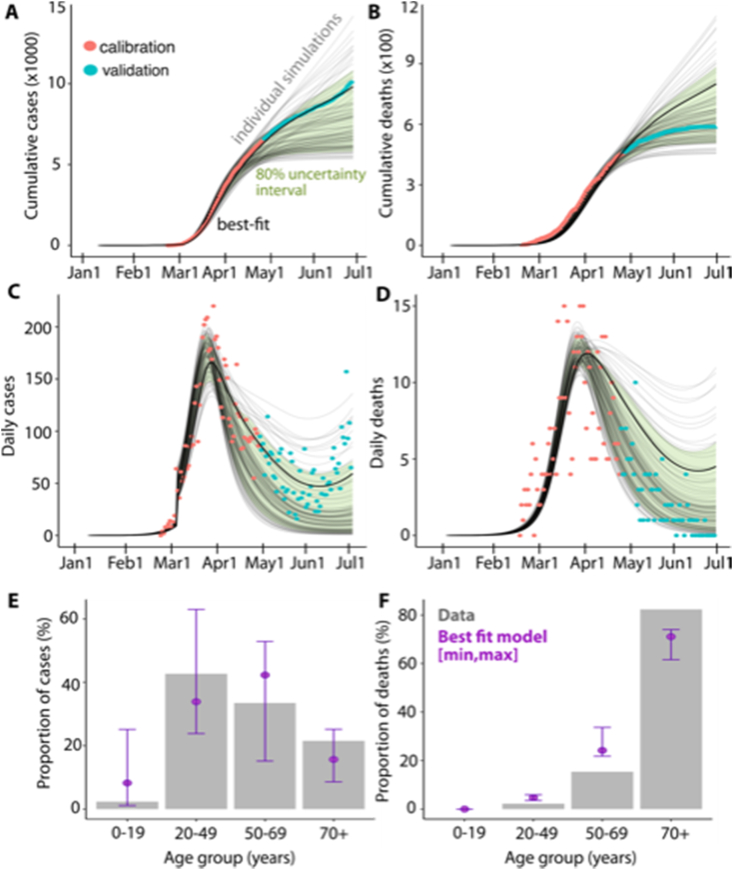
We developed a mathematical model, stratifying the population by age, infection status and treatment status to project SARS-CoV-2 transmission during and after the reopening period. The model was parameterized with demographic and contact data from King County, WA and calibrated to confirmed cases, deaths and epidemic peak timing. Adjunctive prevention interventions were simulated assuming different levels of pre-COVID physical interactions (pC_PI) restored.
The best model fit estimated ~35% pC_PI under the lockdown which prevented ~17,000 deaths by May 15. Gradually restoring 75% pC_PI for all age groups between May 15-July 15 would have resulted in ~350 daily deaths by early September 2020. Maintaining <45% pC_PI was required with current testing practices to ensure low levels of daily infections and deaths. Increased testing, isolation of symptomatic infections, and contact tracing permitted 60% pC_PI without significant increases in daily deaths before November and allowed opening of schools with <15 daily deaths. Inpatient antiviral treatment was predicted to reduce deaths significantly without lowering cases or hospitalizations.
We predict that widespread testing, contact tracing and case isolation would allow relaxation of physical distancing, as well as opening of schools, without a surge in local cases and deaths.
2020年3月下旬,华盛顿州发布了“居家,保持健康”的命令,以应对新冠疫情。5月1日,一项分4阶段的重新开放计划开始实施。我们调查了辅助预防策略是否能允许采取限制较少的物理距离措施,以避免第二波疫情,并确保学校安全重新开学。
我们开发了一个数学模型,按年龄、感染状态和治疗状态对人群进行分层,以预测重新开放期间及之后的新冠病毒传播情况。该模型用华盛顿州金县的人口统计学和接触数据进行参数化,并根据确诊病例、死亡人数和疫情高峰时间进行校准。假设恢复不同水平的新冠疫情前身体互动(pC_PI),对辅助预防干预措施进行了模拟。
最佳模型拟合估计,在封锁期间pC_PI约为35%,到5月15日时可避免约17000人死亡。5月15日至7月15日期间,若所有年龄组逐步恢复75%的pC_PI,到2020年9月初每日死亡人数将约为350人。按照当前的检测做法,需要将pC_PI维持在<45%,以确保每日感染和死亡人数处于低水平。增加检测、隔离有症状感染者以及接触者追踪,可允许60%的pC_PI,且在11月之前每日死亡人数不会显著增加,并允许学校开学时每日死亡人数<15人。预计住院抗病毒治疗可显著减少死亡人数,而不会降低病例数或住院人数。
我们预测,广泛的检测、接触者追踪和病例隔离将允许放松物理距离措施以及学校开学,而不会导致当地病例和死亡人数激增。