School of Biomedical Sciences, The University of Western Australia, Crawley, Western Australia, Australia.
CRC for Honey Bee Products, The University of Western Australia, Crawley, WA, Australia.
PLoS One. 2020 Dec 9;15(12):e0243246. doi: 10.1371/journal.pone.0243246. eCollection 2020.
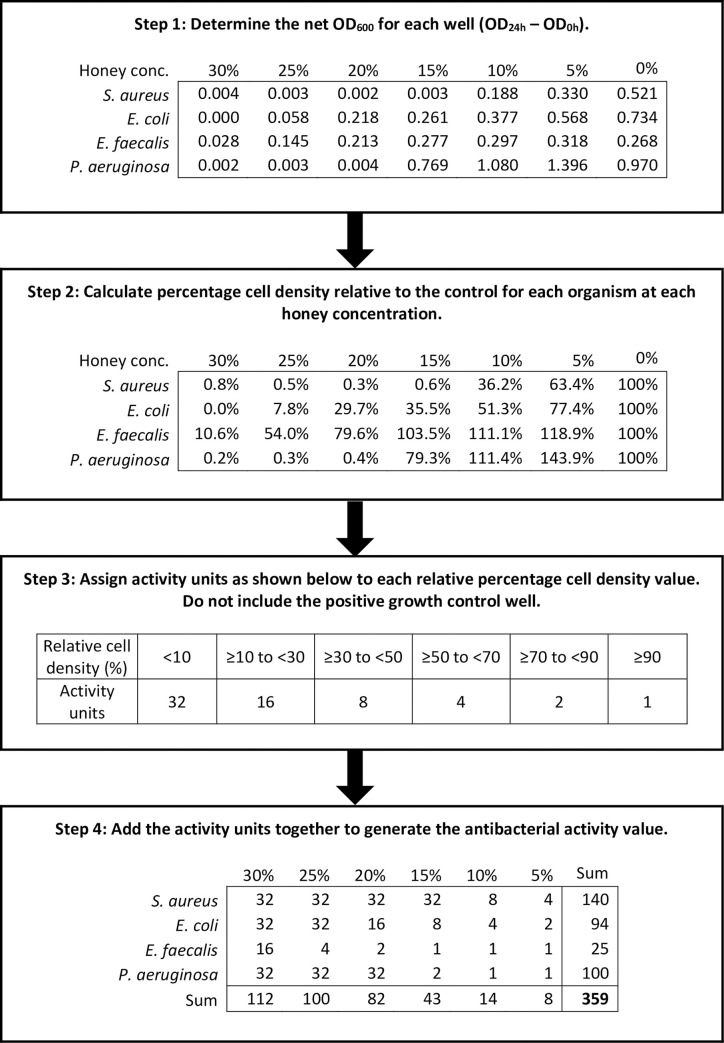
The phenol equivalence assay is the current industry-adopted test used to quantify the antibacterial activity of honeys in Australia and New Zealand. Activity is measured based on the diffusion of honey through agar and resulting zone of growth inhibition. Due to differences in the aqueous solubilities of antibacterial compounds found in honeys, this method may not be optimal for quantifying activity. Therefore, a new method was developed based on the existing broth microdilution assay that is widely used for determining minimum inhibitory concentrations (MICs). It utilises the four organisms Staphylococcus aureus ATCC 29213, Enterococcus faecalis ATCC 29212, Escherichia coli ATCC 25922 and Pseudomonas aeruginosa ATCC 27853, and an optical density endpoint to quantify bacterial growth. Decreases in bacterial growth in the presence of honey, relative to the positive growth control, are then used to derive a single value to represent the overall antibacterial activity of each honey. Antibacterial activity was quantified for a total of 77 honeys using the new method, the phenol equivalence assay and the standard broth microdilution assay. This included 69 honeys with undisclosed floral sources and the comparators Manuka, Jarrah (Eucalyptus marginata), Marri (Corymbia calophylla), artificial and multifloral honey. For the 69 honey samples, phenol equivalence values ranged from 0-48.5 with a mean of 34 (% w/v phenol). Mean MICs, determined as the average of the MICs obtained for each of the four organisms for each honey ranged from 7-24% (w/v honey). Using the new assay, values for the 69 honeys ranged from 368 to 669 activity units, with a mean of 596. These new antibacterial activity values correlated closely with mean MICs (R2 = 0.949) whereas the relationship with phenol equivalence values was weaker (R2 = 0.649). Limit of detection, limit of quantitation, measuring interval, limit of reporting, sensitivity, selectivity, repeatability, reproducibility, and ruggedness were also investigated and showed that the new assay was both robust and reproducible.
苯酚等效物测定法是目前澳大利亚和新西兰采用的行业标准测试,用于量化蜂蜜的抗菌活性。活性是根据蜂蜜通过琼脂扩散和产生的抑菌区来测量的。由于蜂蜜中抗菌化合物的水溶性不同,该方法可能不是量化活性的最佳方法。因此,根据广泛用于确定最小抑菌浓度(MIC)的现有肉汤微量稀释测定法,开发了一种新方法。它利用金黄色葡萄球菌 ATCC 29213、粪肠球菌 ATCC 29212、大肠杆菌 ATCC 25922 和铜绿假单胞菌 ATCC 27853 这四种生物体以及光密度终点来量化细菌生长。与阳性生长对照相比,蜂蜜存在时细菌生长的减少用于得出一个单一值,代表每种蜂蜜的整体抗菌活性。使用新方法、苯酚等效物测定法和标准肉汤微量稀释测定法对总共 77 种蜂蜜进行了抗菌活性定量测定,其中包括 69 种来源不明的蜂蜜以及对照物麦卢卡、桉树(Eucalyptus marginata)、马利(Corymbia calophylla)、人工和百花蜂蜜。对于 69 个蜂蜜样本,苯酚等效值范围为 0-48.5,平均值为 34(% w/v 苯酚)。平均 MIC 值,即每个蜂蜜的四个生物体的 MIC 值的平均值,范围为 7-24%(w/v 蜂蜜)。使用新测定法,69 个蜂蜜样本的活性单位值范围为 368 至 669,平均值为 596。这些新的抗菌活性值与平均 MIC 值密切相关(R2 = 0.949),而与苯酚等效值的关系较弱(R2 = 0.649)。检测了检测限、定量限、测量区间、报告限、灵敏度、选择性、重复性、重现性和稳健性,结果表明新测定法既稳健又可重现。