Haq Shiekh Marifatul, Calixto Eduardo Soares, Yaqoob Umer, Ahmed Riyaz, Mahmoud Ahmed Hossam, Bussmann Rainer W, Mohammed Osama B, Ahmad Khalid, Abbasi Arshad Mehmood
Department of Botany, University of Kashmir Srinagar, Jammu and Kashmir 190006, India.
Wildlife Crime Control Division, Wildlife Trust of India, Noida 201301, India.
Animals (Basel). 2020 Dec 7;10(12):2317. doi: 10.3390/ani10122317.
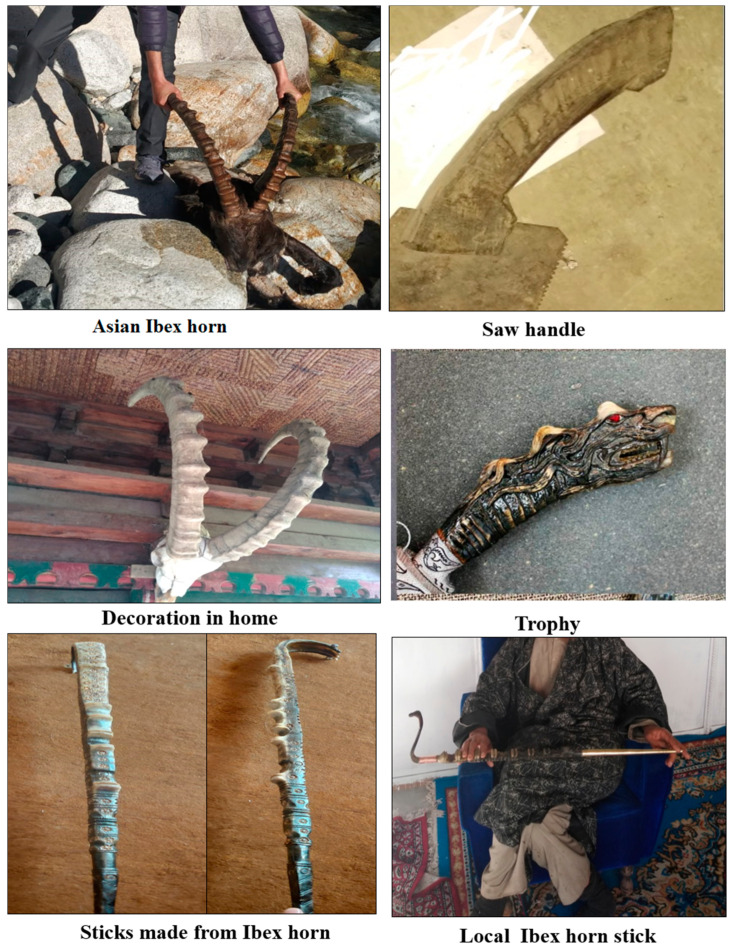
Zootherapy is accepted all around the globe not only in ancient cultures but different animal derived medicines are also part of the practice in the modern health care systems. The present study assessed the traditional ethnozoological usage of wild animals by local inhabitants in Ladakh region, India, and the reference data for scientific approaches for protection of faunal diversity in trans-Himalayas. The ethnozoological documentation of the animals in Ladakh was carried out through semistructured and close-ended questionnaire surveys and interviews. Multivariate ecological community analysis was used to elucidate the relationship between ethnozoological usage and animal species. Our results showed three animal usage clusters with 32% similarity. Moreover, the similarity in animal usage between digging tools, trophy, handle of tools, decoration, and matting, showed less than 32% of similarity. The highest priority of local people was for food followed by decoration and medicinal usage. The most frequently used animal parts were meat followed by fur and horn. Medicinal uses of 48% of the reported species, i.e., (chukar), (Asiatic wild dog), (hares), (marmots), (Ladakh urial), (Tibetan antelope), (Tibetan gazelle), (blue sheep), (Himalayan snow), (Tibetan snow cock), and (common otter) were reported for the first time from this region. Our study provides innovative information regarding the ethnozoological knowledge in the Ladakh region and reference data for policymakers, researchers, land managers, common public, and the other stakeholders to develop logical and scientific approaches for sustainable use of faunal diversity in hotspot regions like trans-Himalayas and other similar biodiversity-rich sites.
动物疗法在全球范围内都被接受,不仅在古代文化中如此,在现代医疗体系中,不同的动物源性药物也是该疗法的一部分。本研究评估了印度拉达克地区当地居民对野生动物的传统民族动物学用途,以及跨喜马拉雅地区保护动物多样性的科学方法的参考数据。通过半结构化和封闭式问卷调查及访谈,对拉达克地区的动物进行了民族动物学记录。采用多变量生态群落分析来阐明民族动物学用途与动物物种之间的关系。我们的结果显示了三个动物用途集群,相似度为32%。此外,挖掘工具、战利品、工具手柄、装饰品和垫子在动物用途上的相似度低于32%。当地人的最高优先级是食物,其次是装饰和药用。最常用的动物部位是肉,其次是皮毛和角。本地区首次报告了48%的被报道物种的药用用途,即石鸡、亚洲野狗、野兔、旱獭、拉达克盘羊、藏羚羊、藏原羚、岩羊、喜马拉雅旱獭、藏雪鸡和普通水獭。我们的研究提供了有关拉达克地区民族动物学知识的创新信息,以及为政策制定者、研究人员、土地管理者、普通公众和其他利益相关者提供参考数据,以便为跨喜马拉雅等热点地区以及其他类似生物多样性丰富的地区制定合理且科学的动物多样性可持续利用方法。