Rush University Medical Center, 1645 West Jackson Blvd, Chicago, IL, 60612, USA.
VA Greater Los Angeles Healthcare System, 11301 Wilshire Blvd, Los Angeles, CA, 90073, USA.
BMC Psychol. 2020 Dec 9;8(1):130. doi: 10.1186/s40359-020-00503-4.
Prenatal posttraumatic stress disorder (PTSD) is a significant complication of pregnancy linked to increased risk of adverse perinatal outcomes. Although 1 in 5 pregnant trauma-exposed individuals have PTSD, most PTSD treatment trials exclude participants who are pregnant, and none focus on treatment specifically during pregnancy. Moreover, access to mental health treatment is particularly challenging in low-resource settings with high rates of trauma. This study examined implementation of Narrative Exposure Therapy (NET), a short-term evidence-based PTSD treatment, in an urban prenatal care setting. Partial telehealth delivery was used to increase accessibility. Study aims were to examine (a) feasibility, (b) acceptability, and (c) case-based treatment outcomes associated with NET participation.
Eight pregnant participants (median age = 27, median gestational week in pregnancy = 22.5) received up to six sessions of NET with partial telehealth delivery. PTSD and depression symptoms were assessed at pre-treatment intake (T1), at each session (T2), and 1-week post-treatment (T3). A multiple case study approach was used to examine recruitment and engagement, retention, treatment completion, treatment barriers, use of telehealth, participants' experiences of treatment, and PTSD and depression symptoms.
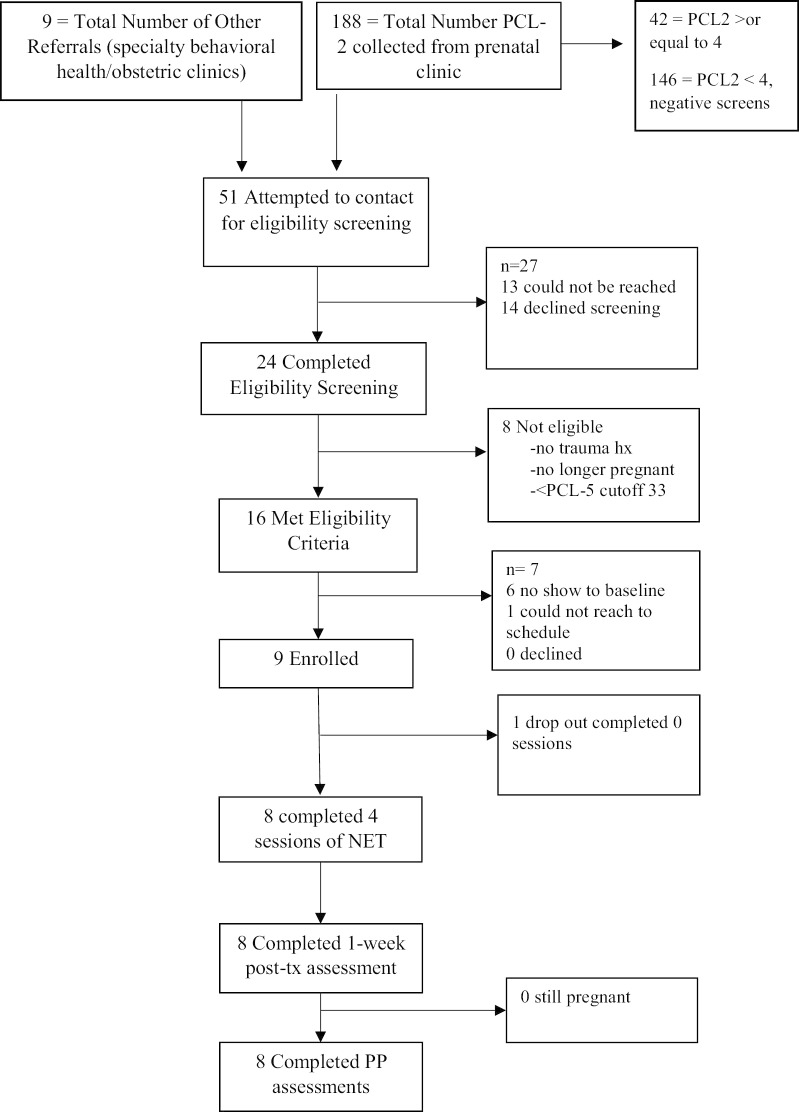
Nine of the 16 participants (56%) who were invited to participate engaged in treatment, and one dropped out after the first session. Eight participants completed the minimum "dose" of 4 NET sessions (N = 8/9, 89%). Seven participants gave the highest ratings of treatment acceptability. The most frequently reported barriers to treatment were competing priorities of work and caring for other children. Pre-post treatment symptom measures revealed clinically meaningful change in PTSD severity for nearly all participants (7/8, 88%).
Results suggest that a brief exposure therapy PTSD treatment can be successfully implemented during pregnancy, suggesting promising results for conducting a larger-scale investigation. Trial registration ClinicalTrials.gov, NCT04525469. Registered 20 August 2020-Retrospectively registered, https://register.clinicaltrials.gov/prs/app/template/EditRecord.vm?epmode=View&listmode=Edit&uid=U00058T2&ts=3&sid=S000A59A&cx=-w1vnvn.
产前创伤后应激障碍(PTSD)是妊娠的一个严重并发症,与不良围产期结局的风险增加有关。尽管有五分之一的怀孕创伤暴露个体患有 PTSD,但大多数 PTSD 治疗试验都排除了怀孕参与者,并且没有一项专门针对怀孕期间的治疗。此外,在创伤发生率高的资源匮乏环境中,获得心理健康治疗尤其具有挑战性。本研究检查了短期循证 PTSD 治疗叙事暴露疗法(NET)在城市产前保健环境中的实施情况。部分远程医疗交付用于提高可及性。研究目的是检查(a)可行性、(b)可接受性和(c)与 NET 参与相关的基于案例的治疗结果。
8 名孕妇(中位年龄 27 岁,中位妊娠周数 22.5 周)接受了最多 6 次 NET 治疗,部分采用远程医疗。在治疗前摄入(T1)、每次治疗(T2)和治疗后 1 周(T3)时评估 PTSD 和抑郁症状。采用多案例研究方法检查招募和参与、保留、治疗完成、治疗障碍、远程医疗的使用、参与者的治疗体验以及 PTSD 和抑郁症状。
邀请参加的 16 名参与者中有 9 名(56%)参与了治疗,1 名在第一次治疗后退出。8 名参与者完成了 4 次 NET 治疗的最低“剂量”(N=8/9,89%)。7 名参与者对治疗的可接受性给予了最高评价。治疗最常报告的障碍是工作和照顾其他孩子的优先事项。治疗前后症状测量显示,近所有参与者(7/8,88%)的 PTSD 严重程度均有临床意义的改善。
结果表明,简短的暴露疗法 PTSD 治疗可以在怀孕期间成功实施,这为开展更大规模的研究提供了有希望的结果。试验注册ClinicalTrials.gov,NCT04525469。2020 年 8 月 20 日注册-回顾性注册,https://register.clinicaltrials.gov/prs/app/template/EditRecord.vm?epmode=View&listmode=Edit&uid=U00058T2&ts=3&sid=S000A59A&cx=-w1vnvn。