Counoupas Claudio, Ferrell Kia C, Ashhurst Anneliese, Bhattacharyya Nayan D, Nagalingam Gayathri, Stewart Erica L, Feng Carl G, Petrovsky Nikolai, Britton Warwick J, Triccas James A
Discipline of Infectious Diseases and Immunology, School of Medical Sciences, Faculty of Medicine and Health, The University of Sydney, Camperdown, NSW, Australia.
Tuberculosis Research Program Centenary Institute, The University of Sydney, Camperdown, NSW, Australia.
NPJ Vaccines. 2020 Nov 12;5(1):105. doi: 10.1038/s41541-020-00255-7.
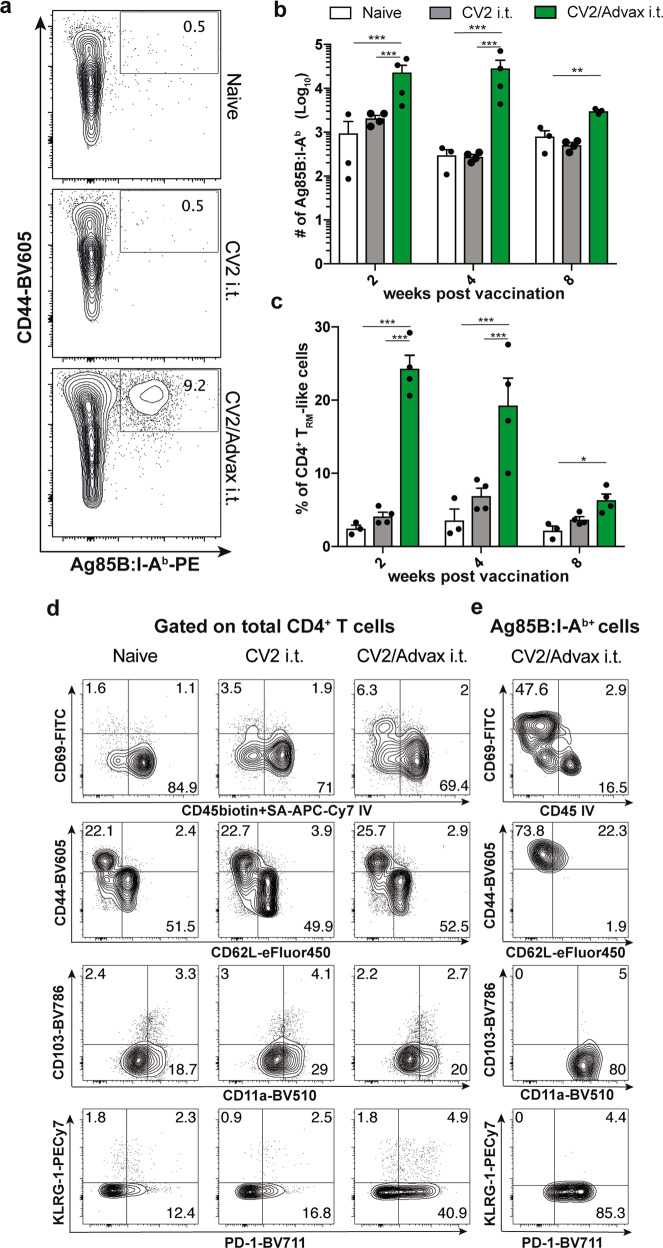
The development of effective vaccines against bacterial lung infections requires the induction of protective, pathogen-specific immune responses without deleterious inflammation within the pulmonary environment. Here, we made use of a polysaccharide-adjuvanted vaccine approach to elicit resident pulmonary T cells to protect against aerosol Mycobacterium tuberculosis infection. Intratracheal administration of the multistage fusion protein CysVac2 and the delta-inulin adjuvant Advax™ (formulated with a TLR9 agonist) provided superior protection against aerosol M. tuberculosis infection in mice, compared to parenteral delivery. Surprisingly, removal of the TLR9 agonist did not impact vaccine protection despite a reduction in cytokine-secreting T cell subsets, particularly CD4IFN-γIL-2TNF multifunctional T cells. CysVac2/Advax-mediated protection was associated with the induction of lung-resident, antigen-specific memory CD4 T cells that expressed IL-17 and RORγT, the master transcriptional regulator of Th17 differentiation. IL-17 was identified as a key mediator of vaccine efficacy, with blocking of IL-17 during M. tuberculosis challenge reducing phagocyte influx, suppressing priming of pathogen-specific CD4 T cells in local lymph nodes and ablating vaccine-induced protection. These findings suggest that tuberculosis vaccines such as CysVac2/Advax that are capable of eliciting Th17 lung-resident memory T cells are promising candidates for progression to human trials.
开发有效的抗细菌性肺部感染疫苗需要在肺部环境中诱导保护性的、病原体特异性免疫反应,同时避免有害炎症。在此,我们采用多糖佐剂疫苗方法来激发肺部驻留T细胞,以抵御气溶胶型结核分枝杆菌感染。与肠胃外给药相比,经气管内给予多阶段融合蛋白CysVac2和δ-菊粉佐剂Advax™(与TLR9激动剂一起配制)可在小鼠中提供更好的抵御气溶胶型结核分枝杆菌感染的保护作用。令人惊讶的是,去除TLR9激动剂尽管会减少分泌细胞因子的T细胞亚群,特别是CD4 IFN-γ IL-2 TNF多功能T细胞,但并不影响疫苗的保护作用。CysVac2/Advax介导的保护作用与诱导肺部驻留的、抗原特异性记忆CD4 T细胞有关,这些细胞表达IL-17和RORγT,RORγT是Th17分化的主要转录调节因子。IL-17被确定为疫苗效力的关键介质,在结核分枝杆菌攻击期间阻断IL-17会减少吞噬细胞流入,抑制局部淋巴结中病原体特异性CD4 T细胞的启动,并消除疫苗诱导的保护作用。这些发现表明,能够激发肺部驻留记忆性Th17细胞的结核病疫苗,如CysVac2/Advax,有望推进到人体试验阶段。