Asmamaw Tadesse, Genet Solomon, Menon Menakath, Tarekegn Getahun, Chekol Endeshaw, Geto Zeleke, Lejisa Tadesse, Habtu Wossene, Getahun Tigist, Tolcha Yosef
Department of Biochemistry, School of Medicine, College of Medicine and Health Sciences, University of Gondar, Gondar, Ethiopia.
Department of Biochemistry, School of Medicine, College of Health Sciences, Addis Ababa University, Addis Ababa, Ethiopia.
Diabetes Metab Syndr Obes. 2020 Dec 3;13:4727-4735. doi: 10.2147/DMSO.S279949. eCollection 2020.
The proportion of patients with end-stage renal disease caused by diabetes has progressively increased during the last few decades. Serum creatinine level is the most commonly used biochemical parameter to estimate GFR in routine practice. However, 50% of GFR can be lost before significant elevation of serum creatinine. Cystatin C is found to be a new promising marker for early detection of renal diseases.
The aim of this study was to determine the value of serum cystatin C and serum creatinine levels for early detection of renal disease in patients with type 2 diabetes mellitus.
A hospital-based comparative cross-sectional study was conducted with a sample size of 120. For early detection of renal disease in patients with type 2 diabetes mellitus, serum creatinine and cystatin C levels were measured and compared.
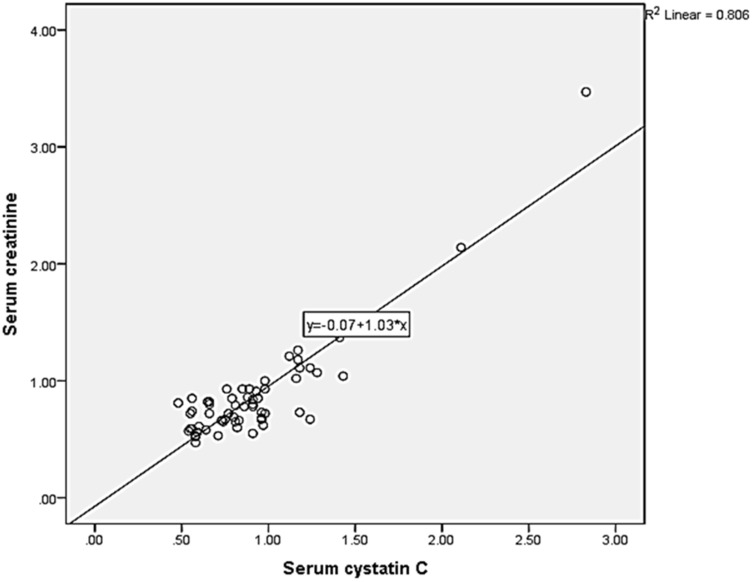
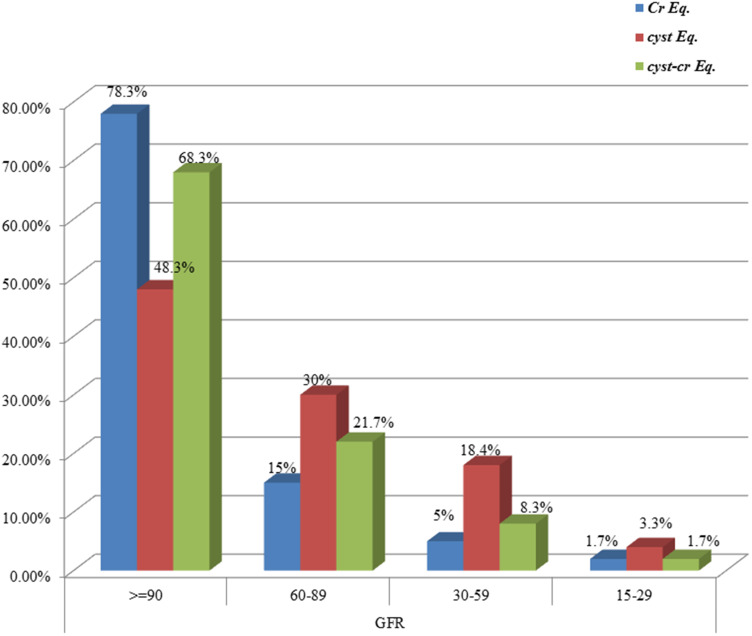
Serum creatinine and cystatin C levels were significantly increased in patients with type 2 diabetes mellitus compared to healthy controls. The mean±SD value of serum creatinine was found to be 0.87±0.44 mg/dL in patients and 0.63±0.27 mg/dL in control. Serum cystatin C level was also found to be significantly (=0.0001) higher in patients (0.92±0.38 mg/L) compared to controls (0.52±0.20 mg/L). The mean±SD of eGFR in three equations (Creatinine Equation, Cystatin C Equation, and Creatinine-Cystatin C Equation) were 105.7±27.5 mL/min/m, 90.4±28.2 mL/min/m, and 100±29.5 mL/min/m, respectively.
Cystatin C-based GFR estimation equations detect renal impairment in patients with type 2 diabetes mellitus earlier than creatinine-based GFR estimation equations.
在过去几十年中,糖尿病所致终末期肾病患者的比例逐渐上升。血清肌酐水平是常规实践中最常用的估算肾小球滤过率(GFR)的生化指标。然而,在血清肌酐显著升高之前,肾小球滤过率可能已丧失50%。胱抑素C被发现是早期检测肾脏疾病的一种新的有前景的标志物。
本研究旨在确定血清胱抑素C和血清肌酐水平在2型糖尿病患者早期肾脏疾病检测中的价值。
进行了一项基于医院的比较性横断面研究,样本量为120例。为早期检测2型糖尿病患者的肾脏疾病,对血清肌酐和胱抑素C水平进行了测量和比较。
与健康对照组相比,2型糖尿病患者的血清肌酐和胱抑素C水平显著升高。患者血清肌酐的平均值±标准差为0.87±0.44mg/dL,对照组为0.63±0.27mg/dL。患者的血清胱抑素C水平(0.92±0.38mg/L)也显著高于对照组(0.52±0.20mg/L)(P = 0.0001)。三个公式(肌酐公式、胱抑素C公式和肌酐-胱抑素C公式)估算的肾小球滤过率的平均值±标准差分别为105.7±27.5mL/min/1.73m²、90.4±28.2mL/min/1.73m²和100±29.5mL/min/1.73m²。
基于胱抑素C的肾小球滤过率估算公式比基于肌酐的肾小球滤过率估算公式能更早地检测出2型糖尿病患者的肾功能损害。