Lemma Mahlet Getachew, Beyene Kidanemariam G/Michael, Tiruneh Mesafint Abeje
Training Department, Sun Optical Technologies, Addis Ababa, Ethiopia.
Director General Office, Ethiopian Food and Drug Authority, Addis Ababa, Ethiopia.
Clin Optom (Auckl). 2020 Dec 3;12:213-222. doi: 10.2147/OPTO.S284934. eCollection 2020.
Prolonged use of computers led users to risk of computer vision syndrome (CVS). CVS is one of the occupational health problems. The aim of this study was to assess CVS and associated factors among secretaries working in government ministry offices in Addis Ababa, Ethiopia.
Institution-based cross-sectional study was conducted. Data were collected using interviewer administered pretested structured questionnaire and ophthalmic examinations. A total of 455 secretaries were participated in the study. Binary logistic regression analysis was applied to investigate determinants associated with CVS. Variables with p-value <0.05 were considered statistically significant.
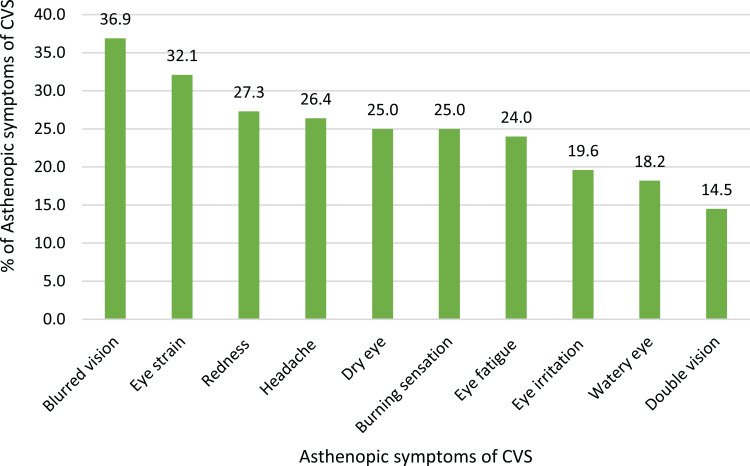
The prevalence of CVS among secretaries working in ministry offices in Addis Ababa was 68.8%. The main reported symptoms were blurred vision (36.9%), eye strain (32.1%), redness of the eye (27.3%) and headache (26.4%). Average monthly income (AOR=0.453, 95% CI: 0.235-0.874), habit of frequent voluntary blinking (AOR=0.313, 95% CI: 0.150-0.655), taking regular breaks between work (AOR=0.279, 95% CI: 0.078-0.996), using computer eye/glasses/spectacles (AOR=0.451, 95% CI: 0.245-0.830), sources of light at work place (AOR=0.009, 95% CI: 0.001-0.076), using an antiglare filter (AOR=0.216, 95% CI: 0.117-0.401) and knowledge (AOR=0.212,95% CI:0.115-0.389) were significantly associated with CVS.
Prevalence of CVS among secretaries was high. Average monthly income, habit of voluntary blinking, taking regular break, using computer spectacles, sources of light at work place, using an antiglare filter and knowledge were significantly associated with CVS. The findings suggest the need for adjusting exposure time to computers and increase awareness on safety measures and regular eye screening.
长期使用电脑会使使用者面临电脑视觉综合征(CVS)的风险。CVS是职业健康问题之一。本研究的目的是评估埃塞俄比亚亚的斯亚贝巴政府部委办公室秘书中CVS及其相关因素。
开展基于机构的横断面研究。通过访谈员管理的预测试结构化问卷和眼科检查收集数据。共有455名秘书参与了该研究。应用二元逻辑回归分析来调查与CVS相关的决定因素。p值<0.05的变量被认为具有统计学意义。
在亚的斯亚贝巴部委办公室工作的秘书中,CVS的患病率为68.8%。报告的主要症状为视力模糊(36.9%)、眼疲劳(32.1%)、眼睛发红(27.3%)和头痛(26.4%)。平均月收入(优势比[AOR]=0.453,95%置信区间[CI]:0.235 - 0.874)、频繁自愿眨眼的习惯(AOR=0.313,95%CI:0.150 - 0.655)、工作期间定期休息(AOR=0.279,95%CI:0.078 - 0.996)、使用电脑护目镜/眼镜(AOR=0.451,95%CI:0.245 - 0.830)、工作场所的光源(AOR=0.009,95%CI:0.001 - 0.076)、使用防眩光滤镜(AOR=0.216,95%CI:0.117 - 0.401)和知识(AOR=0.212,95%CI:0.115 - 0.389)与CVS显著相关。
秘书中CVS的患病率较高。平均月收入、自愿眨眼习惯、定期休息、使用电脑眼镜、工作场所的光源、使用防眩光滤镜和知识与CVS显著相关。研究结果表明需要调整使用电脑的时间,并提高对安全措施和定期眼部筛查的认识。