Department of Technical Biochemistry, Institute of Biochemistry and Technical Biochemistry, University of Stuttgart, Allmandring 31, 70569, Stuttgart, Germany.
Faculty of Chemistry, Organic Chemistry and Biocatalysis, Bielefeld University, Universitätsstraße 25, 33615, Bielefeld, Germany.
Angew Chem Int Ed Engl. 2021 Mar 1;60(10):5554-5560. doi: 10.1002/anie.202014239. Epub 2021 Jan 21.
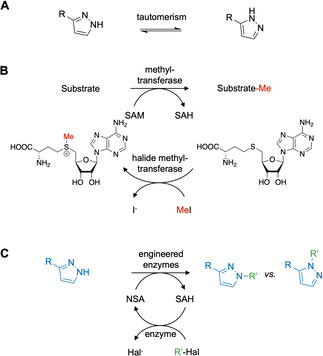
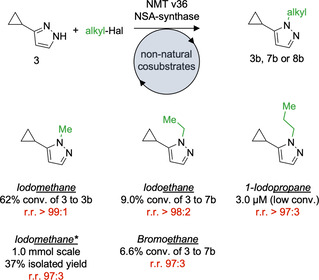
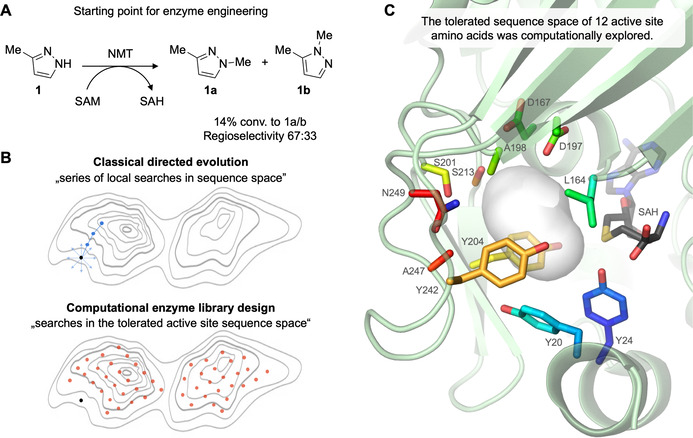
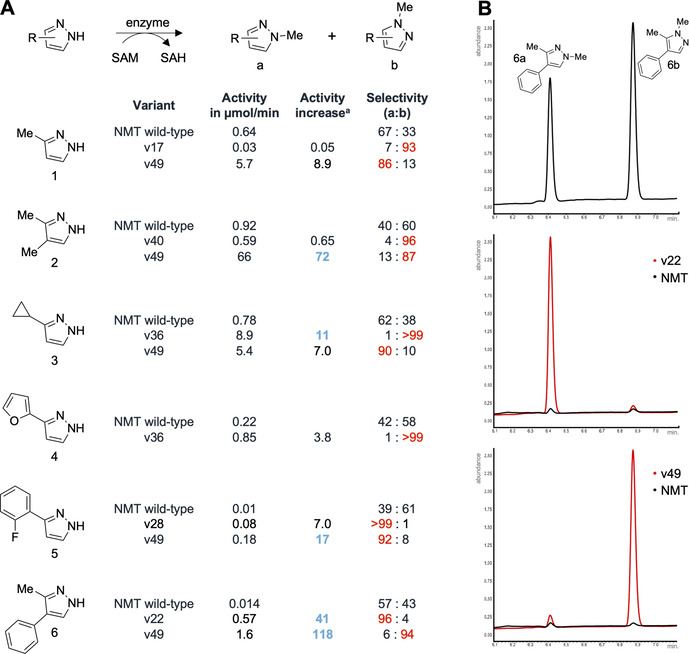
Selective alkylation of pyrazoles could solve a challenge in chemistry and streamline synthesis of important molecules. Here we report catalyst-controlled pyrazole alkylation by a cyclic two-enzyme cascade. In this enzymatic system, a promiscuous enzyme uses haloalkanes as precursors to generate non-natural analogs of the common cosubstrate S-adenosyl-l-methionine. A second engineered enzyme transfers the alkyl group in highly selective C-N bond formations to the pyrazole substrate. The cosubstrate is recycled and only used in catalytic amounts. Key is a computational enzyme-library design tool that converted a promiscuous methyltransferase into a small enzyme family of pyrazole-alkylating enzymes in one round of mutagenesis and screening. With this enzymatic system, pyrazole alkylation (methylation, ethylation, propylation) was achieved with unprecedented regioselectivity (>99 %), regiodivergence, and in a first example on preparative scale.
吡唑的选择性烷基化可以解决化学领域的一个挑战,并简化重要分子的合成。在这里,我们报告了通过循环双酶级联反应来控制吡唑的烷基化。在这个酶系统中,一种混杂酶使用卤代烷作为前体,生成常见共底物 S-腺苷甲硫氨酸的非天然类似物。第二种工程酶将烷基在高度选择性的 C-N 键形成中转移到吡唑底物上。共底物被回收并仅以催化量使用。关键是一种计算酶文库设计工具,它可以在一轮诱变和筛选中,将一种混杂的甲基转移酶转化为一个小的吡唑烷基化酶家族。利用这个酶系统,实现了吡唑的烷基化(甲基化、乙基化、丙基化),具有前所未有的区域选择性(>99%)、区域发散性,并首次在制备规模上实现。