The University of Sydney, Sydney, Australia.
J Med Internet Res. 2021 Jan 7;23(1):e23805. doi: 10.2196/23805.
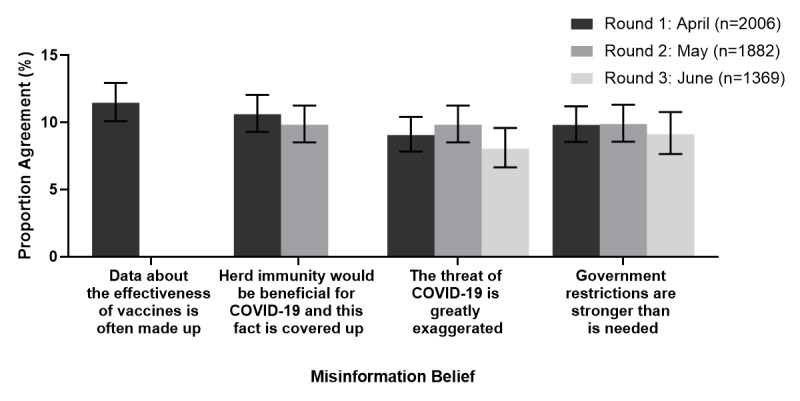
Misinformation about COVID-19 is common and has been spreading rapidly across the globe through social media platforms and other information systems. Understanding what the public knows about COVID-19 and identifying beliefs based on misinformation can help shape effective public health communications to ensure efforts to reduce viral transmission are not undermined.
This study aimed to investigate the prevalence and factors associated with COVID-19 misinformation in Australia and their changes over time.
This prospective, longitudinal national survey was completed by adults (18 years and above) across April (n=4362), May (n=1882), and June (n=1369) 2020.
Stronger agreement with misinformation was associated with younger age, male gender, lower education level, and language other than English spoken at home (P<.01 for all). After controlling for these variables, misinformation beliefs were significantly associated (P<.001) with lower levels of digital health literacy, perceived threat of COVID-19, confidence in government, and trust in scientific institutions. Analyses of specific government-identified misinformation revealed 3 clusters: prevention (associated with male gender and younger age), causation (associated with lower education level and greater social disadvantage), and cure (associated with younger age). Lower institutional trust and greater rejection of official government accounts were associated with stronger agreement with COVID-19 misinformation.
The findings of this study highlight important gaps in communication effectiveness, which must be addressed to ensure effective COVID-19 prevention.
关于 COVID-19 的错误信息很常见,并且通过社交媒体平台和其他信息系统在全球范围内迅速传播。了解公众对 COVID-19 的了解,并根据错误信息识别信念,可以帮助制定有效的公共卫生传播措施,以确保减少病毒传播的努力不会受到破坏。
本研究旨在调查澳大利亚 COVID-19 错误信息的流行情况及其相关因素,并研究其随时间的变化。
本前瞻性、纵向全国性调查于 2020 年 4 月(n=4362)、5 月(n=1882)和 6 月(n=1369)期间由成年人(18 岁及以上)完成。
与错误信息的一致性越强,年龄越小、性别为男性、教育水平越低、在家中使用的语言不是英语(所有 P<.01)。在控制这些变量后,错误信息信念与数字健康素养水平较低、对 COVID-19 的感知威胁、对政府的信心以及对科学机构的信任显著相关(P<.001)。对政府确定的特定错误信息的分析揭示了 3 个集群:预防(与男性和年轻年龄相关)、病因(与较低的教育水平和更大的社会劣势相关)和治疗(与年轻年龄相关)。对机构的信任度较低,对官方政府账户的接受度较低,与对 COVID-19 错误信息的一致性较强相关。
本研究的结果突出了沟通有效性方面的重要差距,必须加以解决,以确保有效的 COVID-19 预防。