Department of Psychology, Faculty of Health and Society, University of Salford, Manchester, UK.
Manchester Centre for Health Psychology, University of Manchester, Manchester, UK.
BMJ Open. 2021 Nov 11;11(11):e048750. doi: 10.1136/bmjopen-2021-048750.
Individual behaviour changes, such as hand hygiene and physical distancing, are required on a population scale to reduce transmission of infectious diseases such as COVID-19. However, little is known about effective methods of communicating risk reducing information, and how populations might respond.
To synthesise evidence relating to what (1) characterises effective public health messages for managing risk and preventing infectious disease and (2) influences people's responses to messages.
A rapid systematic review was conducted. Protocol is published on Prospero CRD42020188704.
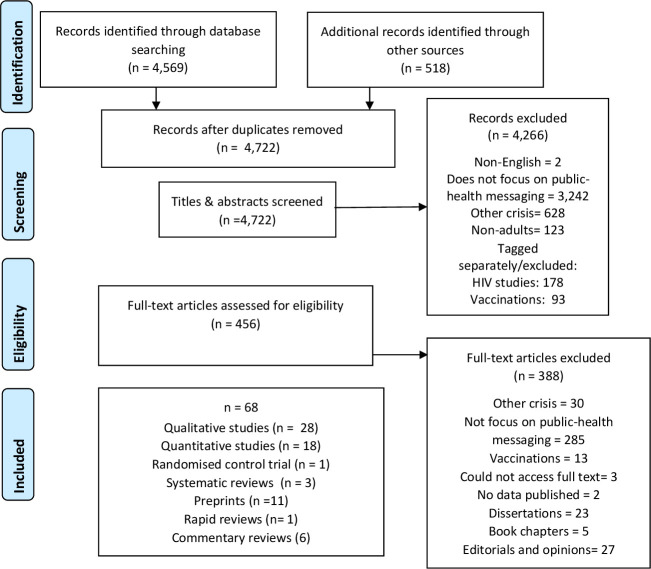
Electronic databases were searched: Ovid Medline, Ovid PsycINFO and Healthevidence.org, and grey literature (PsyarXiv, OSF Preprints) up to May 2020.
All study designs that (1) evaluated public health messaging interventions targeted at adults and (2) concerned a communicable disease spread via primary route of transmission of respiratory and/or touch were included. Outcomes included preventative behaviours, perceptions/awareness and intentions. Non-English language papers were excluded.
Due to high heterogeneity studies were synthesised narratively focusing on determinants of intentions in the absence of measured adherence/preventative behaviours. Themes were developed independently by two researchers and discussed within team to reach consensus. Recommendations were translated from narrative synthesis to provide evidence-based methods in providing effective messaging.
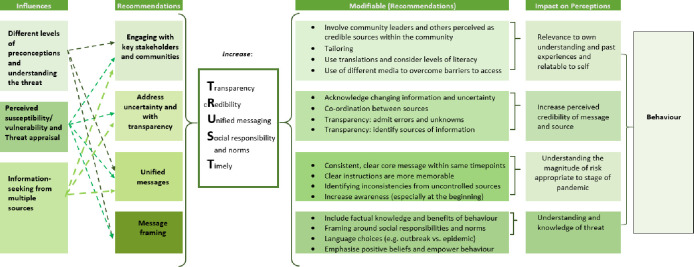
Sixty-eight eligible papers were identified. Characteristics of effective messaging include delivery by credible sources, community engagement, increasing awareness/knowledge, mapping to stage of epidemic/pandemic. To influence intent effectively, public health messages need to be acceptable, increase understanding/perceptions of health threat and perceived susceptibility.
There are four key recommendations: (1) engage communities in development of messaging, (2) address uncertainty immediately and with transparency, (3) focus on unifying messages from sources and (4) frame messages aimed at increasing understanding, social responsibility and personal control. Embedding principles of behavioural science into public health messaging is an important step towards more effective health-risk communication during epidemics/pandemics.
为了降低传染病(如 COVID-19)的传播,需要在人群中进行个人行为改变,例如手部卫生和保持身体距离。然而,人们对有效传达降低风险信息的方法以及人群可能的反应知之甚少。
综合有关以下两个方面的证据:(1)管理风险和预防传染病的有效公共卫生信息的特征;(2)影响人们对信息的反应的因素。
快速系统综述。方案发表在 Prospero CRD42020188704 上。
电子数据库检索:Ovid Medline、Ovid PsycINFO 和 Healthevidence.org,以及灰色文献(PsyarXiv、OSF Preprints),截至 2020 年 5 月。
所有研究设计均(1)评估针对成年人的公共卫生信息干预措施;(2)涉及通过呼吸道和/或触摸的主要传播途径传播的传染病。结果包括预防行为、认知/意识和意图。排除非英语语言的论文。
由于高度异质性,研究进行了叙述性综合,重点是意图的决定因素,而不关注测量的依从性/预防行为。两位研究人员独立开发主题,并在团队内进行讨论以达成共识。建议从叙述性综合翻译而来,为提供有效的信息传递提供循证方法。
确定了 68 篇符合条件的论文。有效的信息传递特征包括由可信来源提供、社区参与、提高意识/知识、与疫情/大流行阶段相匹配。为了有效地影响意图,公共卫生信息需要是可接受的,提高对健康威胁和感知易感性的理解/认知。
有四项关键建议:(1)让社区参与信息的制定;(2)立即并透明地解决不确定性;(3)专注于统一来自来源的信息;(4)针对提高理解、社会责任和个人控制的信息进行宣传。将行为科学原理嵌入公共卫生信息中是在传染病/大流行期间进行更有效的健康风险沟通的重要步骤。