Centre for Crisis Studies and Mitigation, The University of Manchester, Manchester, UK
Department of Earth and Environmental Sciences, The University of Manchester, Manchester, UK.
BMJ Glob Health. 2020 Dec;5(12). doi: 10.1136/bmjgh-2020-003727.
In the absence of effective treatments or vaccines, non-pharmaceutical interventions are the mainstay of control in the COVID-19 pandemic. Refugee populations in displacement camps live under adverse conditions that are likely to favour the spread of disease. To date, only a few cases of COVID-19 have appeared in refugee camps, and whether feasible non-pharmaceutical interventions can prevent the spread of the SARS-CoV-2 virus in such settings remains untested.
We constructed the first spatially explicit agent-based model of a COVID-19 outbreak in a refugee camp, and applied it to evaluate feasible non-pharmaceutical interventions. We parameterised the model using published data on the transmission rates and progression dynamics of COVID-19, and demographic and spatial data from Europe's largest refugee camp, the Moria displacement camp on Lesbos, Greece. We simulated COVID-19 epidemics with and without four feasible interventions.
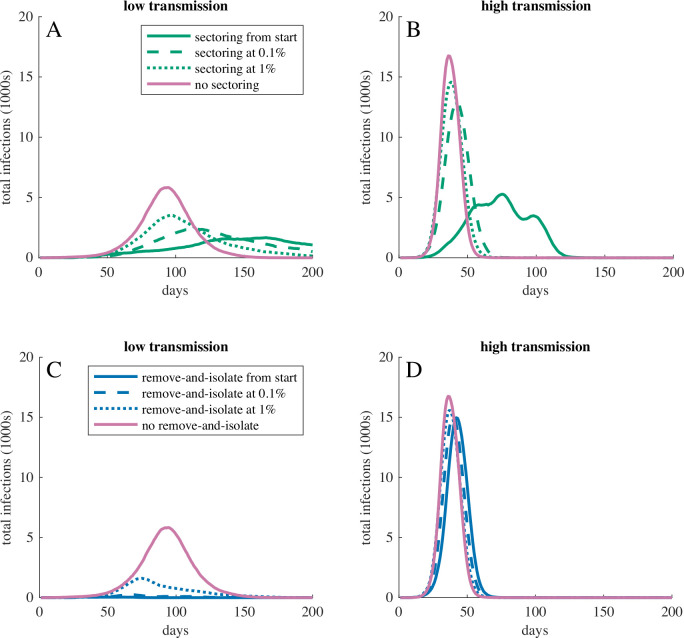
Spatial subdivision of the camp ('sectoring') was able to 'flatten the curve', reducing peak infection by up to 70% and delaying peak infection by up to several months. The use of face masks coupled with the efficient isolation of infected individuals reduced the overall incidence of infection, and sometimes averted epidemics altogether. These interventions must be implemented quickly in order to be maximally effective. Lockdowns had only small effects on COVID-19 dynamics.
Agent-based models are powerful tools for forecasting the spread of disease in spatially structured and heterogeneous populations. Our findings suggest that feasible interventions can slow the spread of COVID-19 in a refugee camp setting, and provide an evidence base for camp managers planning intervention strategies. Our model can be modified to study other closed populations at risk from COVID-19 or future epidemics.
在缺乏有效治疗方法或疫苗的情况下,非药物干预措施是 COVID-19 大流行防控的主要手段。难民营中的难民生活在可能有利于疾病传播的不利条件下。迄今为止,难民营中仅出现少数几例 COVID-19 病例,在这种环境下是否可行的非药物干预措施可以阻止 SARS-CoV-2 病毒的传播仍有待检验。
我们构建了首个难民难民营 COVID-19 暴发的空间显式基于主体模型,并应用该模型评估可行的非药物干预措施。我们使用 COVID-19 传播率和进展动态的已发表数据以及来自欧洲最大的难民营,希腊莱斯博斯岛的莫里亚难民营的人口和空间数据对模型进行了参数化。我们模拟了有无四种可行干预措施的 COVID-19 疫情。
营地的空间细分(分区)能够“使曲线变平”,将感染高峰减少多达 70%,并将感染高峰推迟几个月。使用口罩并结合对感染者的有效隔离可降低总体感染率,有时甚至完全避免疫情暴发。这些干预措施必须迅速实施,才能最大程度地发挥作用。封锁对 COVID-19 动态的影响很小。
基于主体的模型是预测空间结构和异质人群中疾病传播的有力工具。我们的研究结果表明,可行的干预措施可以减缓难民营中 COVID-19 的传播,并为营地管理人员制定干预策略提供证据基础。我们的模型可以进行修改,以研究其他面临 COVID-19 或未来疫情风险的封闭人群。