Tran Binh Thang, Pham Nhu Hiep, Nguyen Thanh Xuan, Choi Kui Son, Sohn Dae Kyung, Kim Sun-Young, Suh Jae Kyung, Nguyen Thuy Duyen, Phan Van Sang, Tran Dinh Trung, Nguyen The Thanh, Nguyen Thi Thanh Binh, Nguyen Minh Tu, Oh Jin-Kyoung
Department of Cancer Control and Population Health, Graduate School of Cancer Science and Policy, National Cancer Center, Goyang, Republic of Korea.
Faculty of Public Health, Hue University of Medicine and Pharmacy, Hue University, Hue City, Vietnam.
Patient Prefer Adherence. 2020 Dec 4;14:2427-2437. doi: 10.2147/PPA.S281500. eCollection 2020.
Health-related quality of life (HRQoL) is an important construct in clinical settings, and it is crucial that it should be properly measured. As the EuroQol-5-dimensions-5 levels (EQ-5D-5L) is more effective for such measurement than the 3-level model, data on economic models, clinical studies, and public health evaluations previously collected through the EQ-5D-3L need to be revaluated using the EQ-5D-5L. This study evaluated colorectal cancer (CRC) patients' HRQoL scores using the Vietnamese EQ-5D-5L value set.
The cross-sectional study included CRC patients treated at a tertiary public hospital. HRQoL was assessed using the EQ-5D-5L, and HRQoL utility scores were calculated using the Vietnamese value set. Tobit regression examined factors associated with HRQoL.
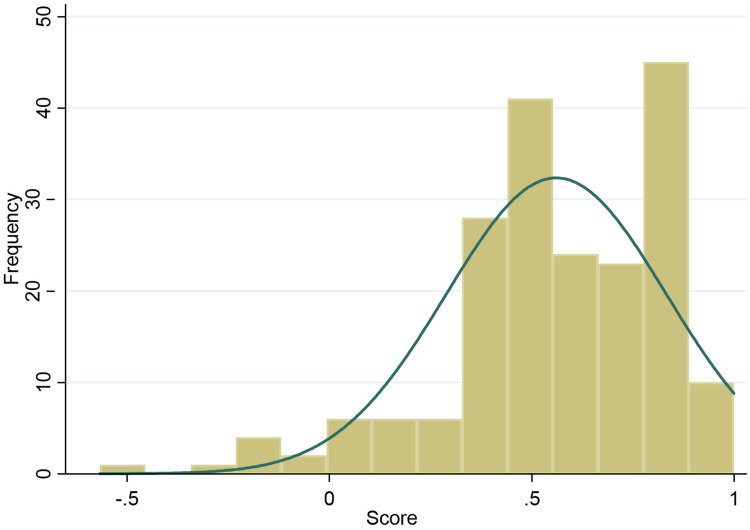
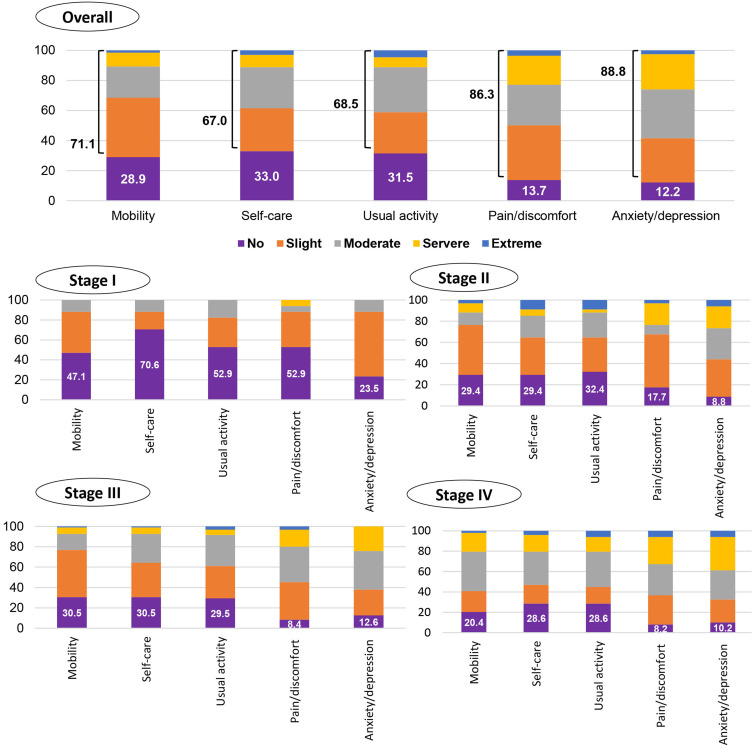
The analysis included 197 CRC patients. Ages ranged from 20 to 87 years (M = 57.64, SD = 13.5); 42.2% and 57.8% were diagnosed with cancer of the colon or rectum/anus, respectively. Mean EQ-5D-5L was 0.561 (range, -0.5115 to 1). Most participants experienced anxiety/depression (88%), followed by pain/discomfort (87%), mobility (71%), usual activity (69%), and self-care (67%). Advanced CRC stage (stage II: β -0.303, se 0.08; stage III: β -0.305, se 0.07; stage IV: β -0.456, se 0.07) and surgery (β -0.113, se 0.05) were negatively associated with EQ-5D-5L scores. Advanced education (high school: β 0.273, se 0.07); college/vocational: β 0.134se 0.05; university/higher: Coef 0.213, se 0.08;) and older age (age group 35-44: β 0.253, se 0.10; 45-54: β 0.327, se 0.09; 55-64: β 0.355 se 0.09; 65+ β 0.204, se 0.09) were positively associated with EQ-5D-5L scores.
Patients in advanced CRC stages or undergoing surgery experienced lower HRQoL and higher prevalence of anxiety/depression and pain/discomfort. Older age and high educational attainment predicted high HRQoL. This study provides information on CRC patients' health utility based on various patient characteristics, which can be used in future economic evaluations.
健康相关生活质量(HRQoL)是临床环境中的一个重要概念,对其进行恰当测量至关重要。由于欧洲五维度五水平健康量表(EQ-5D-5L)在此类测量中比三水平模型更有效,因此先前通过EQ-5D-3L收集的经济模型、临床研究及公共卫生评估数据需要使用EQ-5D-5L重新评估。本研究使用越南版EQ-5D-5L值集评估了结直肠癌(CRC)患者的HRQoL得分。
这项横断面研究纳入了在一家三级公立医院接受治疗的CRC患者。使用EQ-5D-5L评估HRQoL,并使用越南版值集计算HRQoL效用得分。采用 Tobit 回归分析与HRQoL相关的因素。
分析纳入了197例CRC患者。年龄范围为20至87岁(M = 57.64,SD = 13.5);分别有42.2%和57.8%的患者被诊断为结肠癌或直肠癌/肛管癌。EQ-5D-5L的平均得分为0.561(范围为-0.5115至1)。大多数参与者经历过焦虑/抑郁(88%),其次是疼痛/不适(87%)、行动能力(71%)、日常活动(69%)和自我护理(67%)。晚期CRC阶段(II期:β -0.303,标准误0.08;III期:β -0.305,标准误0.07;IV期:β -0.456,标准误0.07)和手术(β -0.113,标准误0.05)与EQ-5D-5L得分呈负相关。高等教育程度(高中:β 0.273,标准误0.07;大专/职业教育:β 0.134,标准误0.05;大学及以上:系数0.213,标准误0.08)和较高年龄(35 - 44岁年龄组:β 0.253,标准误0.10;45 - 54岁:β 0.327,标准误0.09;55 - 64岁:β 0.355,标准误0.09;65岁及以上:β 0.204,标准误0.09)与EQ-5D-5L得分呈正相关。
处于晚期CRC阶段或接受手术的患者HRQoL较低,焦虑/抑郁和疼痛/不适的患病率较高。较高年龄和高教育程度预示着较高的HRQoL。本研究提供了基于各种患者特征的CRC患者健康效用信息,可用于未来的经济评估。