Suwardjo Suwardjo, Avanti Widya Surya, Dwianingsih Ery Kus, Harahap Wirsma Arif, Anwar Sumadi Lukman
Division of Surgical Oncology, Department of Surgery, Dr Sardjito Hospital, Faculty of Medicine, Public Health, and Nursing, Universitas Gadjah Mada, Yogyakarta, 55281, Indonesia.
Department of Radiology, Dr Sardjito Hospital, Faculty of Medicine, Public Health, and Nursing, Universitas Gadjah Mada, Yogyakarta, 55281, Indonesia.
Ann Med Surg (Lond). 2020 Nov 28;60:614-618. doi: 10.1016/j.amsu.2020.11.076. eCollection 2020 Dec.
Although differentiated thyroid cancers generally have a good prognosis, a small proportion of patients will have recurrent or progressive disease. Bone resorption due to thyroid cancer can cause significant challenges in the clinical management and rehabilitation.
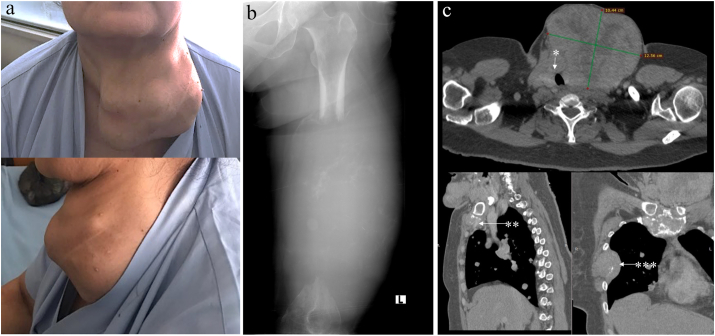
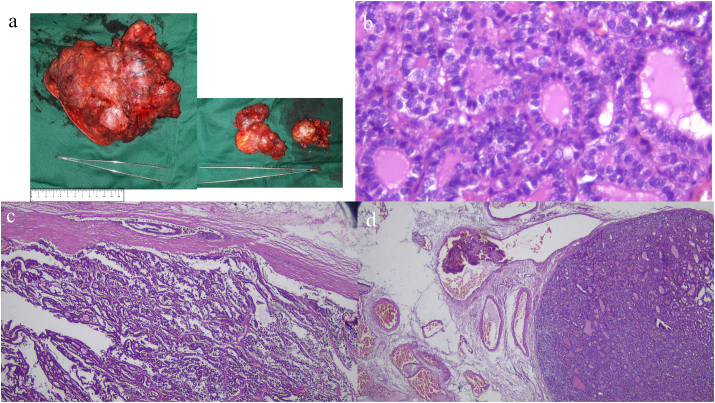
Nearly total femur resorption was found as a first presentation in a patient with thyroid cancer. The patient complained about chronic pain in her left thigh that had progressed into an inability to walk. She was treated by a traditional healer for six years before she was persuaded by a social worker to seek medical help. X-rays showed pathological loss of the right diaphyseal femur. Neck CT-scan showed a left thyroid mass with tracheal deviation, with multiple lytic lesions in the sternum and 5th rib. Needle biopsy of the thyroid mass resulted in an inconclusive follicular neoplasm. Total thyroidectomy and neck dissection revealed a classical type of papillary thyroid carcinoma. After thyroid ablation, she opted for palliative radiotherapy and bisphosphonate treatment for the bone metastases.
Bone metastases are rarely detected at the time of thyroid cancer diagnosis. In the presence of bone metastasis, median survival of well-differentiated thyroid cancer decreases into only 4 years. Bone metastases are often neglected and less studied than regional lymph node and lung metastases.
Although well differentiated thyroid cancer is usually indolent, a neglected bone metastasis at an initial diagnosis might adversely affect patient's quality of life and prognosis.
尽管分化型甲状腺癌总体预后良好,但仍有一小部分患者会出现疾病复发或进展。甲状腺癌导致的骨吸收会给临床管理和康复带来重大挑战。
一名甲状腺癌患者首次就诊时被发现几乎整个股骨都发生了骨吸收。患者主诉左大腿慢性疼痛,已发展到无法行走。她接受了六年的传统治疗,之后在一名社会工作者的劝说下才寻求医疗帮助。X线显示右股骨干病理性骨质缺失。颈部CT扫描显示左侧甲状腺肿物伴气管移位,胸骨和第5肋骨有多个溶骨性病变。甲状腺肿物穿刺活检结果为滤泡性肿瘤,诊断不明确。全甲状腺切除及颈部清扫术后显示为经典型乳头状甲状腺癌。甲状腺消融术后,她选择了姑息性放疗及双膦酸盐治疗骨转移。
甲状腺癌诊断时很少能检测到骨转移。出现骨转移时,分化良好的甲状腺癌患者中位生存期降至仅4年。与区域淋巴结和肺转移相比,骨转移常常被忽视且研究较少。
尽管分化良好的甲状腺癌通常发展缓慢,但初诊时被忽视的骨转移可能会对患者的生活质量和预后产生不利影响。