Xu Li-Ming, Yu Hao, Yuan Ya-Jing, Zhang Jiao, Ma Yue, Cao Xu-Chen, Wang Jun, Zhao Lu-Jun, Wang Ping
Department of Radiotherapy, Tianjin Medical University Cancer Institute & Hospital, National Clinical Research Center for Cancer, Tianjin, China.
Key Laboratory of Cancer Prevention and Therapy, Tianjin's Clinical Research Center for Cancer, Tianjin, China.
Front Cell Dev Biol. 2020 Nov 10;8:553733. doi: 10.3389/fcell.2020.553733. eCollection 2020.
Radioresistance is a major challenge in the use of radiotherapy for the treatment of lung cancer while microRNAs (miRs) have been reported to participate in multiple essential cellular processes including radiosensitization. This study was conducted with the main objective of investigating the potential role of miR-320a in radioresistance of non-small cell lung cancer (NSCLC) via the possible mechanism related to HIF1α, KDM5B, and PTEN.
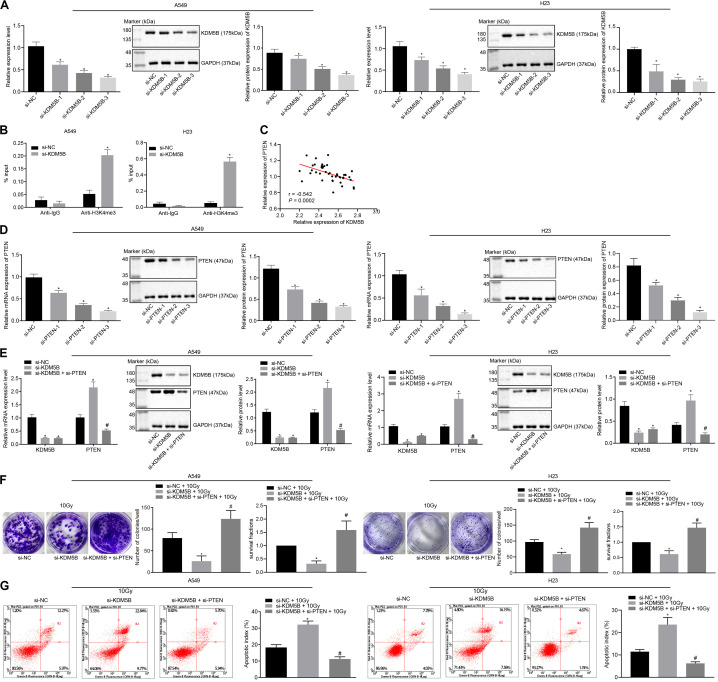
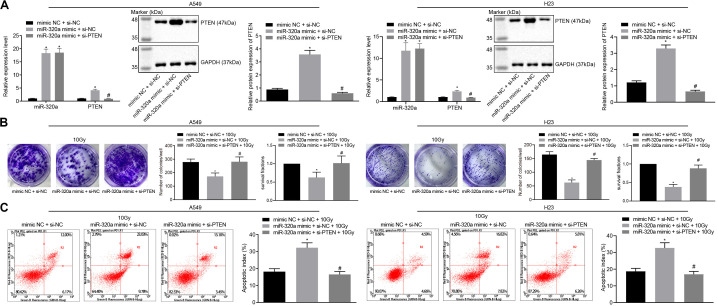
Firstly, NSCLC radiosensitivity-related microarray dataset GSE112374 was obtained. Then, the expression of miR-320a, HIF1α, KDM5B, and PTEN was detected in the collected clinical NSCLC samples, followed by Pearson's correlation analysis. Subsequently, ChIP assay was conducted to determine the content of the PTEN promoter fragment enriched by the IgG antibody and H3K4me3 antibody. Finally, a series of and assays were performed in order to evaluate the effects of miR-320a on radioresistance of NSCLC with the involvement of HIF1α, KDM5B, and PTEN.
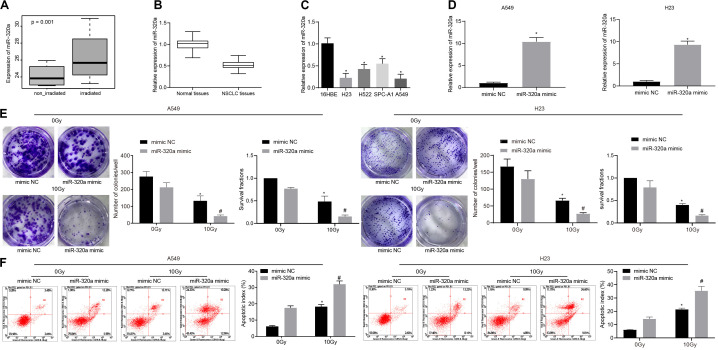
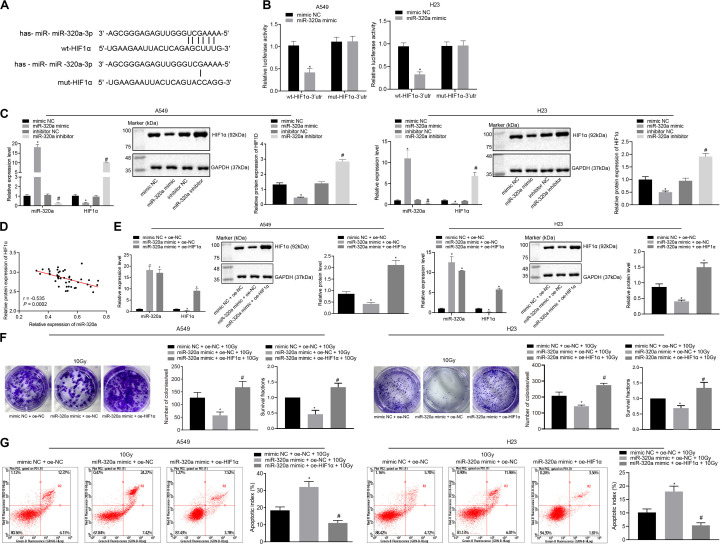
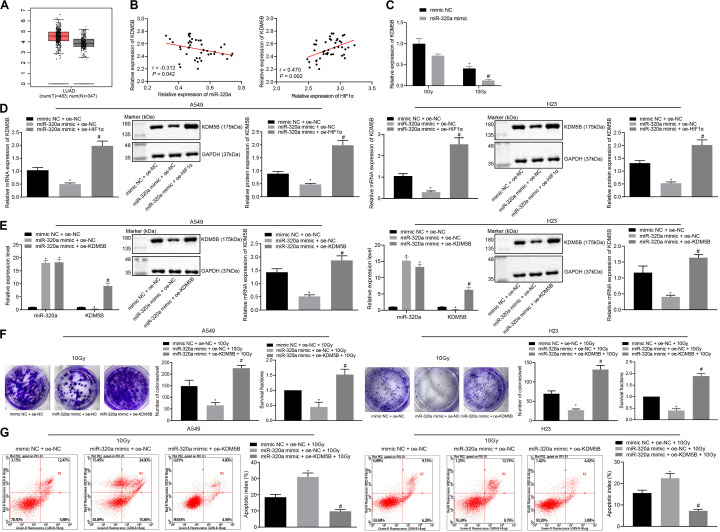
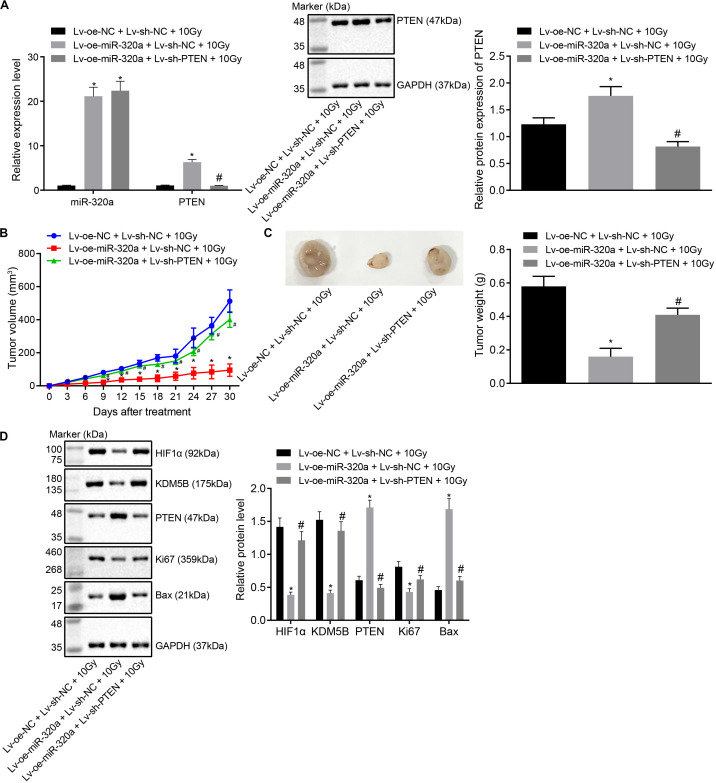
The microarray dataset GSE112374 presented with a high expression of miR-320a in NSCLC radiosensitivity samples, which was further confirmed in our clinical samples with the use of reverse transcription-quantitative polymerase chain reaction. Moreover, miR-320a negatively targeted HIF1α, inhibiting radioresistance of NSCLC. Interestingly, miR-320a suppressed the expression of KDM5B, and KDM5B was found to enhance the radioresistance of NSCLC through the downregulation of PTEN expression. The inhibition of miR-320a in radioresistance of NSCLC was also reproduced by assay.
Taken together, our findings were suggestive of the inhibitory effect of miR-320a on radioresistance of NSCLC through HIF1α-suppression mediated methylation of PTEN.
放射抗性是肺癌放射治疗中的一个主要挑战,而据报道,微小RNA(miR)参与包括放射增敏在内的多个重要细胞过程。本研究的主要目的是通过与缺氧诱导因子1α(HIF1α)、赖氨酸特异性去甲基化酶5B(KDM5B)和第10号染色体缺失的磷酸酶及张力蛋白同源物(PTEN)相关的可能机制,探讨miR-320a在非小细胞肺癌(NSCLC)放射抗性中的潜在作用。
首先,获取NSCLC放射敏感性相关的基因芯片数据集GSE112374。然后,检测收集的临床NSCLC样本中miR-320a、HIF1α、KDM5B和PTEN的表达,随后进行Pearson相关性分析。接着,进行染色质免疫沉淀(ChIP)试验,以确定IgG抗体和H3K4me3抗体富集的PTEN启动子片段的含量。最后,进行一系列的 和 试验,以评估miR-320a在HIF1α、KDM5B和PTEN参与下对NSCLC放射抗性的影响。
基因芯片数据集GSE112374显示NSCLC放射敏感性样本中miR-320a高表达,这在我们的临床样本中通过逆转录定量聚合酶链反应得到进一步证实。此外,miR-320a负向靶向HIF1α,抑制NSCLC的放射抗性。有趣的是,miR-320a抑制KDM5B的表达,并且发现KDM5B通过下调PTEN表达增强NSCLC的放射抗性。 试验也重现了miR-320a对NSCLC放射抗性的抑制作用。
综上所述,我们的研究结果提示miR-320a通过抑制HIF1α介导的PTEN甲基化对NSCLC放射抗性具有抑制作用。