Department of Medical Laboratory Sciences, Faculty of Allied Health Sciences, Arab American University, Jenin, Palestine.
Ramallah Primary Health Care, Palestinian Ministry of Health, Ramallah, Palestine.
PLoS One. 2020 Dec 11;15(12):e0240339. doi: 10.1371/journal.pone.0240339. eCollection 2020.
Hepatitis A virus (HAV) infection is one of the major causes of acute viral hepatitis. HAV genotypes and its genetic diversity is rarely investigated in our region as well as worldwide.
The aims of the present study were to determine the HAV genotypes and its risk factors and to investigate the genetic diversity of the HAV isolates in the West Bank, Palestine.
A cohort of 161 clinically and laboratory-confirmed HAV (IgM-positive) cases and 170 apparently healthy controls from all the districts of the West Bank, Palestine during the period of 2014 to 2016 were tested for HAV infection using IgM antibodies, RT-PCR and sequence analysis of the VP3/VP1 junction region of the HAV genome. Phylogenetic analysis, genetic diversity and haplotypes analysis were used to characterize the VP3/VP1 sequences.
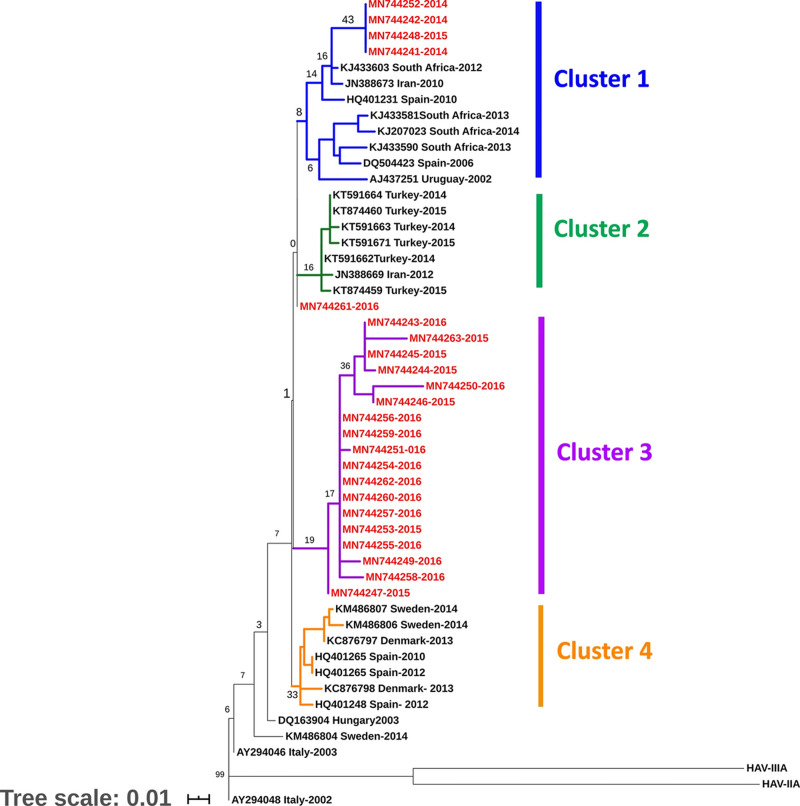
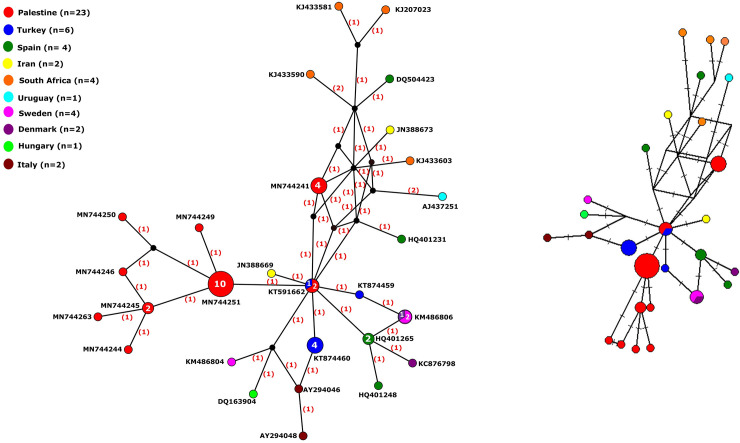
All the 34 sequences of the HAV were found to be of HAV-IB sub-genotype. The phylogenetic analysis showed four main clusters with cluster III exclusively consisting of 18 Palestinian isolates (18/23-78%), but with weak bootstrap values. A high haplotype diversity (Hd) and low nucleotide diversity (π) were observed. Cluster III showed high number of haplotypes (h = 8), but low haplotype (gene) diversity (Hd = 0.69). A total of 28 active haplotypes with some consisting of more than one sequence were observed using haplotype network analysis. The Palestinian haplotypes are characterized by closely related viral haplotypes with one SNV away from each other which ran parallel to cluster III in the phylogenetic tree. A smaller Palestinian haplotype (4 isolates) was three SNVs away from the major haplotype cluster (n = 10) and closer to others haplotypes from Iran, Spain, and South Africa. Young age, low level of parent's education, infrequent hand washing before meals, and drinking of un-treated water were considered the major HAV risk factors in the present study.
Haplotype network analysis revealed haplotype variation among the HAV Palestinian sequences despite low genetic variation and nucleotide diversity. In addition, this study reconfirmed that age and parent's level of education as HAV risk factors, while hand washing and treating drinking water as protective factors.
甲型肝炎病毒(HAV)感染是急性病毒性肝炎的主要原因之一。在我们地区以及全球范围内,HAV 基因型及其遗传多样性的研究很少。
本研究旨在确定 HAV 基因型及其危险因素,并研究巴勒斯坦西岸 HAV 分离株的遗传多样性。
本队列研究包括 2014 年至 2016 年期间来自巴勒斯坦西岸所有地区的 161 例临床和实验室确诊的 HAV(IgM 阳性)病例和 170 名健康对照,使用 IgM 抗体、逆转录聚合酶链反应(RT-PCR)和 HAV 基因组 VP3/VP1 连接区的序列分析检测 HAV 感染。使用系统发育分析、遗传多样性和单倍型分析来描述 VP3/VP1 序列。
所有 34 株 HAV 均为 HAV-IB 亚型。系统发育分析显示有四个主要聚类,其中聚类 III 仅包含 18 株巴勒斯坦分离株(18/23-78%),但支持度较弱。观察到高单倍型多样性(Hd)和低核苷酸多样性(π)。聚类 III 显示出高数量的单倍型(h = 8),但低单倍型(基因)多样性(Hd = 0.69)。使用单倍型网络分析观察到 28 个活跃的单倍型,其中一些由一个以上的序列组成。巴勒斯坦单倍型的特点是与其他单倍型密切相关,彼此之间只有一个 SNV,与系统发育树中的聚类 III 平行。一个较小的巴勒斯坦单倍型(4 株)与主要单倍型聚类(n = 10)相差 3 个 SNV,与来自伊朗、西班牙和南非的其他单倍型更为接近。本研究发现,年龄较小、父母受教育程度较低、饭前洗手频率较低以及饮用未经处理的水是 HAV 的主要危险因素。
尽管遗传变异和核苷酸多样性较低,但单倍型网络分析显示巴勒斯坦 HAV 序列存在单倍型变异。此外,本研究再次证实年龄和父母受教育程度是 HAV 的危险因素,而饭前洗手和饮用水处理是保护因素。