Department of Psychiatry, Amsterdam Public Health, Amsterdam University Medical Center, Vrije Universiteit, Amsterdam, Netherlands; Geestelijke gezondheidszorg (GGZ) InGeest Specialized Mental Health Care, Amsterdam, Netherlands.
Department of Psychiatry, Amsterdam Public Health, Amsterdam University Medical Center, Vrije Universiteit, Amsterdam, Netherlands; Geestelijke gezondheidszorg (GGZ) InGeest Specialized Mental Health Care, Amsterdam, Netherlands.
J Affect Disord. 2022 May 15;305:85-93. doi: 10.1016/j.jad.2022.02.056. Epub 2022 Feb 24.
Little is known about the longer-term impact of the Covid-19 pandemic beyond the first months of 2020, particularly for people with pre-existing mental health disorders. Studies including pre-pandemic data from large psychiatric cohorts are scarce.
Between April 2020 and February 2021, twelve successive online questionnaires were distributed among participants of the Netherlands Study of Depression and Anxiety, Netherlands Study of Depression in Older Persons, and Netherlands Obsessive Compulsive Disorder Association Study (N = 1714, response rate 62%). Outcomes were depressive symptoms, anxiety, worry, loneliness, perceived mental health impact of the pandemic, fear of Covid-19, positive coping, and happiness. Using linear mixed models we compared trajectories between subgroups with different pre-pandemic chronicity of disorders and healthy controls.
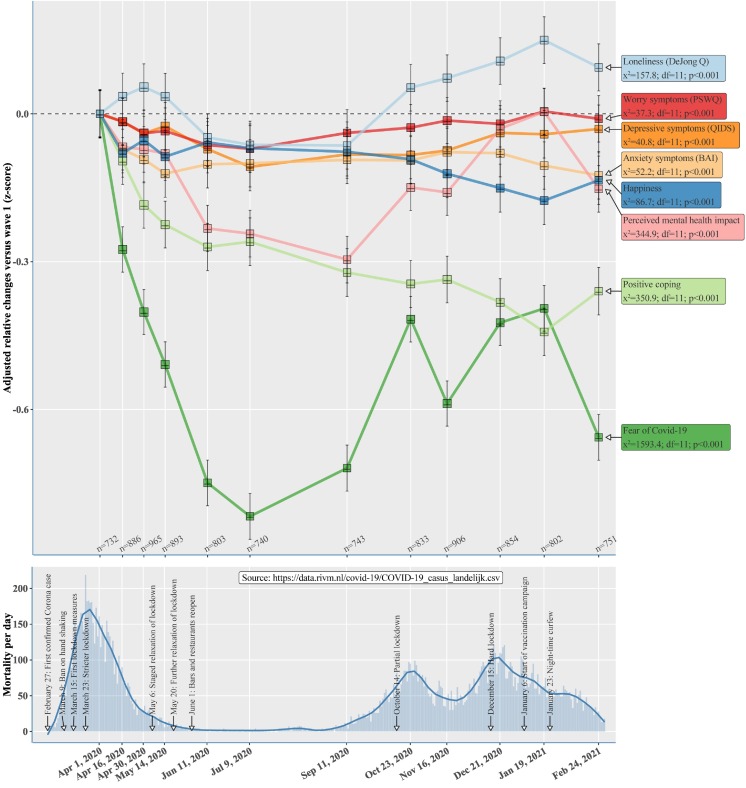
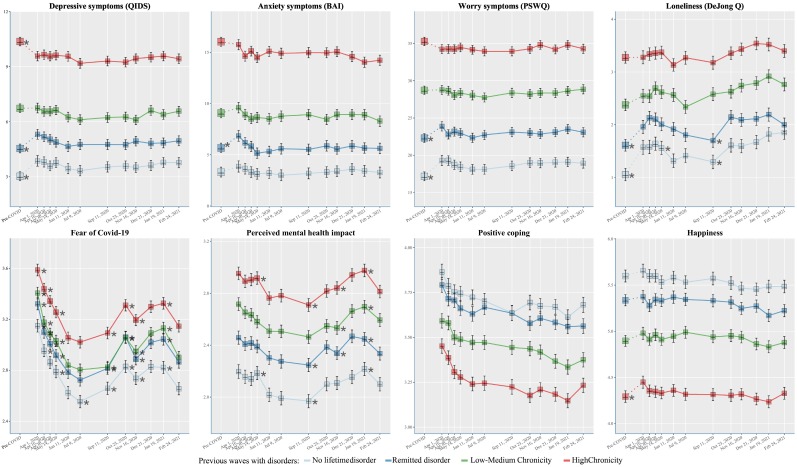
Depressive, anxiety and worry symptoms were stable since April-May 2020 whereas happiness slightly decreased. Furthermore, positive coping steadily decreased and loneliness increased - exceeding pre-Covid and April-May 2020 levels. Perceived mental health impact and fear of Covid-19 fluctuated in accordance with national Covid-19 mortality rate changes. Absolute levels of all outcomes were poorer with higher chronicity of disorders, yet trajectories did not differ among subgroups.
The most vulnerable psychiatric groups may have been underrepresented and results may not be generalizable to lower income countries.
After a year, levels of depressive and worry symptoms remained higher than before the pandemic in healthy control groups, yet not in psychiatric groups. Nevertheless, persistent high symptoms in psychiatric groups and increasing loneliness in all groups are specific points of concern for mental health care professionals.
在 2020 年的前几个月之外,人们对新冠疫情的长期影响知之甚少,尤其是对于那些患有先前存在的精神健康障碍的人。包括来自大型精神科队列的大流行前数据的研究很少。
在 2020 年 4 月至 2021 年 2 月期间,连续 12 次向荷兰抑郁与焦虑研究、荷兰老年抑郁研究和荷兰强迫症协会研究的参与者(N=1714,回复率为 62%)分发了在线调查问卷。结果是抑郁症状、焦虑、担忧、孤独感、对大流行的心理健康影响的感知、对新冠病毒的恐惧、积极应对和幸福感。我们使用线性混合模型比较了不同疾病慢性组与健康对照组之间的轨迹差异。
自 2020 年 4 月至 5 月以来,抑郁、焦虑和担忧症状一直稳定,而幸福感略有下降。此外,积极应对能力稳步下降,孤独感增加,超过了新冠疫情前和 2020 年 4 月至 5 月的水平。对心理健康的影响和对新冠病毒的恐惧随国家新冠病毒死亡率的变化而波动。所有结果的绝对水平在慢性疾病程度较高的情况下较差,但各组之间的轨迹没有差异。
最脆弱的精神科群体可能代表性不足,结果可能不适用于低收入国家。
一年后,健康对照组的抑郁和担忧症状水平仍高于大流行前,而在精神科组中则没有。然而,精神科组中持续的高症状和所有组中孤独感的增加是精神卫生保健专业人员特别关注的问题。