Department of Infectious Diseases, The First Affiliated Hospital of Guangxi Medical University, Nanning, Guangxi, People's Republic of China.
Technol Cancer Res Treat. 2020 Jan-Dec;19:1533033820980785. doi: 10.1177/1533033820980785.
To investigate the feasibility of serum extra spindle pole bodies-like 1 (ESPL1) used as a biomarker for patients with hepatitis B virus (HBV)-related hepatocellular carcinoma (HCC).
131 chronic HBV-infection patients were recruited and divided into HBV S gene integration, non-HBV S gene integration, chronic hepatitis B (CHB), HBV-related liver cirrhosis (LC) and HBV-related HCC group, 24 non-HBV-related HCC patients were selected as HCC control group, 30 people without HBV-infection as healthy control group. Serum ESPL1 were detected and compared.
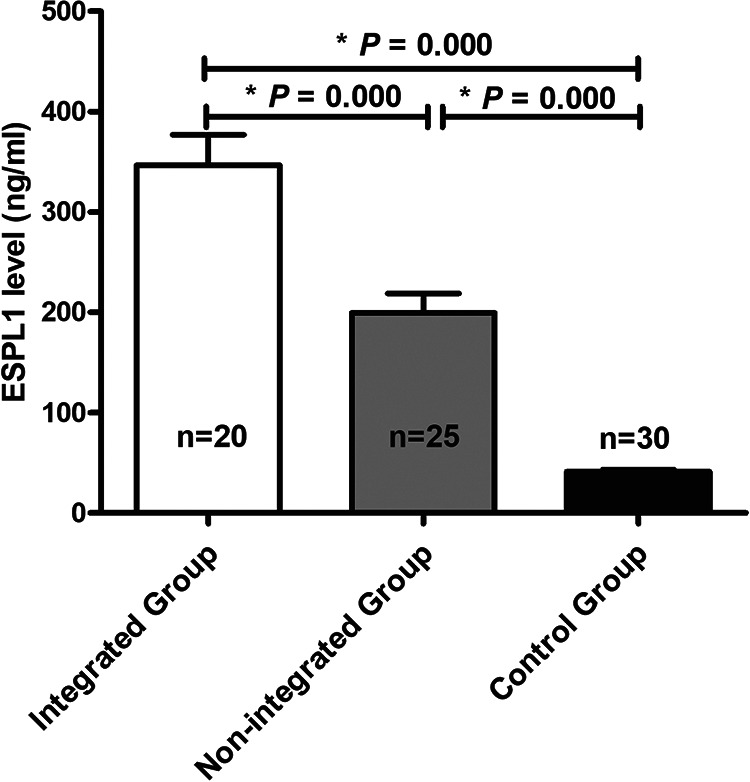
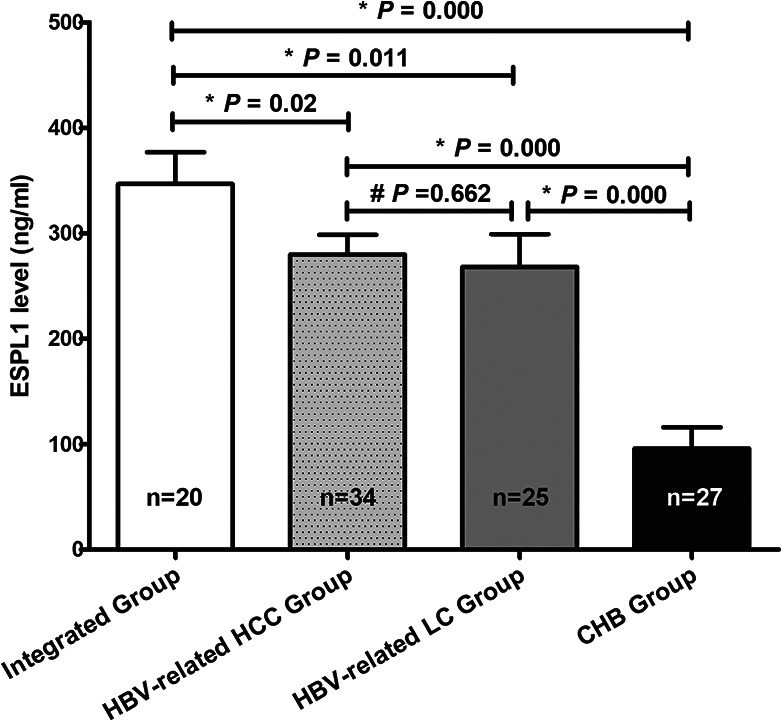
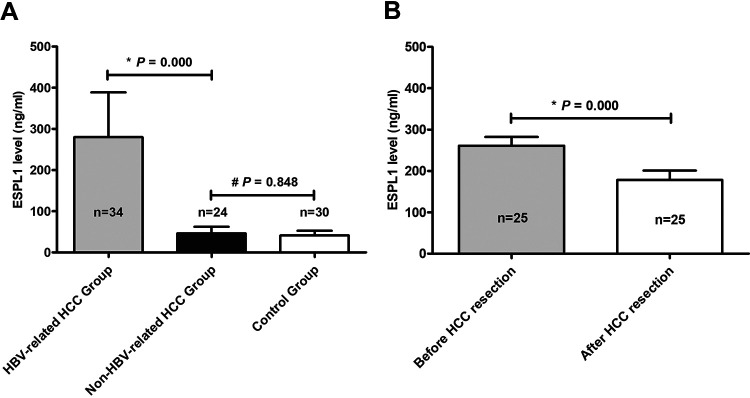
ESPL1 level of integration group was significantly higher than that of non-integration group (346.7 vs 199.6 ng/ml, = 0.000) and healthy control group (346.7 vs 41.3 ng/ml, = 0.000). ESPL1 level of non-integration group was significantly higher than that of healthy control group (199.6 vs 41.3 ng/ml, = 0.000); ESPL1 levels in chronic HBV-infection related groups were increased in turn according to CHB group (95.8 ng/ml), HBV-related LC group (268.2 ng/ml), HBV-related HCC group (279.9 ng/ml) and integration group (346.7 ng/ml). Except that there was no significant difference in ESPL1 levels between HBV-related LC and HCC group ( = 0.662), pairwise comparisons between other groups showed significant differences ( < 0.05). ESPL1 level of HBV-related HCC group was significantly higher than that of non-HBV-related HCC group (279.9 vs 46.6 ng/ml, = 0.000), there was no noticeable difference between non-HBV-related HCC and healthy control group (46.6 vs 41.3 ng/ml, = 0.848). ESPL1 level of HBV-related HCC group after resection was significantly lower than that of before resection (178.4 vs 260.8 ng/ml, = 0.000).
Chronic HBV-infection patients with high ESPL1 level may indicate HBV S gene integration and is a high-risk population for HBV-related HCC. Serum ESPL1 can be used as a biomarker for screening HBV-related HCC high-risk population and monitoring recurrence.
探讨血清额外纺锤体极体样 1(ESPL1)作为乙型肝炎病毒(HBV)相关肝细胞癌(HCC)患者标志物的可行性。
招募了 131 例慢性 HBV 感染患者,并将其分为 HBV S 基因整合、非 HBV S 基因整合、慢性乙型肝炎(CHB)、HBV 相关肝硬化(LC)和 HBV 相关 HCC 组,选择 24 例非 HBV 相关 HCC 患者作为 HCC 对照组,30 例无 HBV 感染的人作为健康对照组。检测血清 ESPL1 并进行比较。
整合组 ESPL1 水平明显高于非整合组(346.7 vs 199.6 ng/ml, = 0.000)和健康对照组(346.7 vs 41.3 ng/ml, = 0.000)。非整合组 ESPL1 水平明显高于健康对照组(199.6 vs 41.3 ng/ml, = 0.000);慢性 HBV 感染相关组的 ESPL1 水平依次升高,CHB 组(95.8 ng/ml)、HBV 相关 LC 组(268.2 ng/ml)、HBV 相关 HCC 组(279.9 ng/ml)和整合组(346.7 ng/ml)。除 HBV 相关 LC 和 HCC 组之间的 ESPL1 水平无显著差异( = 0.662)外,其他组之间的两两比较均有显著差异( < 0.05)。HBV 相关 HCC 组的 ESPL1 水平明显高于非 HBV 相关 HCC 组(279.9 vs 46.6 ng/ml, = 0.000),而非 HBV 相关 HCC 与健康对照组之间无明显差异(46.6 vs 41.3 ng/ml, = 0.848)。HBV 相关 HCC 组患者术后 ESPL1 水平明显低于术前(178.4 vs 260.8 ng/ml, = 0.000)。
慢性 HBV 感染患者 ESPL1 水平升高可能提示 HBV S 基因整合,是 HBV 相关 HCC 的高危人群。血清 ESPL1 可作为筛选 HBV 相关 HCC 高危人群和监测复发的标志物。