Harvard T. H. Chan School of Public Health, 677 Huntington Avenue, Boston, MA, 02115, USA.
Broad Institute, 415 Main St., Cambridge, MA, 02142, USA.
Genome Biol. 2020 Dec 11;21(1):301. doi: 10.1186/s13059-020-02209-7.
Staphylococcus aureus is a leading cause of healthcare- and community-associated infections and can be difficult to treat due to antimicrobial resistance. About 30% of individuals carry S. aureus asymptomatically in their nares, a risk factor for later infection, and interactions with other species in the nasal microbiome likely modulate its carriage. It is thus important to identify ecological or functional genetic elements within the maternal or infant nasal microbiomes that influence S. aureus acquisition and retention in early life.
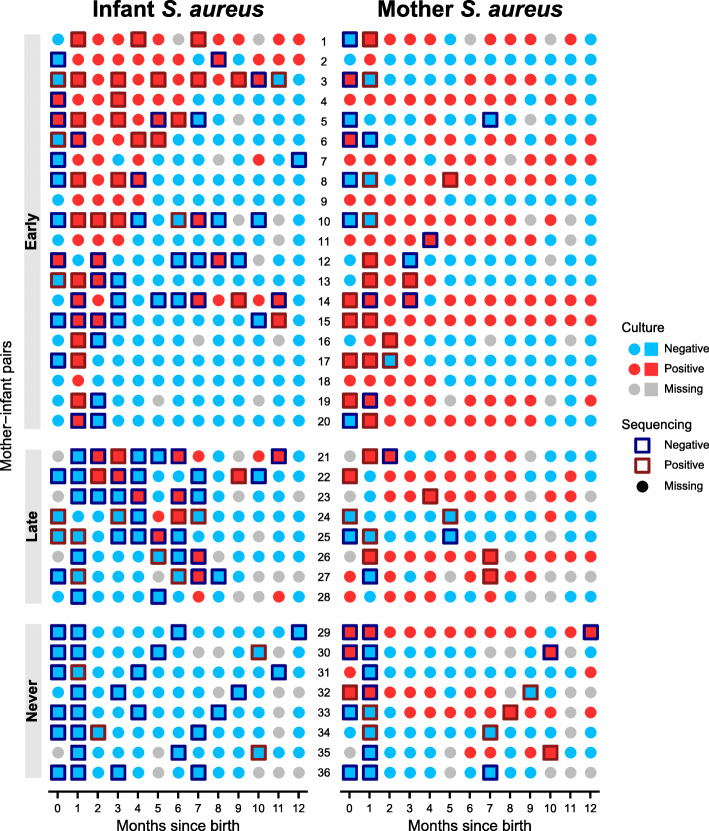
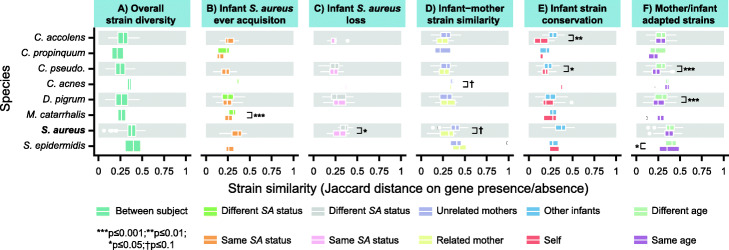
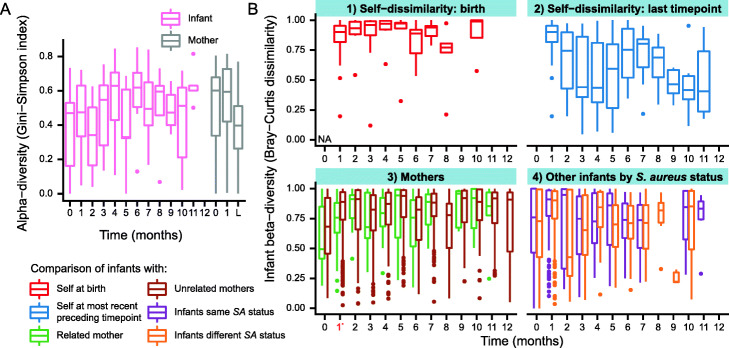
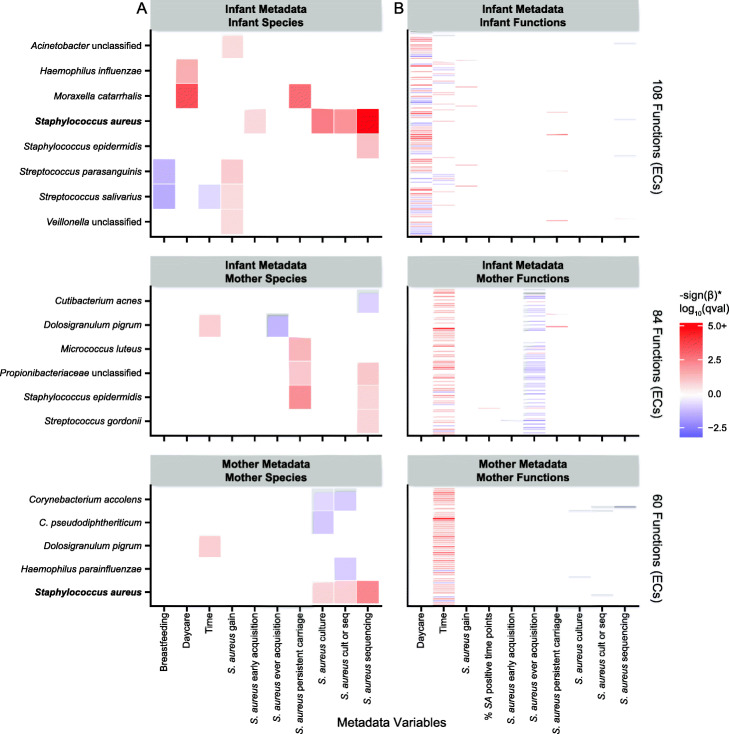
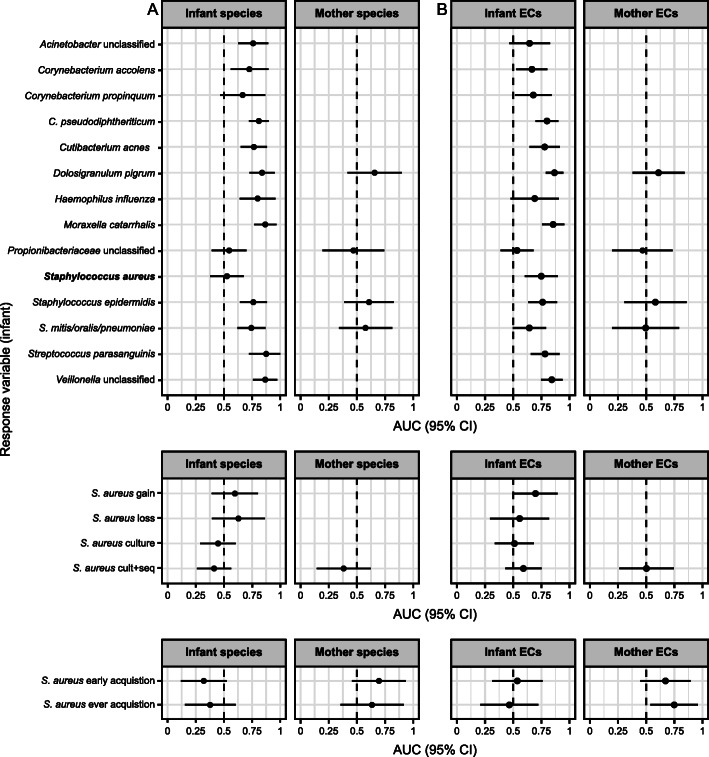
We recruited 36 mother-infant pairs and profiled a subset of monthly longitudinal nasal samples from the first year after birth using shotgun metagenomic sequencing. The infant nasal microbiome is highly variable, particularly within the first 2 months. It is weakly influenced by maternal nasal microbiome composition, but primarily shaped by developmental and external factors, such as daycare. Infants display distinctive patterns of S. aureus carriage, positively associated with Acinetobacter species, Streptococcus parasanguinis, Streptococcus salivarius, and Veillonella species and inversely associated with maternal Dolosigranulum pigrum. Furthermore, we identify a gene family, likely acting as a taxonomic marker for an unclassified species, that is significantly anti-correlated with S. aureus in infants and mothers. In gene content-based strain profiling, infant S. aureus strains are more similar to maternal strains.
This improved understanding of S. aureus colonization is an important first step toward the development of novel, ecological therapies for controlling S. aureus carriage.
金黄色葡萄球菌是导致医疗保健和社区相关感染的主要原因,由于其对抗菌药物的耐药性,治疗变得困难。大约 30%的个体无症状携带金黄色葡萄球菌在其鼻腔中,这是后期感染的一个风险因素,并且与鼻腔微生物组中的其他物种的相互作用可能会调节其携带情况。因此,确定母体或婴儿鼻腔微生物组中的生态或功能遗传元素,这些元素会影响金黄色葡萄球菌在生命早期的获得和保留,这一点很重要。
我们招募了 36 对母婴对,并使用鸟枪法宏基因组测序对出生后第一年的部分每月纵向鼻腔样本进行了分析。婴儿鼻腔微生物组高度多样化,尤其是在前 2 个月内。它受母体鼻腔微生物组组成的影响较弱,但主要由发育和外部因素(如日托)塑造。婴儿显示出独特的金黄色葡萄球菌携带模式,与不动杆菌属、副血链球菌、唾液链球菌和韦荣氏球菌属呈正相关,与母体多形拟杆菌呈负相关。此外,我们鉴定出一个基因家族,可能作为一个未分类物种的分类标记,与婴儿和母亲的金黄色葡萄球菌呈显著负相关。在基于基因内容的菌株分析中,婴儿金黄色葡萄球菌菌株与母体菌株更为相似。
对金黄色葡萄球菌定植的这种更深入的理解是开发新型生态疗法控制金黄色葡萄球菌定植的重要的第一步。