Fundació Institut Universitari per a la recerca a l'Atenció Primària de Salut Jordi Gol i Gurina (IDIAPJGol), Barcelona, Spain.
Primary Healthcare Centre Dreta de l'Eixample, Barcelona, Spain.
PLoS One. 2020 Dec 14;15(12):e0243974. doi: 10.1371/journal.pone.0243974. eCollection 2020.
Information about how patients with advanced heart failure (HF) live and cope with their disease remains scarce. The objective of this study was to explore, from phenomenological and holistic perspectives, the experiences of patients suffering from advanced HF, attended at home in the primary care setting in 2018.
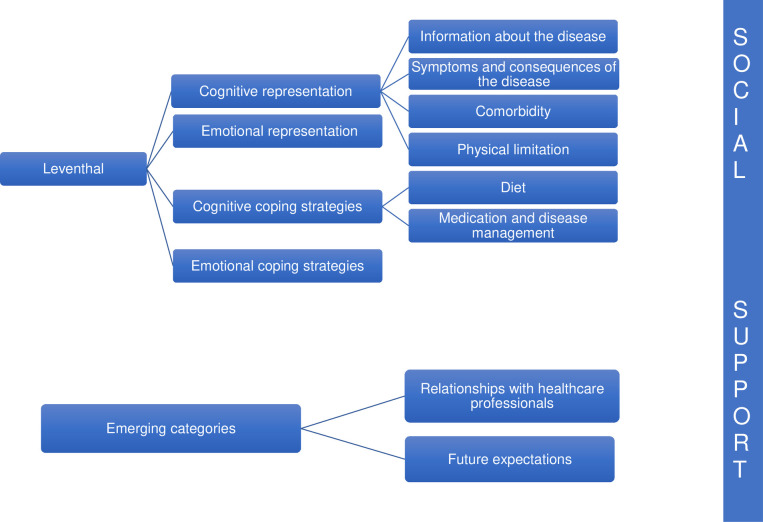
Qualitative study conducted in 4 primary healthcare centers in Barcelona (Spain). Twelve in-depth interviews were conducted in advanced HF patients, aged over 65 and visited regularly at home. We developed a purposeful sampling, accounting for variability in gender, age, and socioeconomic level. Leventhal's framework was used to analyze the interviews.
Participants received insufficient and contradictory information about HF. They talked about their cognitive representation and claimed a better communication with healthcare professionals. Due to their advanced age, subjects considered their daily living limitations to be normal rather than as a consequence of HF. Gender differences in emotional representation were clearly observed. Women considered themselves the keystone of correct family "functioning" and thought that they were not useful if they could not correspond to gendered societal expectations. Cognitive coping strategies included specific diets, taking medication, and registering weight and blood pressure. Nevertheless, they perceived the locus of control as external and felt unable to manage HF progression. Their emotional coping strategies included some activities at home such as watching television and reading. Social support was perceived crucial to the whole process.
Locus of control in advanced HF was perceived as external. Healthcare professionals should adapt emotional health interventions in patients with advanced HF based on a gender perspective. Social support was found to be crucial in facing the disease. Patients reported poor communication with healthcare professionals.
关于患有晚期心力衰竭(HF)的患者如何生活以及如何应对疾病的信息仍然很少。本研究的目的是从现象学和整体的角度探讨 2018 年在初级保健环境中在家中接受治疗的晚期 HF 患者的体验。
在巴塞罗那(西班牙)的 4 个初级保健中心进行了定性研究。对 12 名年龄在 65 岁以上且定期在家中接受访视的晚期 HF 患者进行了深入访谈。我们采用了有目的的抽样方法,考虑了性别、年龄和社会经济水平的变异性。采用 Leventhal 框架分析访谈。
参与者获得的关于 HF 的信息不足且相互矛盾。他们谈论了自己的认知表现,并声称与医疗保健专业人员进行了更好的沟通。由于年龄较大,患者认为他们的日常生活限制是正常的,而不是 HF 的结果。在情绪表现方面,明显观察到了性别差异。女性认为自己是家庭“正常运转”的关键,并且如果她们不能符合社会性别期望,则认为自己没有用处。认知应对策略包括特定的饮食、服用药物以及记录体重和血压。但是,他们认为控制的重心在外部,并且觉得自己无法控制 HF 的进展。他们的情绪应对策略包括在家中进行一些活动,例如看电视和阅读。社会支持被认为是整个过程的关键。
晚期 HF 的控制重心被认为是外部的。医疗保健专业人员应根据性别观点调整针对晚期 HF 患者的情绪健康干预措施。社会支持被发现对疾病的应对至关重要。患者报告称与医疗保健专业人员的沟通不畅。