Prabu Kumar Archana, Omprakash Abirami, Kuppusamy Maheshkumar, K N Maruthy, B W C Sathiyasekaran, P V Vijayaraghavan, Ramaswamy Padmavathi
Present Address: Medical Education Unit, College of Medicine and Medical Sciences, Arabian Gulf University, Manama, Bahrain.
Department of Physiology, Sri Ramachandra Medical College and Research Institute, Sri Ramachandra Institute of Higher Education and Research, Porur, Chennai, Tamil Nadu, India.
BMC Med Educ. 2020 Dec 14;20(1):507. doi: 10.1186/s12909-020-02416-7.
The reaction time (RT) is "the time taken for the appearance of rapid voluntary reaction by an individual following a stimulus, either auditory or visual" and the Critical Flickering Fusion Frequency (CFFF) is "the rate at which successively presented light stimuli appear to be steady and continuous". RT and CFFF are commonly used for the assessment of cognitive functions that are known to influence academic performance. However, data about the exact correlation between these are scarce, particularly in India. This research aimed to study the association between visual RT (VRT), auditory RT (ART) and CFFF and their impact on the academic performance of undergraduate students.
This cross-sectional study was conducted on 700 students of Faculty of Medicine and Dentistry at a private medical university in South India, during the period from 2015 to 2017. The VRT, ART and CFFF were evaluated, and the best out of three subsequent attempts was recorded. The mean score (in percentage) of the three best marks out of the five internal assessments for the course during each academic year was considered for analysis. The association between the different cognitive tests and the average academic performance was analysed.
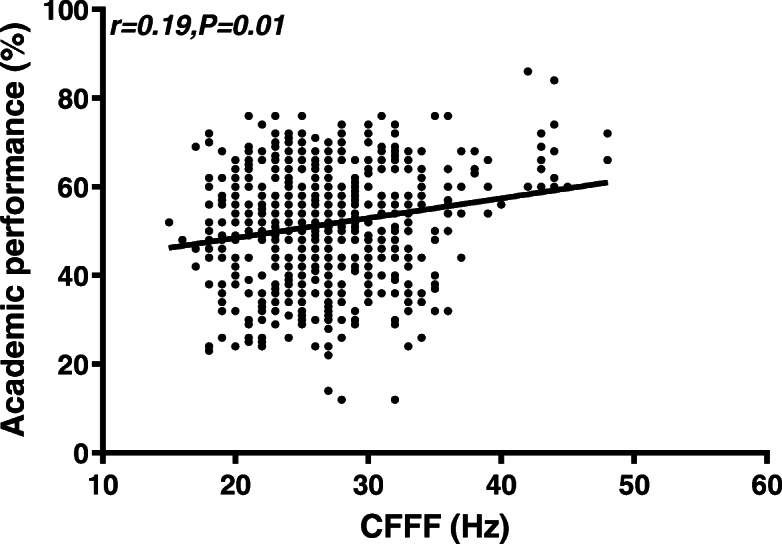
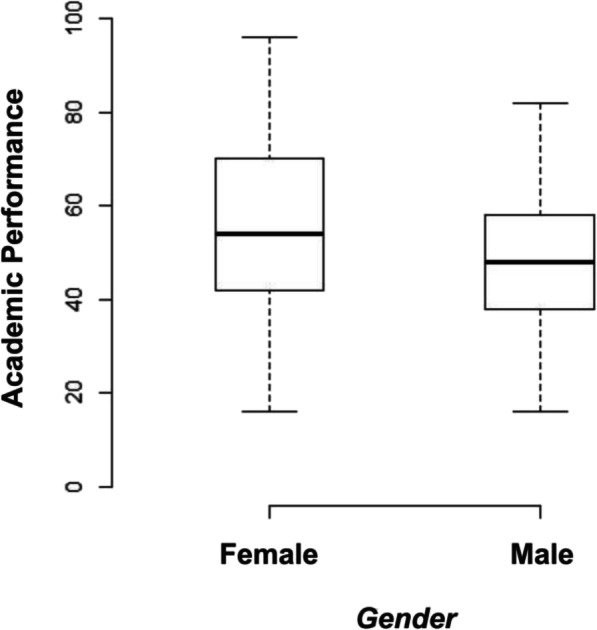
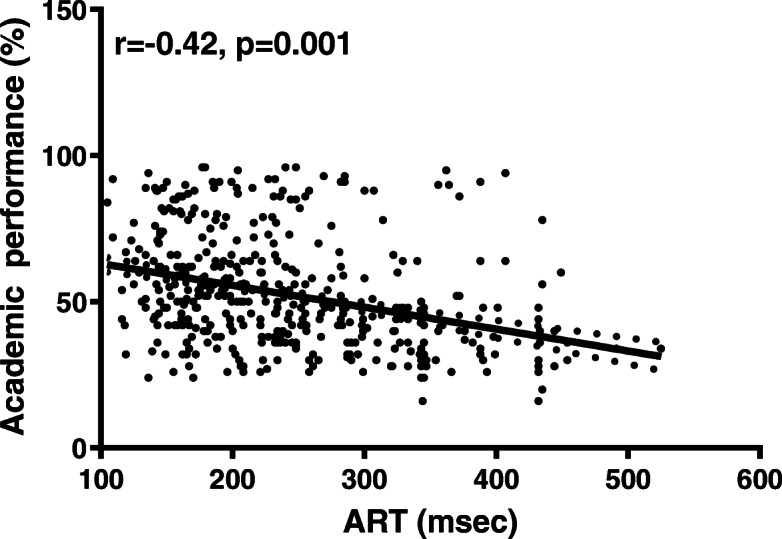
Female students had faster VRT (n = 345, mean = 243.97, SD = 83.87) than male students (n = 273, mean = 274.86, SD = 96.97) (p = 0.001). VRT and ART had a moderate negative correlation with academic performance (for ART, r = - 0.42, p < 0.001; for VRT; r = - 0.40, p < 0.001). CFFF had a very weak positive correlation with academic performance (r = 0.19, p = 0.01). The only independent predictors of academic performance were RT and gender (Adjusted R = 0.11).
Although there is a correlation between CFFF and cognitive function, our study showed only a weak correlation between CFFF and academic performance. Female students had faster RTs, and gender was an independent predictor of academic performance. Rather, students with faster RTs appear to have an advantage in academic performance.
反应时间(RT)是“个体在受到听觉或视觉刺激后出现快速自主反应所花费的时间”,临界闪烁融合频率(CFFF)是“连续呈现的光刺激看起来稳定且连续的速率”。RT和CFFF常用于评估已知会影响学业成绩的认知功能。然而,关于它们之间确切相关性的数据很少,尤其是在印度。本研究旨在探讨视觉反应时间(VRT)、听觉反应时间(ART)和CFFF之间的关联及其对本科生学业成绩的影响。
本横断面研究于2015年至2017年期间对印度南部一所私立医科大学的700名医科和牙科学院学生进行。评估了VRT、ART和CFFF,并记录了三次后续尝试中的最佳成绩。分析时考虑了每个学年该课程五次内部评估中三个最佳成绩的平均分数(以百分比表示)。分析了不同认知测试与平均学业成绩之间的关联。
女生的VRT(n = 345,平均值 = 243.97,标准差 = 83.87)比男生(n = 273,平均值 = 274.86,标准差 = 96.97)快(p = 0.001)。VRT和ART与学业成绩呈中度负相关(对于ART,r = -0.42,p < 0.001;对于VRT,r = -0.40,p < 0.001)。CFFF与学业成绩呈非常弱的正相关(r = 0.19,p = 0.01)。学业成绩的唯一独立预测因素是反应时间和性别(调整后的R = 0.11)。
虽然CFFF与认知功能之间存在相关性,但我们的研究表明CFFF与学业成绩之间只有微弱的相关性。女生的反应时间更快,性别是学业成绩的独立预测因素。相反,反应时间较快的学生在学业成绩上似乎具有优势。