Australian Centre for Health Engagement, Evidence and Values, School of Health & Society, University of Wollongong, Wollongong, Australia.
Sydney Health Ethics, School of Public Health, University of Sydney, Sydney, Australia.
Vaccine. 2021 Jan 8;39(2):255-262. doi: 10.1016/j.vaccine.2020.12.010. Epub 2020 Dec 13.
Pandemic planning has historically been oriented to respond to an influenza virus, with vaccination strategy being a key focus. As the current COVID-19 pandemic plays out, the Australian government is closely monitoring progress towards development of SARS-CoV2 vaccines as a definitive intervention. However, as in any pandemic, initial supply will likely be exceeded by demand due to limited manufacturing output.
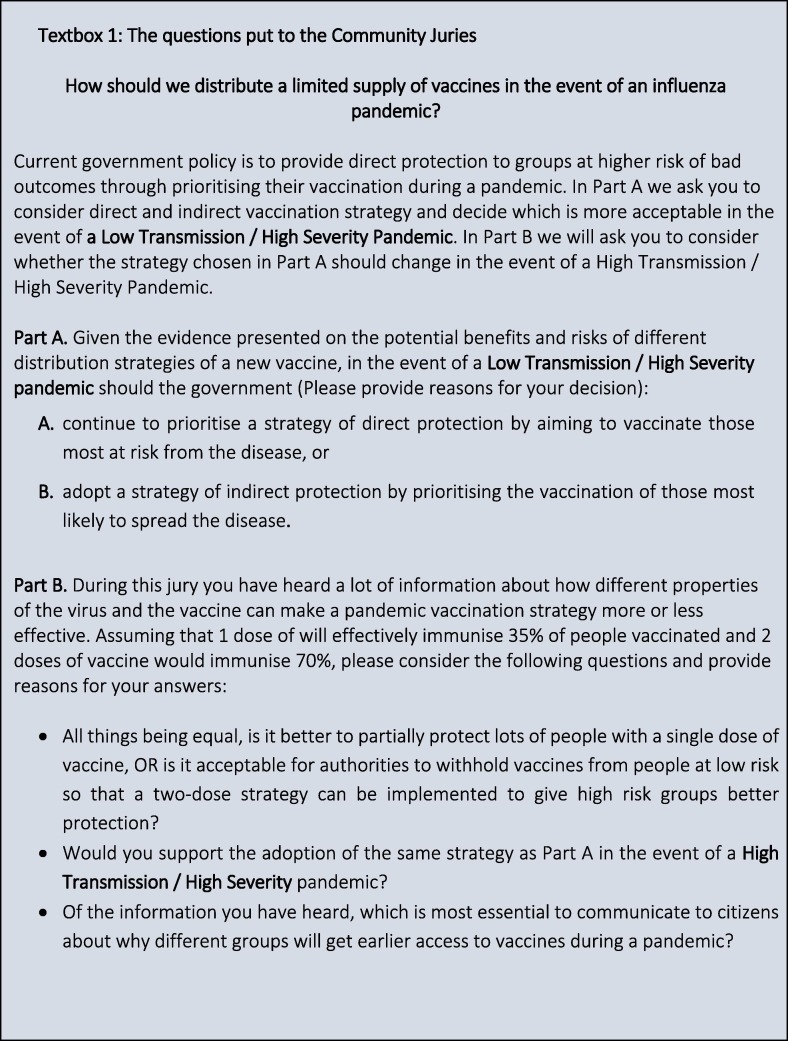
We convened community juries in three Australian locations in 2019 to assess public acceptability and perceived legitimacy of influenza pandemic vaccination distribution strategies. Preparatory work included literature reviews on pandemic vaccine allocation strategies and on vaccine allocation ethics, and simulation modelling studies. We assumed vaccine would be provided to predefined priority groups. Jurors were then asked to recommend one of two strategies for distributing remaining early doses of vaccine: directly vaccinate people at higher risk of adverse outcomes from influenza; or indirectly protect the general population by vaccinating primary school students, who are most likely to spread infection.
Thirty-four participants of diverse backgrounds and ages were recruited through random digit dialling and topic-blinded social media advertising. Juries heard evidence and arguments supporting different vaccine distribution strategies, and questioned expert presenters. All three community juries supported prioritising school children for influenza vaccination (aiming for indirect protection), one by 10-2 majority and two by consensus. Justifications included that indirect protection benefits more people and is likely to be more publicly acceptable.
In the context of an influenza pandemic, informed citizens were not opposed to prioritising groups at higher risks of adverse outcomes, but if resources and epidemiological conditions allow, achieving population benefits should be a strategic priority. These insights may inform future SARS-CoV-2 vaccination strategies.
大流行规划历来以应对流感病毒为导向,疫苗接种策略是重点。随着当前 COVID-19 大流行的发展,澳大利亚政府正在密切监测 SARS-CoV2 疫苗开发的进展,将其作为一种明确的干预措施。然而,与任何大流行一样,由于生产能力有限,初始供应可能会超过需求。
我们于 2019 年在澳大利亚的三个地点召集了社区陪审团,以评估公众对流感大流行疫苗接种分配策略的可接受性和合法性。前期工作包括对大流行疫苗分配策略和疫苗分配伦理的文献综述,以及模拟建模研究。我们假设疫苗将提供给预先定义的优先群体。然后,陪审员被要求为分配剩余早期剂量的疫苗推荐以下两种策略之一:直接为有更高流感不良后果风险的人接种疫苗;或者通过为最有可能传播感染的小学生接种疫苗来间接保护普通人群。
通过随机数字拨号和主题盲社交媒体广告招募了 34 名背景和年龄各异的参与者。陪审团听取了支持不同疫苗分配策略的证据和论点,并对专家证人进行了质询。所有三个社区陪审团都支持为流感接种疫苗的小学生(旨在间接保护),一个以 10-2 的多数票支持,两个以共识支持。理由包括间接保护使更多人受益,而且可能更受公众欢迎。
在流感大流行的背景下,知情公民并不反对优先考虑有不良后果高风险的群体,但如果资源和流行病学条件允许,实现人群利益应成为战略重点。这些见解可能为未来的 SARS-CoV-2 疫苗接种策略提供信息。