Li Ru, Wen Annie, Lin Jun
Department of Anesthesiology, Stony Brook University Health Sciences Center, Stony Brook, NY 11794-8480, USA.
Cancers (Basel). 2020 Dec 13;12(12):3752. doi: 10.3390/cancers12123752.
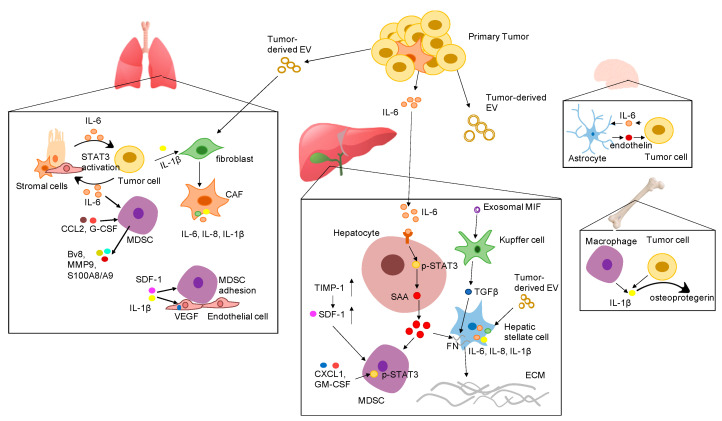
In the presence of a primary tumor, the pre-metastatic niche is established in secondary organs as a favorable microenvironment for subsequent tumor metastases. This process is orchestrated by bone marrow-derived cells, primary tumor-derived factors, and extracellular matrix. In this review, we summarize the role of pro-inflammatory cytokines including interleukin (IL)-6, IL-1β, CC-chemokine ligand 2 (CCL2), granulocyte-colony stimulating factor (G-CSF), granulocyte-macrophage colony-stimulating factor (GM-CSF), stromal cell-derived factor (SDF)-1, macrophage migration inhibitory factor (MIF), and Chemokine (C-X-C motif) ligand 1 (CXCL1) in the formation of the pre-metastatic niche according to the most recent studies. Pro-inflammatory cytokines released from tumor cells or stromal cells act in both autocrine and paracrine manners to induce phenotype changes in tumor cells, recruit bone marrow-derived cells, and form an inflammatory milieu, all of which prime a secondary organ's microenvironment for metastatic cell colonization. Considering the active involvement of pro-inflammatory cytokines in niche formation, clinical strategies targeting them offer ways to inhibit the establishment of the pre-metastatic niche and therefore attenuate metastatic progression. We review clinical trials targeting different inflammatory cytokines in patients with metastatic cancers. Due to the pleiotropy and redundancy of pro-inflammatory cytokines, combined therapies should be designed in the future.
在原发性肿瘤存在的情况下,转移前生态位在次级器官中形成,成为后续肿瘤转移的有利微环境。这一过程由骨髓来源的细胞、原发性肿瘤来源的因子和细胞外基质共同协调。在本综述中,我们根据最新研究总结了促炎细胞因子在转移前生态位形成中的作用,这些促炎细胞因子包括白细胞介素(IL)-6、IL-1β、CC趋化因子配体2(CCL2)、粒细胞集落刺激因子(G-CSF)、粒细胞巨噬细胞集落刺激因子(GM-CSF)、基质细胞衍生因子(SDF)-1、巨噬细胞迁移抑制因子(MIF)和趋化因子(C-X-C基序)配体1(CXCL1)。肿瘤细胞或基质细胞释放的促炎细胞因子以自分泌和旁分泌方式发挥作用,诱导肿瘤细胞表型改变,募集骨髓来源的细胞,并形成炎症环境,所有这些都为转移细胞定植准备了次级器官的微环境。鉴于促炎细胞因子积极参与生态位形成,针对它们的临床策略提供了抑制转移前生态位建立从而减轻转移进展的方法。我们综述了针对转移性癌症患者不同炎症细胞因子的临床试验。由于促炎细胞因子的多效性和冗余性,未来应设计联合疗法。