Ribeiro Deidiane Elisa, Oliveira-Giacomelli Ágatha, Glaser Talita, Arnaud-Sampaio Vanessa F, Andrejew Roberta, Dieckmann Luiz, Baranova Juliana, Lameu Claudiana, Ratajczak Mariusz Z, Ulrich Henning
Department of Biochemistry, Institute of Chemistry, University of São Paulo, São Paulo, Brazil.
Department of Psychiatry, Federal University of São Paulo, São Paulo, Brazil.
Mol Psychiatry. 2021 Apr;26(4):1044-1059. doi: 10.1038/s41380-020-00965-3. Epub 2020 Dec 16.
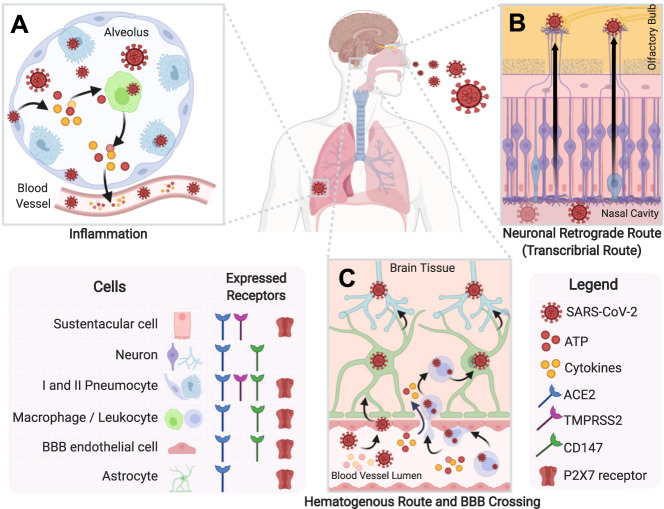
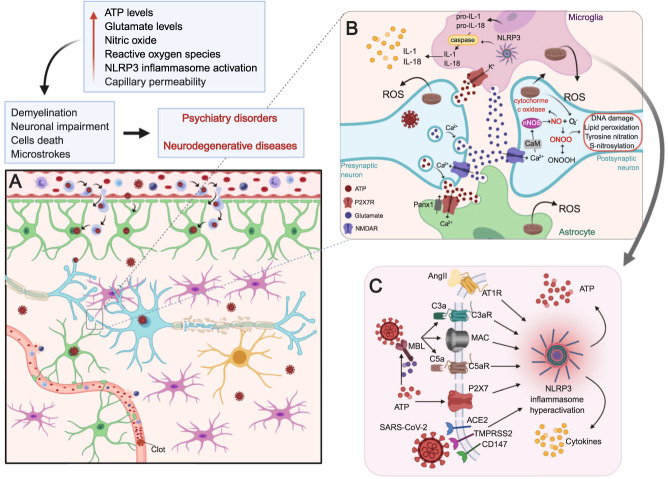
Scientists and health professionals are exhaustively trying to contain the coronavirus disease 2019 (COVID-19) pandemic by elucidating viral invasion mechanisms, possible drugs to prevent viral infection/replication, and health cares to minimize individual exposure. Although neurological symptoms are being reported worldwide, neural acute and long-term consequences of SARS-CoV-2 are still unknown. COVID-19 complications are associated with exacerbated immunoinflammatory responses to SARS-CoV-2 invasion. In this scenario, pro-inflammatory factors are intensely released into the bloodstream, causing the so-called "cytokine storm". Both pro-inflammatory factors and viruses may cross the blood-brain barrier and enter the central nervous system, activating neuroinflammatory responses accompanied by hemorrhagic lesions and neuronal impairment, which are largely described processes in psychiatric disorders and neurodegenerative diseases. Therefore, SARS-CoV-2 infection could trigger and/or worse brain diseases. Moreover, patients with central nervous system disorders associated to neuroimmune activation (e.g. depression, Parkinson's and Alzheimer's disease) may present increased susceptibility to SARS-CoV-2 infection and/or achieve severe conditions. Elevated levels of extracellular ATP induced by SARS-CoV-2 infection may trigger hyperactivation of P2X7 receptors leading to NLRP3 inflammasome stimulation as a key mediator of neuroinvasion and consequent neuroinflammatory processes, as observed in psychiatric disorders and neurodegenerative diseases. In this context, P2X7 receptor antagonism could be a promising strategy to prevent or treat neurological complications in COVID-19 patients.
科学家和健康专家正在竭尽全力,通过阐明病毒入侵机制、预防病毒感染/复制的可能药物以及尽量减少个人接触的医疗措施,来遏制2019冠状病毒病(COVID-19)大流行。尽管全球都在报告神经系统症状,但严重急性呼吸综合征冠状病毒2(SARS-CoV-2)对神经的急性和长期影响仍然未知。COVID-19并发症与对SARS-CoV-2入侵加剧的免疫炎症反应有关。在这种情况下,促炎因子会大量释放到血液中,引发所谓的“细胞因子风暴”。促炎因子和病毒都可能穿过血脑屏障进入中枢神经系统,激活伴有出血性病变和神经元损伤的神经炎症反应,而这些在精神疾病和神经退行性疾病中大多是常见的过程。因此,SARS-CoV-2感染可能引发和/或加重脑部疾病。此外,与神经免疫激活相关的中枢神经系统疾病(如抑郁症、帕金森病和阿尔茨海默病)患者可能对SARS-CoV-2感染的易感性增加和/或病情严重。如在精神疾病和神经退行性疾病中所观察到的,SARS-CoV-2感染诱导的细胞外ATP水平升高可能触发P2X7受体的过度激活,导致NLRP3炎性小体的刺激,这是神经侵袭和随之而来的神经炎症过程的关键介质。在这种情况下,P2X7受体拮抗作用可能是预防或治疗COVID-19患者神经并发症的一种有前景的策略。