American Association of Kidney Patients, Tampa, FL, USA.
Neuroscience Research Center, Iran University of Medical Sciences, Tehran, Iran.
Cell Mol Biol Lett. 2022 Feb 2;27(1):10. doi: 10.1186/s11658-022-00311-1.
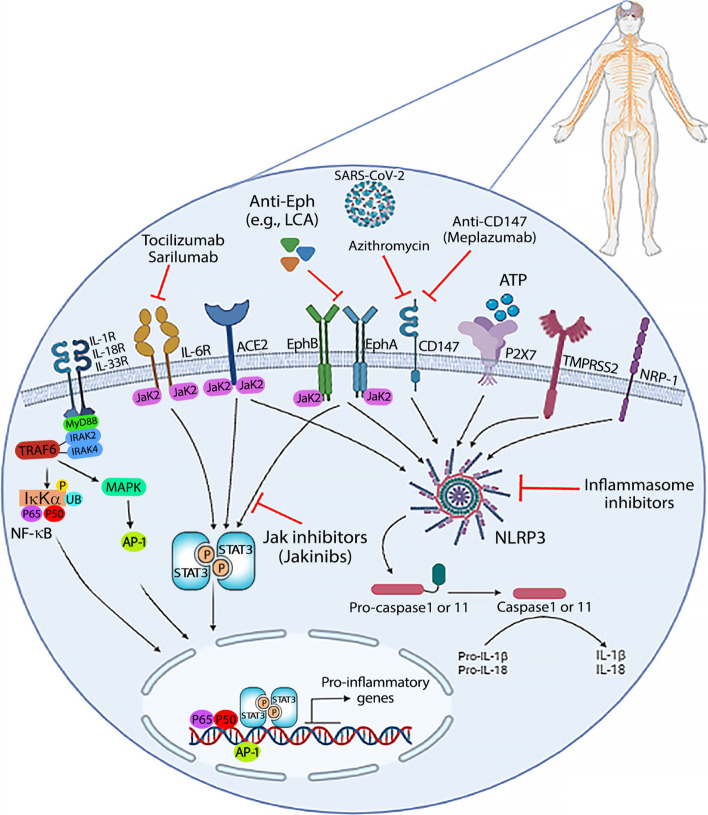
The novel coronavirus disease 2019 (COVID-19) pandemic has spread worldwide, and finding a safe therapeutic strategy and effective vaccine is critical to overcoming severe acute respiratory syndrome coronavirus 2 (SARS-CoV-2). Therefore, elucidation of pathogenesis mechanisms, especially entry routes of SARS-CoV-2 may help propose antiviral drugs and novel vaccines. Several receptors have been demonstrated for the interaction of spike (S) protein of SARS-CoV-2 with host cells, including angiotensin-converting enzyme (ACE2), ephrin ligands and Eph receptors, neuropilin 1 (NRP-1), P2X7, and CD147. The expression of these entry receptors in the central nervous system (CNS) may make the CNS prone to SARS-CoV-2 invasion, leading to neurodegenerative diseases. The present review provides potential pathological mechanisms of SARS-CoV-2 infection in the CNS, including entry receptors and cytokines involved in neuroinflammatory conditions. Moreover, it explains several neurodegenerative disorders associated with COVID-19. Finally, we suggest inflammasome and JaK inhibitors as potential therapeutic strategies for neurodegenerative diseases.
新型冠状病毒病 2019(COVID-19)大流行已在全球范围内蔓延,寻找安全的治疗策略和有效的疫苗对于克服严重急性呼吸系统综合征冠状病毒 2(SARS-CoV-2)至关重要。因此,阐明发病机制,特别是 SARS-CoV-2 的进入途径可能有助于提出抗病毒药物和新型疫苗。已经证明有几种受体可用于 SARS-CoV-2 的刺突(S)蛋白与宿主细胞相互作用,包括血管紧张素转换酶(ACE2)、表皮生长因子配体和 Eph 受体、神经纤毛蛋白 1(NRP-1)、P2X7 和 CD147。这些进入受体在中枢神经系统(CNS)中的表达可能使 CNS 容易受到 SARS-CoV-2 的侵袭,导致神经退行性疾病。本综述提供了 SARS-CoV-2 感染 CNS 的潜在病理机制,包括参与神经炎症状态的进入受体和细胞因子。此外,还解释了与 COVID-19 相关的几种神经退行性疾病。最后,我们建议使用炎症小体和 JaK 抑制剂作为神经退行性疾病的潜在治疗策略。