Department of Neurosurgery, Clinical Neuroscience Research Center, Tulane University School of Medicine, New Orleans, LA, 70112, USA.
Department of Neurology, Tulane University School of Medicine, New Orleans, LA, 70112, USA.
Cytokine Growth Factor Rev. 2021 Apr;58:1-15. doi: 10.1016/j.cytogfr.2021.02.002. Epub 2021 Feb 19.
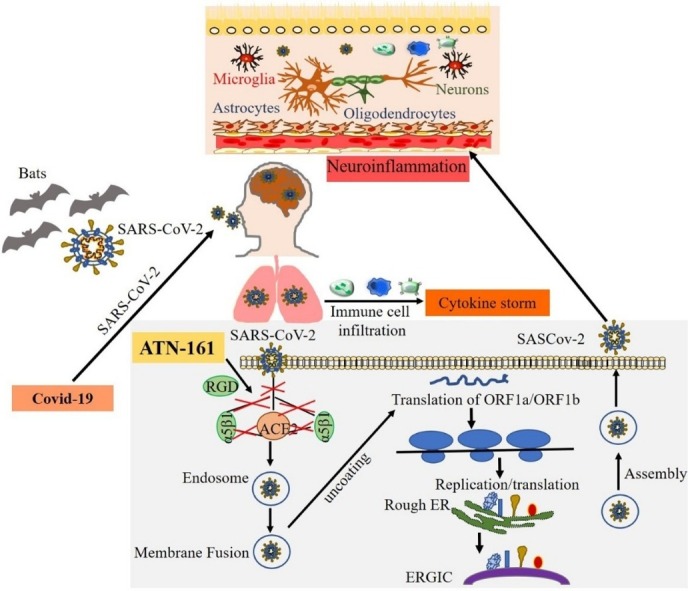
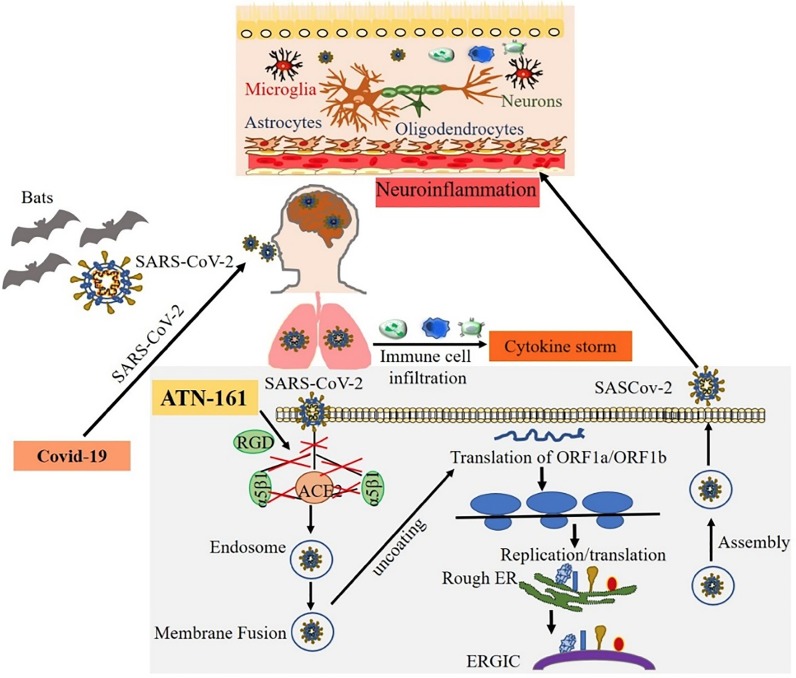
SARS-CoV-2 is a novel coronavirus that severely affects the respiratory system, is the cause of the COVID-19 pandemic, and is projected to result in the deaths of 2 million people worldwide. Recent reports suggest that SARS-CoV-2 also affects the central nervous system along with other organs. COVID-19-associated complications are observed in older people with underlying neurological conditions like stroke, Alzheimer's disease, and Parkinson's disease. Hence, we discuss SARS-CoV-2 viral replication and its inflammation-mediated infection. This review also focuses on COVID-19 associated neurological complications in individuals with those complications as well as other groups of people. Finally, we also briefly discuss the current therapies available to treat patients, as well as ongoing available treatments and vaccines for effective cures with a special focus on the therapeutic potential of a small 5 amino acid peptide (PHSCN), ATN-161, that inhibits SARS-CoV-2 spike protein binding to both integrin α5β1 and α5β1/hACE2.
新型冠状病毒(SARS-CoV-2)是一种严重影响呼吸系统的新型冠状病毒,是 COVID-19 大流行的病因,预计将导致全球 200 万人死亡。最近的报告表明,SARS-CoV-2 还会影响中枢神经系统和其他器官。患有中风、阿尔茨海默病和帕金森病等潜在神经疾病的老年人会出现与 COVID-19 相关的并发症。因此,我们讨论了 SARS-CoV-2 病毒的复制及其炎症介导的感染。本综述还重点介绍了患有这些并发症以及其他人群的 COVID-19 相关神经并发症。最后,我们还简要讨论了目前可用于治疗患者的疗法,以及正在进行的可用治疗方法和疫苗,特别关注一种 5 个氨基酸小肽(PHSCN)、ATN-161 的治疗潜力,该肽可抑制 SARS-CoV-2 刺突蛋白与整合素 α5β1 和 α5β1/hACE2 的结合。