Li Yi, Yin Lu, Fan Zhongmin, Su Binxiao, Chen Yu, Ma Yan, Zhong Ya, Hou Wugang, Fang Zongping, Zhang Xijing
Department of Anaesthesiology and Perioperative Medicine, Xijing Hospital, The Fourth Military Medical University, Xi'an, China.
Front Pharmacol. 2020 Nov 27;11:600421. doi: 10.3389/fphar.2020.600421. eCollection 2020.
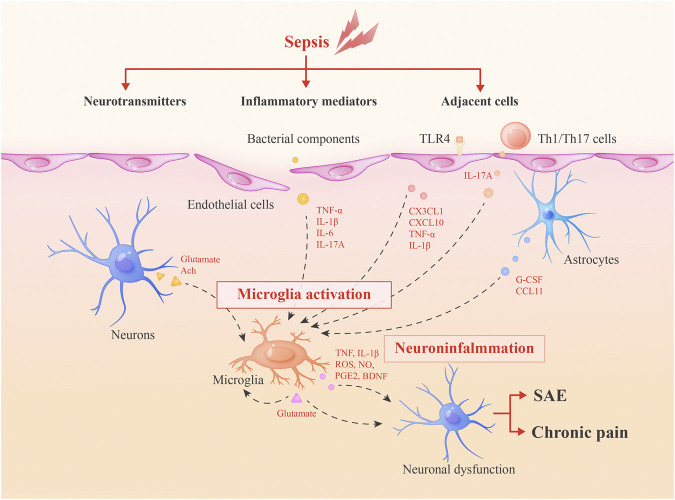
Neurological dysfunction, one of the severe manifestations of sepsis in patients, is closely related to increased mortality and long-term complications in intensive care units, including sepsis-associated encephalopathy (SAE) and chronic pain. The underlying mechanisms of these sepsis-induced neurological dysfunctions are elusive. However, it has been well established that microglia, the dominant resident immune cell in the central nervous system, play essential roles in the initiation and development of SAE and chronic pain. Microglia can be activated by inflammatory mediators, adjacent cells and neurotransmitters in the acute phase of sepsis and then induce neuronal dysfunction in the brain. With the spotlight focused on the relationship between microglia and sepsis, a deeper understanding of microglia in SAE and chronic pain can be achieved. More importantly, clarifying the mechanisms of sepsis-associated signaling pathways in microglia would shed new light on treatment strategies for SAE and chronic pain.
神经功能障碍是脓毒症患者的严重表现之一,与重症监护病房患者死亡率增加及长期并发症密切相关,包括脓毒症相关性脑病(SAE)和慢性疼痛。这些脓毒症诱导的神经功能障碍的潜在机制尚不清楚。然而,已经明确的是,小胶质细胞作为中枢神经系统中主要的常驻免疫细胞,在SAE和慢性疼痛的发生发展中起重要作用。在脓毒症急性期,小胶质细胞可被炎症介质、相邻细胞和神经递质激活,进而诱导大脑中的神经元功能障碍。随着对小胶质细胞与脓毒症之间关系的关注,人们对SAE和慢性疼痛中的小胶质细胞有了更深入的了解。更重要的是,阐明小胶质细胞中脓毒症相关信号通路的机制将为SAE和慢性疼痛的治疗策略提供新的思路。