Janiri Delfina, Petracca Martina, Moccia Lorenzo, Tricoli Luca, Piano Carla, Bove Francesco, Imbimbo Isabella, Simonetti Alessio, Di Nicola Marco, Sani Gabriele, Calabresi Paolo, Bentivoglio Anna Rita
Department of Psychiatry, Fondazione Policlinico Universitario Agostino Gemelli IRCCS, Rome, Italy.
Department of Psychiatry and Neurology, Sapienza University of Rome, Rome, Italy.
Front Psychiatry. 2020 Nov 27;11:581144. doi: 10.3389/fpsyt.2020.581144. eCollection 2020.
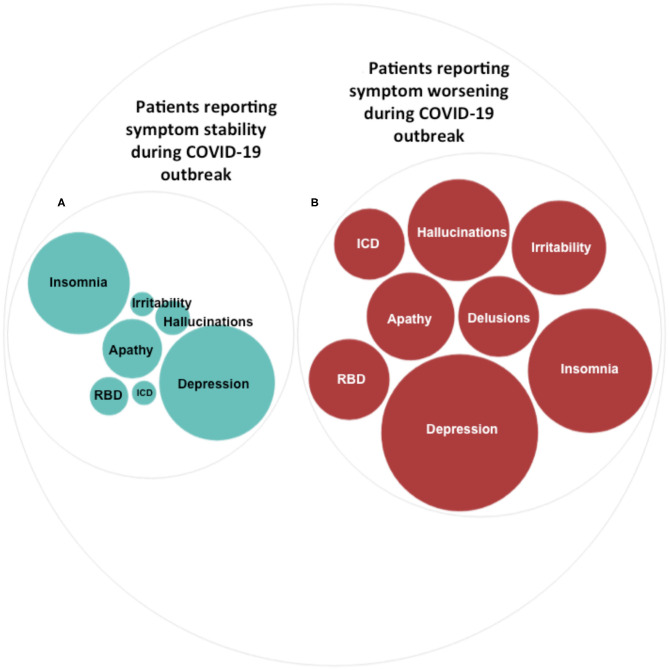
The coronavirus disease 2019 (COVID-19) pandemic represents a condition of increased vulnerability and frailty for elderly patients with Parkinson's disease (PD). Social isolation may worsen the burden of the disease and specifically exacerbate psychiatric symptoms, often comorbid with PD. This study aimed at identifying risk/protective factors associated with subjective worsening of psychiatric symptomatology during the COVID-19 outbreak in a sample of individuals with PD aged 65 years or older. Patients with PD routinely followed at the outpatient clinic of Gemelli University Hospital, Rome, were assessed for subjective worsening of psychiatric symptoms through a dedicated telephone survey, after Italy COVID-19 lockdown. Patients' medical records were reviewed to collect sociodemographic and clinical data, including lifetime psychiatric symptoms and pharmacological treatment. Overall, 134 individuals were assessed and 101 (75.4%) reported lifetime psychiatric symptoms. Among those, 23 (22.8%) presented with subjective worsening of psychiatric symptomatology during the COVID-19 outbreak. In this group, the most frequent symptom was depression (82.6%), followed by insomnia (52.2%). Subjective worsening of neurological symptoms (Wald = 24.03, df = 1, = 0.001) and lifetime irritability (Wald = 6.35, df = 1, = 0.020), together with younger age (Wald = 5.06, df = 1, = 0.038) and female sex (Wald = 9.07 df = 1, = 0.007), resulted as specific risk factors for ingravescence of psychiatric presentation. Lifetime pre-existing delusions, having received antipsychotics, and not having received mood stabilizer were also associated with subjective worsening of psychiatric symptomatology due to the COVID-19 pandemic. Individuals with PD and lifetime history of psychiatric symptoms may be exposed to increased vulnerability to the stressful effect of COVID-19 outbreak. Interventions aimed at reducing irritability and mood instability might have an indirect effect on the health of patients with PD during the COVID-19 pandemic.
2019年冠状病毒病(COVID-19)大流行对患有帕金森病(PD)的老年患者来说,意味着他们更易患病且身体更虚弱。社交隔离可能会加重病情负担,尤其会加剧通常与PD并存的精神症状。本研究旨在确定在COVID-19疫情期间,65岁及以上PD患者样本中与精神症状主观恶化相关的风险/保护因素。罗马杰梅利大学医院门诊常规随访的PD患者,在意大利实施COVID-19封锁后,通过专门的电话调查评估其精神症状的主观恶化情况。查阅患者的病历以收集社会人口学和临床数据,包括终生精神症状和药物治疗情况。总体而言,共评估了134人,其中101人(75.4%)报告有终生精神症状。在这些人中,23人(22.8%)在COVID-19疫情期间出现精神症状主观恶化。在这组人群中,最常见的症状是抑郁(82.6%),其次是失眠(52.2%)。神经症状主观恶化(Wald = 24.03,自由度 = 1,P = 0.001)、终生易怒(Wald = 6.35,自由度 = 1,P = 0.020),以及较年轻的年龄(Wald = 5.06,自由度 = 1,P = 0.038)和女性(Wald = 9.07,自由度 = 1,P = 0.007),是精神症状加重的特定风险因素。终生存在的妄想、接受过抗精神病药物治疗以及未接受过情绪稳定剂治疗,也与COVID-19大流行导致的精神症状主观恶化有关。有PD且有终生精神症状史的个体,可能更容易受到COVID-19疫情压力效应的影响。在COVID-19大流行期间,旨在减轻易怒和情绪不稳定的干预措施可能会对PD患者的健康产生间接影响。