Sng Christopher C T, Wong Yien Ning Sophia, Wu Anjui, Ottaviani Diego, Chopra Neha, Galazi Myria, Benafif Sarah, Soosaipillai Gehan, Roylance Rebecca, Lee Alvin J X, Shaw Heather
Cancer Division, University College London Hospitals NHS Foundation Trust, London, United Kingdom.
UCL Cancer Institute, University College London, London, United Kingdom.
Front Oncol. 2020 Nov 20;10:595804. doi: 10.3389/fonc.2020.595804. eCollection 2020.
The COVID-19 pandemic remains a pressing concern to patients with cancer as countries enter the second peak of the pandemic and beyond. It remains unclear whether cancer and its treatment contribute an independent risk for mortality in COVID-19.
We included patients at a London tertiary hospital with laboratory confirmed SARS-CoV-2 infection. All patients with a history of solid cancer were included. Age- and sex-matched patients without cancer were randomly selected. Patients with hematological malignancies were excluded.
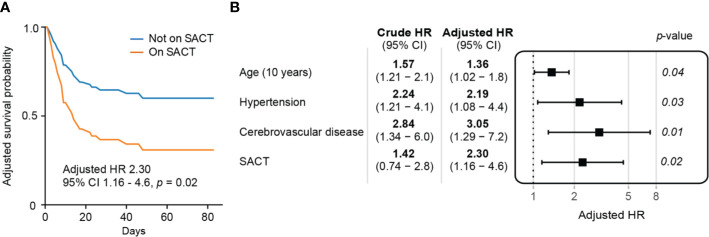
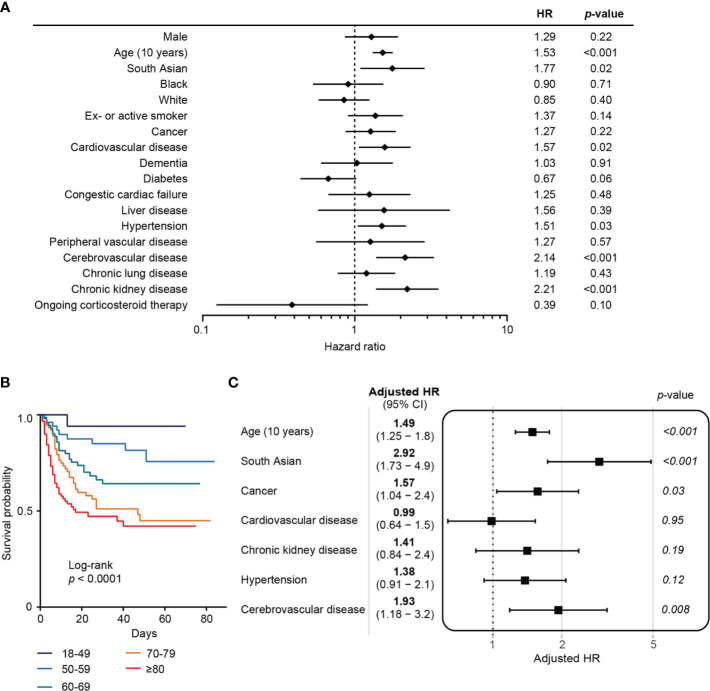
We identified 94 patients with cancer, matched to 226 patients without cancer. After adjusting for age, ethnicity, and co-morbidities, patients with cancer had increased mortality following COVID-19 (HR 1.57, 95% CI:1.04-2.4, = 0.03). Increasing age (HR 1.49 every 10 years, 95% CI:1.25-1.8, < 0.001), South Asian ethnicity (HR 2.92, 95% CI:1.73-4.9, < 0.001), and cerebrovascular disease (HR 1.93, 95% CI:1.18-3.2, = 0.008) also predicted mortality. Within the cancer cohort, systemic anti-cancer therapy (SACT) within 60 days of COVID-19 diagnosis was an independent risk factor for mortality (HR 2.30, 95% CI: 1.16-4.6, = 0.02).
Along with known risk factors, cancer and SACT confer an independent risk for mortality following COVID-19. Further studies are needed to understand the socio-economic influences and pathophysiology of these associations.
随着各国进入新冠疫情的第二个高峰及之后阶段,新冠疫情仍是癌症患者面临的紧迫问题。目前尚不清楚癌症及其治疗是否会增加新冠患者死亡的独立风险。
我们纳入了伦敦一家三级医院中实验室确诊感染严重急性呼吸综合征冠状病毒2(SARS-CoV-2)的患者。所有有实体癌病史的患者均被纳入。随机选择年龄和性别匹配的无癌症患者。血液系统恶性肿瘤患者被排除。
我们确定了94例癌症患者,并与226例无癌症患者进行匹配。在调整年龄、种族和合并症后,癌症患者在感染新冠病毒后的死亡率有所增加(风险比1.57,95%置信区间:1.04 - 2.4,P = 0.03)。年龄增长(每10岁风险比1.49,95%置信区间:1.25 - 1.8,P < 0.001)、南亚种族(风险比2.92,95%置信区间:1.73 - 4.9,P < 0.001)和脑血管疾病(风险比1.93,95%置信区间:1.18 - 3.2,P = 0.008)也预示着更高的死亡率。在癌症队列中,新冠病毒诊断后60天内进行的全身抗癌治疗(SACT)是死亡的独立危险因素(风险比2.30,95%置信区间:1.16 - 4.6,P = 0.02)。
除了已知的风险因素外,癌症和全身抗癌治疗会增加新冠病毒感染后死亡的独立风险。需要进一步研究以了解这些关联的社会经济影响和病理生理学机制。