Kim Ri Na, Lee Jin-Hyuck, Hong Seok Ha, Jeon Jin Ho, Jeong Woong Kyo
Department of Rehabilitation Medicine, Sahmyook Medical Center, Seoul, Korea.
Sports Medical Center, Korea University Anam Hospital, Seoul, Korea.
Clin Shoulder Elb. 2018 Sep 1;21(3):145-150. doi: 10.5397/cise.2018.21.3.145. eCollection 2018 Sep.
This study evaluated the shoulder girdle muscle characteristics of elite archery athletes and provides suggestions for archery training programs.
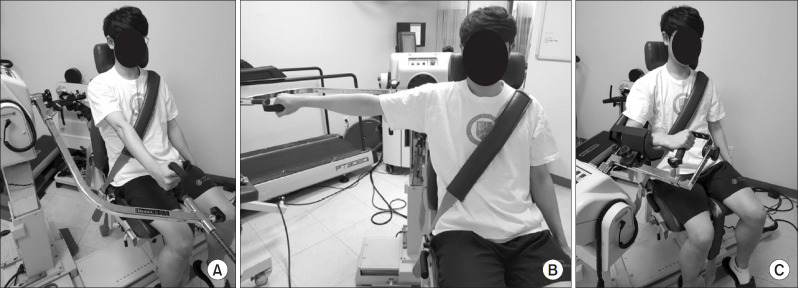
This study enrolled 15 cases of high level archery athletes (7 males, 8 females) and 30 cases of (15 males, 15 females) sex, age-matched, healthy, non-athletic individuals. We measured peak torques of flexion (FL), extension (EX), abduction (ABD), adduction (ADD), external rotation (ER) and internal rotation (IR) of both shoulders at an angular velocity of 30°/sec, 60°/sec, and 180°/sec. The peak torques and peak torque ratios of FL/EX, ABD/ADD, and ER/IR of the two groups were compared.
The archer group had a greater peak torque of IR and ADD, but only in the left shoulder (<0.05). In the same group, both shoulders had greater peak torque of EX and lower peak torque of FL. The peak torque ratios of FL/EX of both shoulders were significantly lower in the archer group at all three angular velocities (<0.05). The peak torque ratios of ABD/ADD were significantly greater in only the left shoulder of the archer group (<0.05).
The prominent characteristics of the shoulder girdle muscles of an elite archer are stronger adductor muscles of the bow shoulder and stronger extensors of both shoulders, as compared to healthy, non-athletic individuals. These muscle groups of the shoulder probably contribute a major role in maintaining the accuracy and stability during archery shooting. Hence, a training program that selectively enhances the adductor and extensor muscles could prove helpful in enhancing the archery skills of the athlete.
本研究评估了优秀射箭运动员的肩胛带肌肉特征,并为射箭训练计划提供建议。
本研究纳入了15例高水平射箭运动员(7名男性,8名女性)和30例(15名男性,15名女性)性别、年龄匹配的健康非运动员个体。我们在30°/秒、60°/秒和180°/秒的角速度下测量了双肩的屈曲(FL)、伸展(EX)、外展(ABD)、内收(ADD)、外旋(ER)和内旋(IR)的峰值扭矩。比较了两组的峰值扭矩以及FL/EX、ABD/ADD和ER/IR的峰值扭矩比值。
射箭运动员组的内旋和内收峰值扭矩更大,但仅在左肩(<0.05)。在同一组中,双肩的伸展峰值扭矩更大,屈曲峰值扭矩更低。在所有三个角速度下,射箭运动员组双肩的FL/EX峰值扭矩比值均显著更低(<0.05)。射箭运动员组仅左肩的ABD/ADD峰值扭矩比值显著更大(<0.05)。
与健康的非运动员个体相比,优秀射箭运动员肩胛带肌肉的突出特征是持弓肩的内收肌更强以及双肩的伸肌更强。肩部的这些肌肉群可能在射箭过程中维持准确性和稳定性方面发挥主要作用。因此,一个有选择地增强内收肌和伸肌的训练计划可能有助于提高运动员的射箭技能。