Ying Yuchen, Lin Shaoyi, Kong Fanqian, Li Yuying, Xu Shujun, Liang Xiaofeng, Wang Changyi, Han Liyuan
Zhejiang Provincial Key Laboratory of Pathophysiology, School of Medicine, Ningbo University, Ningbo, China.
Cardiology Department, Ningbo First Hospital, Ningbo, China.
Front Cardiovasc Med. 2020 Nov 23;7:590809. doi: 10.3389/fcvm.2020.590809. eCollection 2020.
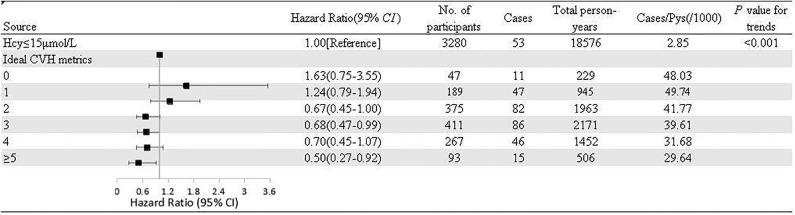
This study aimed to assess the relationship between ideal cardiovascular health (CVH) metrics and incident ischemic stroke (IS) in hypertensive patients, especially those with hyperhomocysteinemia (HHcy). A prospective cohort study enrolled 5,488 hypertensive patients in Nanshan District of Shenzhen City in southern China from September 2011 to December 2017. CVH metrics were defined according to the American Heart Association. Cox proportional hazards models were used to examine the associations between the number of ideal CVH metrics and the incidence of IS by calculating multivariable-adjusted hazard ratios (HRs) and 95% CI. During an average follow-up of 5.7 years, 340 IS patients were identified. Compared with those having 0 ideal CVH metrics, the HRs (95% CIs) for IS among those with 1, 2, 3, 4, and 5-6 ideal CVH metrics were 0.62 (0.31-1.25), 0.37 (0.19-0.74), 0.37 (0.18-0.74), 0.34 (0.16-0.71), and 0.28 (0.12-0.63), respectively ( < 0.001). An ideal healthy diet score and ideal fasting blood glucose level were independently associated with IS among participants, with HRs (95% CIs) of 0.53 (0.33-0.86) and 0.32 (0.17-0.66), respectively. Additionally, compared with those with normal total homocysteine (tHcy) levels (<15 μmol/L), the HR (95% CI) for IS among participants with HHcy and who had 5-6 ideal CVH metrics was 0.50 (0.27-0.92). An increased number of ideal CVH metrics was inversely associated with the incidence of IS in hypertensive patients. The participants with HHcy who had 5-6 ideal CVH metrics exhibited a lower IS risk than those with normal tHcy levels.
本研究旨在评估高血压患者,尤其是高同型半胱氨酸血症(HHcy)患者的理想心血管健康(CVH)指标与缺血性卒中(IS)发病之间的关系。一项前瞻性队列研究于2011年9月至2017年12月在中国南方深圳市南山区招募了5488例高血压患者。CVH指标根据美国心脏协会进行定义。采用Cox比例风险模型,通过计算多变量调整风险比(HRs)和95%置信区间(CI),来检验理想CVH指标数量与IS发病率之间的关联。在平均5.7年的随访期间,共识别出340例IS患者。与具有0项理想CVH指标的患者相比,具有1、2、3、4和5 - 6项理想CVH指标的患者发生IS的HRs(95% CIs)分别为0.62(0.31 - 1.25)、0.37(0.19 - 0.74)、0.37(0.18 - 0.74)、0.34(0.16 - 0.71)和0.28(0.12 - 0.63)(<0.001)。理想健康饮食评分和理想空腹血糖水平与参与者中的IS独立相关,HRs(95% CIs)分别为0.53(0.33 - 0.86)和0.32(0.17 - 0.66)。此外,与总同型半胱氨酸(tHcy)水平正常(<15 μmol/L)的参与者相比,HHcy且具有5 - 6项理想CVH指标的参与者发生IS的HR(95% CI)为0.50(0.27 - 0.92)。理想CVH指标数量增加与高血压患者IS发病率呈负相关。具有5 - 6项理想CVH指标的HHcy参与者比tHcy水平正常的参与者表现出更低的IS风险。