Cao Zhi, Li Shu, Yang Hongxi, Xu Chenjie, Zhang Yuan, Yang Xueli, Yan Tao, Liu Tong, Wang Yaogang
School of Public Health, Tianjin Medical University, Tianjin, China.
Department of Big Data in Health Science, School of Public Health, Zhejiang University School of Medicine, Hangzhou, China.
EClinicalMedicine. 2021 Mar 18;33:100791. doi: 10.1016/j.eclinm.2021.100791. eCollection 2021 Mar.
Although many cardiovascular risk factors for stroke have been reported before, it has not been investigated comprehensively for all major stroke types in large datasets. This study aimed to evaluate the associations of healthy behaviors, biological phenotypes and cardiovascular health (CVH) with long-term risks of strokes events, overall and stroke subtypes (ischemic stroke [IS], intracerebral hemorrhage [ICH], subarachnoid hemorrhage [SAH], and unspecified stroke).
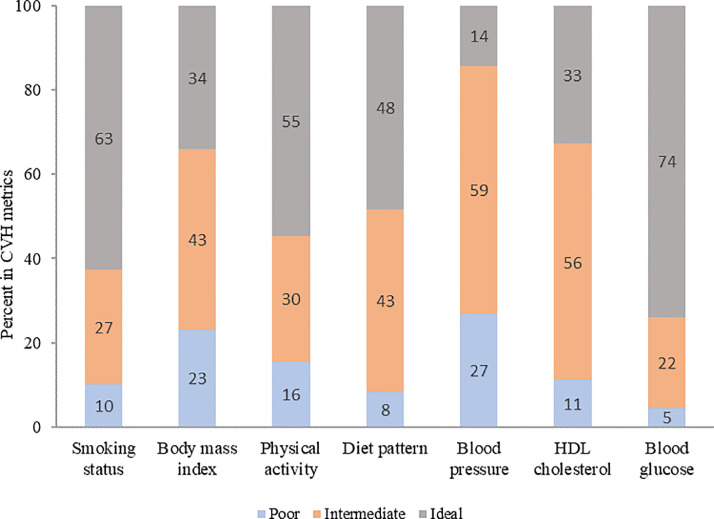
Between 2006 and 2010, a total of 354,976 participants (age 40-70 years) in the UK Biobank free of stroke and coronary heart disease were examined and thereafter followed up to 2020. According to American Heart Association guideline, the global CVH included four behavioral (smoking, diet, physical activity, body mass index) and three biological (blood glucose, blood cholesterol, blood pressure) metrics. The behavioral, biological and global CVH score was the sum of four, three, and seven metrics, respectively, and then was categorized into poor, intermediate and ideal group. Cox proportional hazard models were used to estimate the hazard ratios (HRs) and 95% confidence intervals (CIs) of stroke events.
A total of 5804 incident stroke cases, including 3664 IS, 714 ICH and 453 SAH, were documented over a median follow-up of 11 years. The risk of stroke decreased significantly and linearly with both increasing behavioral CVH score and biological CVH score. Ideal behavioral CVH group was significantly associated with lower risks of all stroke subtypes, biological CVH was related to stroke events except for SAH. Additionally, the 1-point increment in global CVH score was associated with 11%,13%, 8% and 13% lower risks of stroke, IS, ICH and unspecified stroke, however, there was no significant dose-dependent association between global CVH and SAH.
Our findings suggest inverse linear associations of behavioral, biological and global CVH with long-term risks of stroke and stroke subtypes, except for SAH, highlighting the benefits of maintaining better CVH status as a primordial prevention strategy of stroke.
The National Natural Science Foundation of China (71,910,107,004, 91,746,205).
尽管此前已报道了许多中风的心血管危险因素,但尚未在大型数据集中对所有主要中风类型进行全面研究。本研究旨在评估健康行为、生物学表型和心血管健康(CVH)与中风事件的长期风险之间的关联,包括总体风险以及中风亚型(缺血性中风[IS]、脑出血[ICH]、蛛网膜下腔出血[SAH]和未明确类型的中风)。
在2006年至2010年期间,对英国生物银行中354976名年龄在40 - 70岁之间、无中风和冠心病的参与者进行了检查,并随访至2020年。根据美国心脏协会指南,全球CVH包括四个行为指标(吸烟、饮食、身体活动、体重指数)和三个生物学指标(血糖、血胆固醇、血压)。行为、生物学和全球CVH得分分别是四个、三个和七个指标的总和,然后分为差、中等和理想组。使用Cox比例风险模型估计中风事件的风险比(HRs)和95%置信区间(CIs)。
在中位随访11年期间,共记录了5804例新发中风病例,包括3664例IS、714例ICH和453例SAH。中风风险随着行为CVH得分和生物学CVH得分的增加而显著且呈线性下降。理想的行为CVH组与所有中风亚型的较低风险显著相关,生物学CVH与除SAH之外的中风事件相关。此外,全球CVH得分每增加1分,中风、IS、ICH和未明确类型中风的风险分别降低11%、13%、8%和13%,然而,全球CVH与SAH之间没有显著的剂量依赖性关联。
我们的研究结果表明,行为、生物学和全球CVH与中风及中风亚型的长期风险呈负向线性关联,但SAH除外,这突出了保持更好的CVH状态作为中风一级预防策略的益处。
中国国家自然科学基金(71910107004,91746205)。